Union Budget emphasizes fiscal prudence and manufacturing support
Source:The Hindu ↗
Why It Matters
The Union Budget is a crucial annual policy statement. Understanding its allocations, macroeconomic targets (like fiscal deficit and capital expenditure), and sectoral focuses (like semiconductors, biopharma, and MSMEs) is essential for answering GS3 questions on economic growth, industrial policy, infrastructure, and fiscal consolidation.
Summary
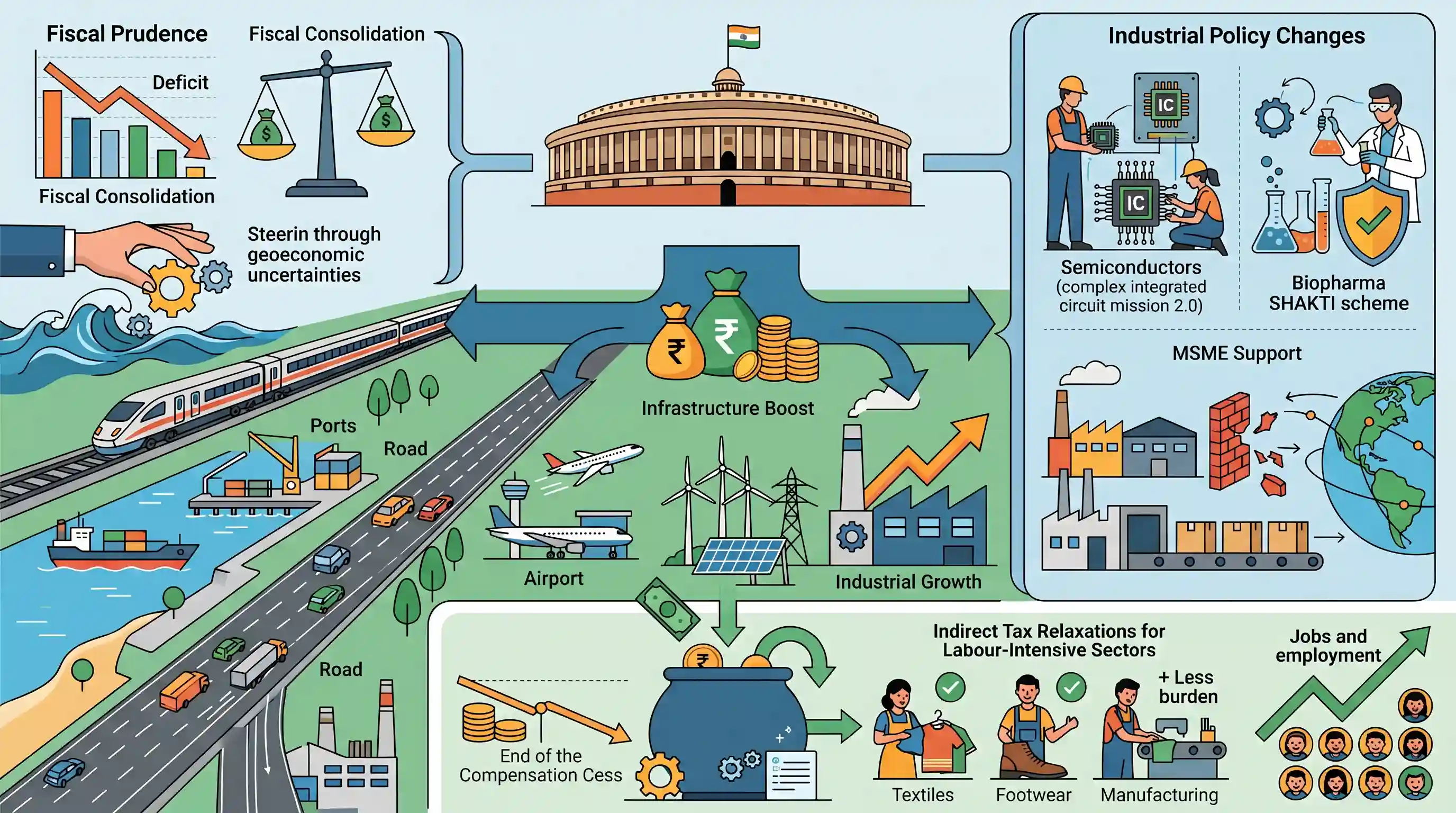
The Union Budget 2026-27 focuses on fiscal prudence and incremental progress rather than sweeping reforms, adopting a multipronged approach to steer the Indian economy through geoeconomic uncertainties. Key highlights include substantial support for the manufacturing sector with initiatives like the India Semiconductor Mission 2.0 and the Biopharma SHAKTI scheme, along with targeted assistance for MSMEs to sustain export momentum against unfavorable trade tariffs. Infrastructure gets a boost with a capital expenditure allocation of ₹12.2 lakh crore, prioritizing dedicated freight and coastal corridors. The budget projects a conservative fiscal deficit of 4.3% of GDP, reflecting continued fiscal consolidation. Additionally, it factors in a contraction in GST revenues following rate rationalisations and the end of the Compensation Cess, alongside indirect tax relaxations for labour-intensive sectors.
Key Points
- The Union Budget 2026-27 emphasizes fiscal prudence and multipronged sectoral measures over targeted 'Big Bang' reforms.
- Manufacturing initiatives feature prominently, targeting sectors like biopharma, semiconductors, and electronics through schemes like India Semiconductor Mission 2.0 and the ₹10,000 crore Biopharma SHAKTI scheme.
- Support for 'Champion MSMEs' is highlighted to bolster India's exports, particularly mitigating risks from U.S. tariffs ahead of the EU Free Trade Agreement (FTA).
- Capital expenditure is set to rise to ₹12.2 lakh crore (4.4% of GDP) in 2026-27, focusing on dedicated freight corridors, coastal shipping, and inland waterways.
- Fiscal deficit is targeted to decrease slightly to 4.3% of GDP, demonstrating continued fiscal consolidation efforts since the pandemic.
- Gross GST revenue is projected to contract by 13.5% due to the September 2025 rate rationalisation and the cessation of the GST Compensation Cess.
Important Terms
India Semiconductor Mission 2.0

The second phase of India's semiconductor strategy focusing on technological depth, including equipment manufacturing, materials, and full-stack Indian Intellectual Property (IP), building upon the foundational fabrication-focused first phase.
UPSC context
GS Paper III: Industrial Policy and Science & Technology; tests understanding of strategic autonomy and high-tech manufacturing ecosystems.
Biopharma SHAKTI scheme
A flagship mission (Strategy for Healthcare Advancement through Knowledge, Technology, and Innovation) with a ₹10,000 crore outlay to boost domestic production of biologics and biosimilars using non-animal testing models.
UPSC context
GS Paper III: Indian Economy and Health; tests knowledge of pharmaceutical sector shifts from generics to innovation-driven biotechnology.
Electronics Component Manufacturing Scheme (ECMS)
A scheme aimed at building a self-sustaining ecosystem for electronic components and sub-assemblies; its outlay was increased to ₹40,000 crore in the 2026-27 budget to deepen domestic value addition.
UPSC context
GS Paper III: Changes in Industrial Policy; critical for understanding India's strategy to reduce electronics import dependence.
Coastal Cargo Promotion Scheme
A 2026-27 budget initiative designed to incentivize shifting freight from road and rail to energy-efficient water routes, aiming to double water-based cargo share to 12% by 2047.
UPSC context
GS Paper III: Infrastructure and Logistics; relevant for topics on reducing logistics costs and promoting sustainable transport.
Export Promotion Mission (EPM)
A consolidated framework with a ₹25,060 crore outlay (2025-2031) that replaces fragmented export schemes to improve MSME competitiveness through financial (NIRYAT PROTSAHAN) and non-financial (NIRYAT DISHA) enablers.
UPSC context
GS Paper III: Indian Economy and Exports; tests understanding of trade facilitation and institutional reforms for MSME-led exports.
Coconut Promotion Scheme
A budget 2026-27 initiative to enhance farm productivity and competitiveness by replacing old, non-productive trees with high-yielding varieties and modernising farming practices in major growing states.
UPSC context
GS Paper III: Agriculture and Farmers' Welfare; focuses on crop diversification and high-value horticultural development.
GST Compensation Cess
A levy on luxury and sin goods introduced in 2017 to compensate states for revenue losses; it officially expires on March 31, 2026, after repaying pandemic-era borrowings.
UPSC context
GS Paper III: Government Budgeting and Fiscal Policy; tests knowledge of cooperative federalism and GST transition dynamics.
MSMEs
Enterprises forming the backbone of India's economy; the 2026-27 budget supports them through a ₹10,000 crore SME Growth Fund and enhanced liquidity via the TReDS platform.
UPSC context
GS Paper III: Indian Economy and Employment; central to discussions on inclusive growth and manufacturing-led development.
Prelims Trap
Gross GST revenues are projected to experience double-digit growth in 2026-27.
The Budget actually projects a 13.5% contraction in gross GST revenue due to the end of the Compensation Cess and prior rate rationalisation.
Static Concepts Connected
What constitutes the Fiscal Deficit under the FRBM framework?
- Calculation: Total Expenditure minus (Revenue Receipts + Non-debt Capital Receipts). It explicitly indicates the total borrowing requirements of the government.
- FRBM Glide Path: The statutory roadmap to bring the fiscal deficit down to sustainable levels over time. The budget’s 4.3% target reflects adherence to this post-pandemic consolidation path.
What was the structure and purpose of the GST Compensation Cess?
- Core Purpose: Introduced via the GST (Compensation to States) Act to compensate States for revenue loss arising from the transition to the GST regime.
- Levy Mechanism: Levied exclusively on specified luxury and demerit goods (e.g., tobacco, automobiles, aerated drinks) over and above the highest GST tax slab.
- Sunset Clause: Originally designed for a five-year period (until 2022), it was extended to service pandemic-era borrowing but is now culminating.
Cross-Topic Patterns
Geoeconomics + Industrial Policy
Semiconductor Mission 2.0 and Biopharma SHAKTI reflect India's shift from pure liberalization toward strategic import substitution to insulate supply chains from global geoeconomic shocks.
Fiscal Federalism + Taxation
The culmination of the GST Compensation Cess directly impacts State finances, intensifying the fiscal federalism debate around resource allocation, devolution formulas, and state-level borrowing limits.

Expect a multi-statement question linking the GST Compensation Cess culmination, state revenue impact, and the FRBM fiscal glide path.
Linked PYQs · 5
Linked PYQs · 5
- 2021MainsGS3
Distinguish between Capital Budget and Revenue Budget. Explain the components of both these Budgets.
- 2025MainsGS3
Discuss the rationale of the Production Linked Incentive (PLI) scheme. What are its achievements? In what way can the functioning and outcomes of the scheme be improved?
- 2025MainsGS3
India aims to become a semiconductor manufacturing hub. What are the challenges faced by the semiconductor industry in India? Mention the salient features of the India Semiconductor Mission.
- 2023MainsGS3
Faster economic growth requires increased share of the manufacturing sector in GDP, particularly of MSMEs. Comment on the present policies of the Government in this regard.
- 2020MainsGS3
Explain the rationale behind the Goods and Services Tax (Compensation to States) Act of 2017. How has COVID-19 impacted the GST compensation fund and created new federal tensions?
