Land Subsidence Triggers Deep Cracks in Shimla Village Houses
Source:newsarenaindia ↗
Why It Matters
Demonstrates the delicate balance of Himalayan geology and how unplanned urbanisation (drainage issues) and large-scale infrastructure projects (road widening) can trigger man-made disasters, a recurring theme in geography and disaster management.
Summary
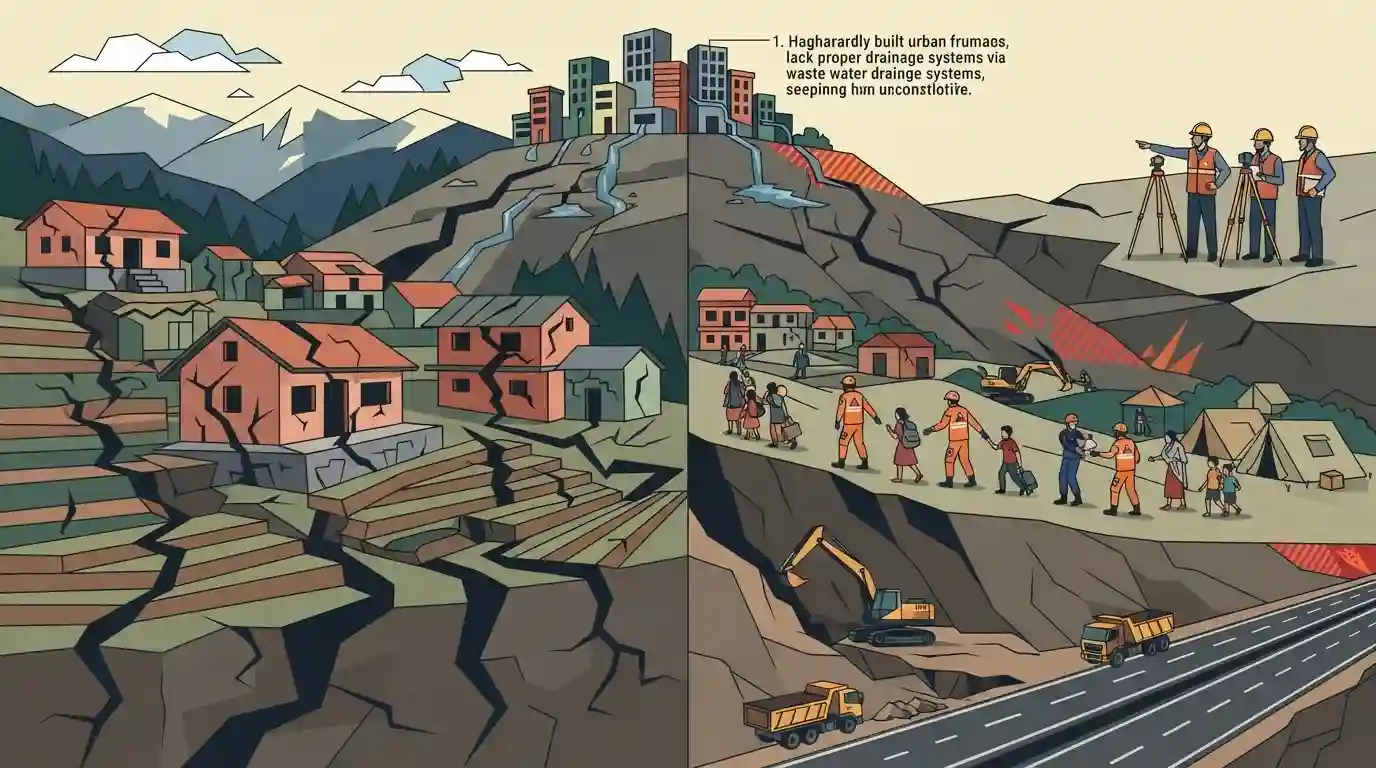
Residents of Shakrala village near Shimla are facing severe distress as land subsidence has caused wide cracks in multiple houses and fields. The administration, along with SDRF teams, has initiated evacuations for at-risk households and is awaiting a geological survey. Villagers suspect that unscientific urban drainage from higher elevations and the excavation work for a four-lane road at the hill's base are the primary anthropogenic triggers destabilizing the fragile mountainous terrain.
Key Points
- Land in Shakrala village near Shimla has been steadily sinking, leading to large cracks in more than a dozen houses and agricultural lands.
- The State Disaster Response Force (SDRF) and local administration inspected the site, advising the evacuation of the most vulnerable homes.
- Locals attribute the instability to unscientific drainage of rainwater and wastewater from urban settlements located uphill.
- The ongoing construction of a four-lane road at the base of the village is also suspected by residents to be a contributing factor to the slope destabilization.
- A formal geological survey is awaited to determine the exact cause of the subsidence and formulate remedial measures.
Important Terms
Land subsidence

The gradual settling or sudden sinking of the Earth's surface due to subsurface movement of earth materials, often triggered by heavy rainfall, poor drainage, or excavation.
UPSC context
Relevant for GS-1 & GS-3 (Geography & Disaster Management). Tests understanding of geomorphic hazards in fragile terrains.
State Disaster Response Force (SDRF)
A specialized state-level force constituted under the Disaster Management Act of 2005. It provides rapid, on-the-ground response and relief operations during notified natural and man-made disasters.
UPSC context
Covers GS-3 (Disaster Management). Tests knowledge of India’s decentralized institutional framework and statutory bodies for emergency response.
Geological Survey of India (GSI)
An attached office under the Ministry of Mines acting as India's nodal agency for geological studies, natural hazard assessments, and landslide susceptibility mapping.
UPSC context
Vital for GS-1 & GS-3 (Geography & Disaster Management). Evaluates awareness of specific scientific agencies managing earth sciences and hazard warnings.
Anthropogenic triggers
Human activities—such as unscientific urban drainage, deforestation, and uncontrolled excavation—that destabilize environments and artificially induce or worsen natural disasters in vulnerable regions.
UPSC context
Crucial for GS-3 (Environment/Disasters). Highlights the intersection of unchecked infrastructure development and ecological degradation.
Himalayan Ecosystem Vulnerability
The extreme susceptibility of the geologically young and fragile Himalayan terrain to mass wasting, landslides, and subsidence, exacerbated by erratic monsoons and unscientific infrastructure projects.
UPSC context
GS-1 and GS-3 (Geography & Ecology). Frequently tested in mains regarding sustainable hill development and climate resilience.
Prelims Trap
Pore-water pressure saturation increases the shear strength of Himalayan soils, making them less prone to sudden downslope mass movements.
In reality, high pore-water pressure reduces effective stress and internal shear strength of soil, destabilizing slopes and acting as a primary trigger for landslides and subsidence.
Static Concepts Connected
How does pore-water pressure trigger slope failure and land subsidence?
- Soil saturation: Water fills pore spaces between soil particles, exerting outward pressure.
- Effective stress: This pressure reduces the effective normal stress holding soil particles together.
- Shear strength loss: Lower effective stress drastically reduces the soil's internal shear strength, triggering downslope failure.
What are the core NDMA guidelines for landslide risk mitigation?
- Hazard Zonation: Mandates macro and meso-level Landslide Hazard Zonation (LHZ) mapping across hilly terrains.
- Early Warning: Focuses on deploying Rainfall-Threshold-based Landslide Early Warning Systems (LEWS).
- Stabilization: Encourages slope stabilization using bio-engineering, retaining walls, and improved drainage networks.
Cross-Topic Patterns
Infrastructure vs. Ecologically Sensitive Zones
Himalayan highway expansion projects clash with Eco-Sensitive Zone (ESZ) regulations, exposing critical gaps in Environmental Impact Assessment (EIA) protocols for fragile mountain terrains.
Urban Planning and Hydrology
Unregulated uphill municipal drainage changes subterranean hydrology, demonstrating how poor local governance directly compromises geological stability and accelerates disaster risks.

Himalayan slope instability, pore-water pressure mechanics, and NDMA landslide hazard zonation will likely be tested as a conceptual MCQ in 2026.
Linked PYQs · 4
Linked PYQs · 4
- 2020HPAS_PRELIMSGS1
Read the passage carefully and attempt the question by choosing the most appropriate option: Desertification is a term used to explain a process of decline in the biological productivity of an ecosystem, leading to total loss of productivity. While this phenomenon is often linked to the arid, semi-arid and sub-humid ecosystems, even in the humid tropics, the impact could be most dramatic. Impoverishment of human-impacted terrestrial ecosystems may exhibit itself in a variety of ways; accelerated erosion as in the mountain regions of the country, salinization of land as in the semi-arid and arid 'green revolution' areas of the country, e.g., Haryana and Western Uttar Pradesh, and site quality decline – a common phenomenon due to general decline in tree cover and monotonous monoculture of rice / wheat across the Indian plains. A major consequence of deforestation is that it relates to adverse alterations in the hydrology and related soil nutrient losses. The consequence of deforestation invariably arise out of site degradation through erosive losses. Tropical Asia, Africa and South America have the highest levels of erosion. The ultimate consequences of site desertification are soil degradation, alteration in available water and its quality and the consequent decline in food, fodder and fuel-wood yields essentials for the economic well beings of rural communities. Accelerated erosion chiefly occurs in __________.
- 2018HPAS_PRELIMSGS1
The impacts caused by construction of dams and reservoirs include all, except :
- 2020HPAS_PRELIMSGS1
Read the passage carefully and attempt the question by choosing the most appropriate option: Desertification is a term used to explain a process of decline in the biological productivity of an ecosystem, leading to total loss of productivity. While this phenomenon is often linked to the arid, semi-arid and sub-humid ecosystems, even in the humid tropics, the impact could be most dramatic. Impoverishment of human-impacted terrestrial ecosystems may exhibit itself in a variety of ways; accelerated erosion as in the mountain regions of the country, salinization of land as in the semi-arid and arid 'green revolution' areas of the country, e.g., Haryana and Western Uttar Pradesh, and site quality decline – a common phenomenon due to general decline in tree cover and monotonous monoculture of rice / wheat across the Indian plains. A major consequence of deforestation is that it relates to adverse alterations in the hydrology and related soil nutrient losses. The consequence of deforestation invariably arise out of site degradation through erosive losses. Tropical Asia, Africa and South America have the highest levels of erosion. The ultimate consequences of site desertification are soil degradation, alteration in available water and its quality and the consequent decline in food, fodder and fuel-wood yields essentials for the economic well beings of rural communities. Deforestation adversely affects the __________.
- 2013HPAS_PRELIMSGS1
Soil erosion can be prevented by :
