Lucknow Kanpur Expressway Structural Damage and Quality Issues
Source:keralakaumudi ↗
Why It Matters
Infrastructure development is a key priority for both the central and Uttar Pradesh state governments. Incidents of newly constructed expressways caving in highlight issues with quality control, corruption, and the impact of extreme weather events on civil engineering projects, making it highly relevant for UPPSC questions on state infrastructure and governance.
Summary
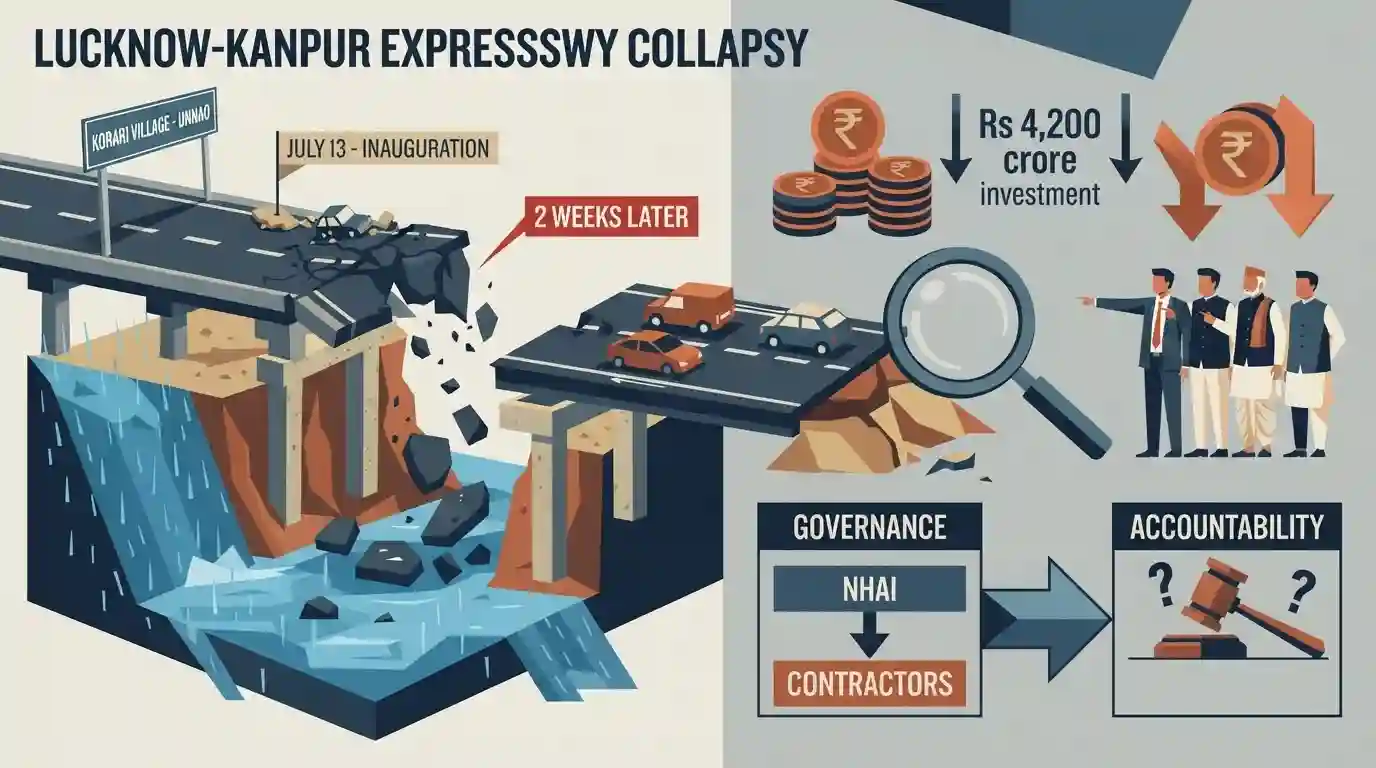
Less than two weeks after its inauguration, a section of the Rs 4,200 crore Lucknow-Kanpur Expressway in Uttar Pradesh collapsed near Korari village in Unnao due to heavy rainfall. The 63-km expressway, inaugurated by top state and central leaders on July 13, suffered structural failure when water washed away the underlying soil. The incident has raised serious questions about the quality of infrastructure projects, with officials stating that accountability will be sought from the National Highways Authority of India (NHAI) and the contractors involved.
Key Points
- A section of the newly built Rs 4,200 crore Lucknow-Kanpur Expressway caved in following heavy rainfall in Unnao district.
- The 63-km-long expressway was inaugurated just two weeks prior on July 13, 2026, by UP Chief Minister Yogi Adityanath and Union Ministers Rajnath Singh and Nitin Gadkari.
- The subsidence was caused by heavy rains washing away the underlying mud, creating a massive crack and collapse.
- Authorities indicated that the National Highways Authority of India (NHAI) was responsible for the construction, and action would be taken against those accountable for the poor quality of work.
Important Terms
Lucknow-Kanpur Expressway

A 63-km-long, 6-lane access-controlled highway in Uttar Pradesh designated as National Expressway 6 (NE-6). It is India's first expressway built using automated and intelligent machine-guided construction (AIMGC) technology.
UPSC context
GS Paper 3 (Infrastructure: Roads, Transport); tests regional connectivity, PPP models, and logistics corridors in India.
National Highways Authority of India (NHAI)
A statutory, autonomous body established under the NHAI Act, 1988, under the Ministry of Road Transport and Highways, tasked with developing, maintaining, and managing India's National Highways network.
UPSC context
GS Paper 2 (Statutory Bodies) and GS Paper 3 (Infrastructure); tests regulatory functions, project execution, and financing models.
Public Works Department (PWD)
A government department in each Indian state responsible for planning, constructing, and maintaining public infrastructure, including state highways, local roads, bridges, and government buildings.
UPSC context
GS Paper 2 (Governance) and GS Paper 3 (Infrastructure); tests state-level administrative machinery, construction quality control, and disaster management.
Prelims Trap
In the Hybrid Annuity Model (HAM) used for expressways, the private developer bears the revenue risk by collecting tolls.
Incorrect. In HAM, the government (NHAI) collects the tolls and bears the traffic/revenue risk. The private developer receives fixed annuity payments over time, unlike the BOT-Toll model.
Static Concepts Connected
What are the key features of the Hybrid Annuity Model (HAM) in infrastructure?
- Funding Structure: The government pays 40% of the project cost during the construction phase, while the remaining 60% is paid as fixed annuities over the operational period.
- Risk Allocation: The government bears the revenue and traffic risks, whereas the private developer assumes the construction and maintenance risks.
- Revenue Collection: Toll collection is solely the responsibility of the government (NHAI), differentiating it from the Build-Operate-Transfer (BOT) Toll model.
What is the statutory mandate and funding mechanism of NHAI?
- Statutory Origin: Established by the NHAI Act of 1988, it functions as an autonomous, statutory agency under the Ministry of Road Transport and Highways.
- Core Funding: It is primarily funded via the Central Road and Infrastructure Fund (CRIF) (via a fuel cess), toll remittances, and market borrowings.
Cross-Topic Patterns
HAM performance metrics & Governance
Frequent structural failures in newly built PPP projects raise GS2/GS4 governance issues regarding contractor accountability, quality audits, and the withholding of HAM annuity payments by NHAI.
Expressway Grids & Defence Corridors
NE-6 directly connects Lucknow and Kanpur—two key nodes of the UP Defence Industrial Corridor—highlighting how PM Gati Shakti aligns civilian transit grids with strategic manufacturing logistics.

Expect a Prelims question comparing risk allocation (traffic, financing, construction) across HAM, BOT-Toll, and EPC models in road projects.
Linked PYQs · 1
Linked PYQs · 1
- 2023UPPSC_PRELIMSGS1
Which of the following Scheme/Programme is not the Central Government Programme and it is Uttar Pradesh Government's Programme?
