Firecracker Ban Violations and Air Quality Decline
Source:The Hindu ↗
Why It Matters
This article is highly relevant for GS-3 (Environment) as it highlights the recurring winter air pollution crisis in North India, the application of science in developing 'green crackers' via NEERI, and the administrative challenges in enforcing environmental regulations and judicial bans at the grassroots level.
Summary
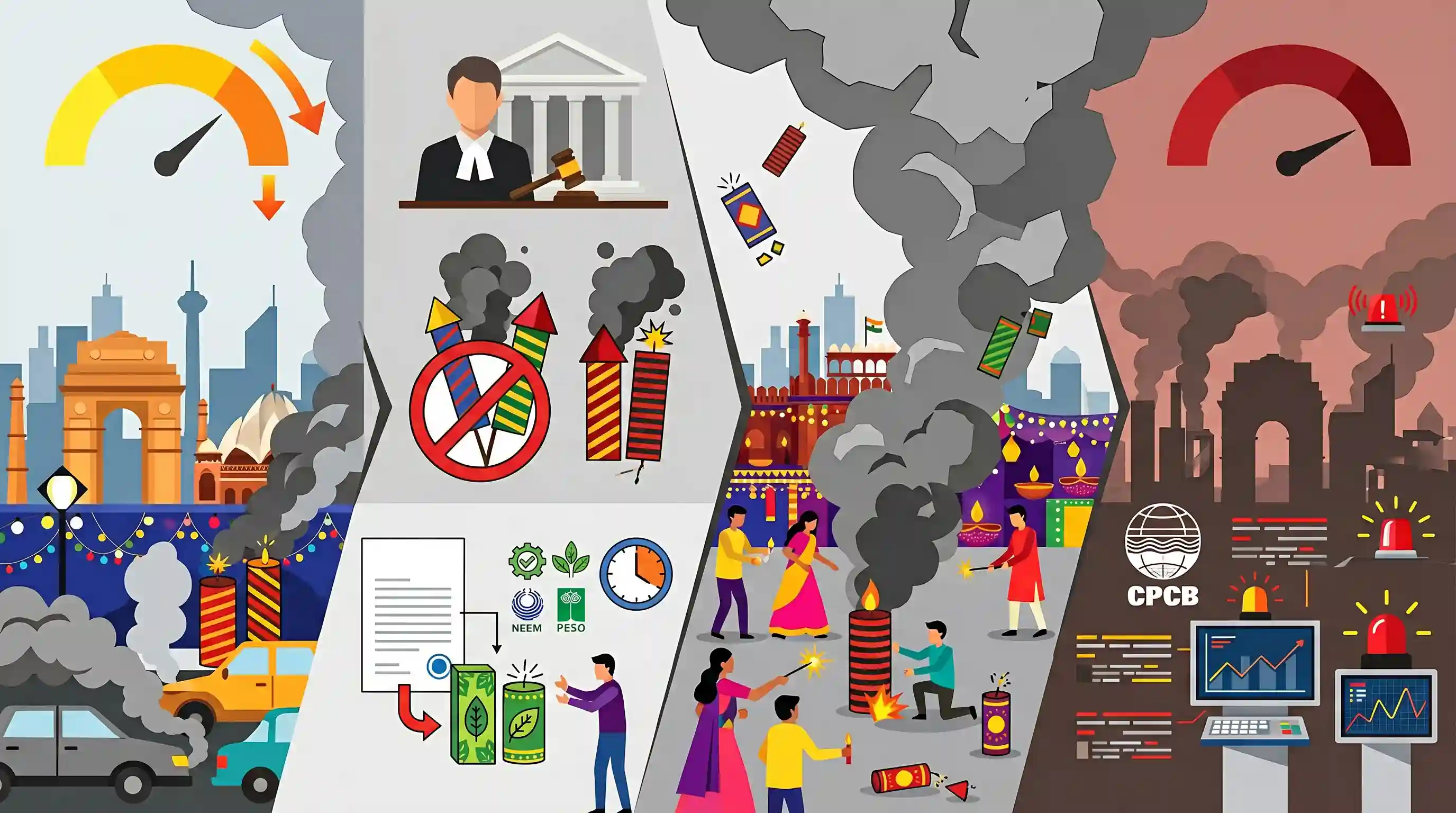
Delhi's air quality steadily deteriorated ahead of Deepavali, dropping into the 'poor' category as citizens violated the Supreme Court's ban on conventional firecrackers. Despite the court restricting usage strictly to green firecrackers approved by NEERI and PESO during limited hours, widespread non-compliance was reported. The Central Pollution Control Board (CPCB) and the Air Quality Early Warning System have warned that emissions will likely push the city's AQI into the 'severe' category in the days following the festival, exacerbating the capital's chronic winter pollution crisis.
Key Points
- Delhi's Air Quality Index (AQI) dropped to the 'poor' category (268) ahead of Deepavali, with several localities hitting 'severe' levels due to the bursting of firecrackers.
- The Supreme Court had strictly limited permissions to the use of 'green firecrackers' approved by NEERI and PESO during specified hours.
- Widespread violation of the Supreme Court's conditional ban is expected to push Delhi's AQI into the 'severe' category (401-500) post-Deepavali.
- The Central government's Air Quality Early Warning System for Delhi predicted a sustained period of 'very poor' to 'severe' air quality in the days following the festival.
Important Terms
Air Quality Early Warning System (AQEWS)

A forecasting model by the Ministry of Earth Sciences that predicts extreme pollution events 72-hours in advance to trigger mitigation measures like the Graded Response Action Plan (GRAP).
UPSC context
GS III: Environmental Pollution. Tests knowledge of technological interventions and proactive governance in managing seasonal air quality crises.
Central Pollution Control Board (CPCB)
A statutory body under the MoEFCC responsible for monitoring air and water quality, setting emission standards, and coordinating with State Pollution Control Boards (SPCBs).
UPSC context
GS II & III: Statutory Bodies/Environment. Crucial for understanding the institutional framework of India's environmental regulation and enforcement.
National Environmental Engineering Research Institute (NEERI)
A CSIR laboratory and the nodal agency that developed 'green crackers' (SWAS, STAR, SAFAL) to reduce particulate emissions by at least 30% compared to traditional fireworks.
UPSC context
GS III: Science & Tech. Tests understanding of indigenous R&D solutions for environmental challenges and sustainable technology.
Petroleum and Explosives Safety Organisation (PESO)
The nodal agency under the Ministry of Commerce and Industry that regulates and licenses the manufacture, storage, and sale of explosives, including certified green crackers.
UPSC context
GS II: Regulatory Bodies. Relevant for questions on industrial safety standards and the certification process for eco-friendly products.
Judicial Activism in Environmental Governance
The apex court's use of Article 21 (Right to Life) to mandate environmental protections, such as banning toxic barium-based crackers and enforcing 'green' alternatives.
UPSC context
GS II: Judiciary. Tests the concept of balancing fundamental rights with cultural practices and the role of the court in policy-making.
Prelims Trap
"PESO, which certifies green crackers for environmental compliance, functions under the Ministry of Environment, Forest and Climate Change."
PESO actually functions under the Department for Promotion of Industry and Internal Trade (DPIIT), Ministry of Commerce and Industry, not the Environment Ministry.
Static Concepts Connected
Which 8 pollutants are tracked under the National Air Quality Index (NAQI)?
- Particulates: PM10 and PM2.5 are the primary drivers of the index, especially during winter smog and festival events.
- Reactive Gases: Nitrogen dioxide (NO2), Sulphur dioxide (SO2), Carbon monoxide (CO), and ground-level Ozone (O3).
- Other Elements: Ammonia (NH3) and Lead (Pb). Note that Carbon Dioxide (CO2) and Methane (CH4) are NOT included in the NAQI.
What are the key variants of green crackers developed by CSIR-NEERI?
- SWAS: Safe Water Releaser crackers release water vapor upon bursting to suppress dust and particulate emissions.
- STAR: Safe Thermite Crackers eliminate the use of potassium nitrate and sulphur to reduce toxic emissions.
- SAFAL: Safe Minimal Aluminium crackers substitute highly reactive aluminium with magnesium to lower particulate matter output.
- Barium Ban: All green crackers strictly exclude Barium salts, which produce green flames but cause severe respiratory distress and are banned by the Supreme Court.
Cross-Topic Patterns
Article 21 & Environmental Jurisprudence
The Supreme Court's ban on toxic barium in firecrackers is rooted in an expanded interpretation of Article 21, reinforcing the Right to Clean Air as an enforceable fundamental right.
Winter Smog: Stubble vs Local Sources
Post-Deepavali AQI spikes perfectly overlap with the North Indian stubble burning season. Questions frequently force aspirants to weigh agricultural emissions against urban pollution sources.

Expect a multi-statement Prelims question combining CSIR-NEERI green cracker formulations (SWAS/STAR) with NAQI pollutant exclusions.
Linked PYQs · 3
Linked PYQs · 3
- 2020MainsGS3
What are the key features of the National Clean Air Programme (NCAP) initiated by the Government of India?
- 2021MainsGS3
Describe the key points of the revised Global Air Quality Guidelines (AQGs) recently released by the World Health Organisation (WHO). How are these different from its last update in 2005? What changes in India's National Clean Air Programme are required to achieve these revised standards?
- 2022MainsGS3
Discuss in detail the photochemical smog emphasizing its formation, effects and mitigation. Explain the 1999 Gothenburg Protocol.
