Delhi Urban Air Pollution Mitigation and Vehicular Emission Rules
Source:Indian Express ↗
Why It Matters
Delhi's winter air pollution is a recurring public health and environmental crisis. Understanding the specific mitigation technologies (like anti-smog guns) and regulatory enforcements (vehicle scrappage rules) is highly relevant for GS-3 Environment questions evaluating the effectiveness of policies like the National Clean Air Programme (NCAP).
Summary
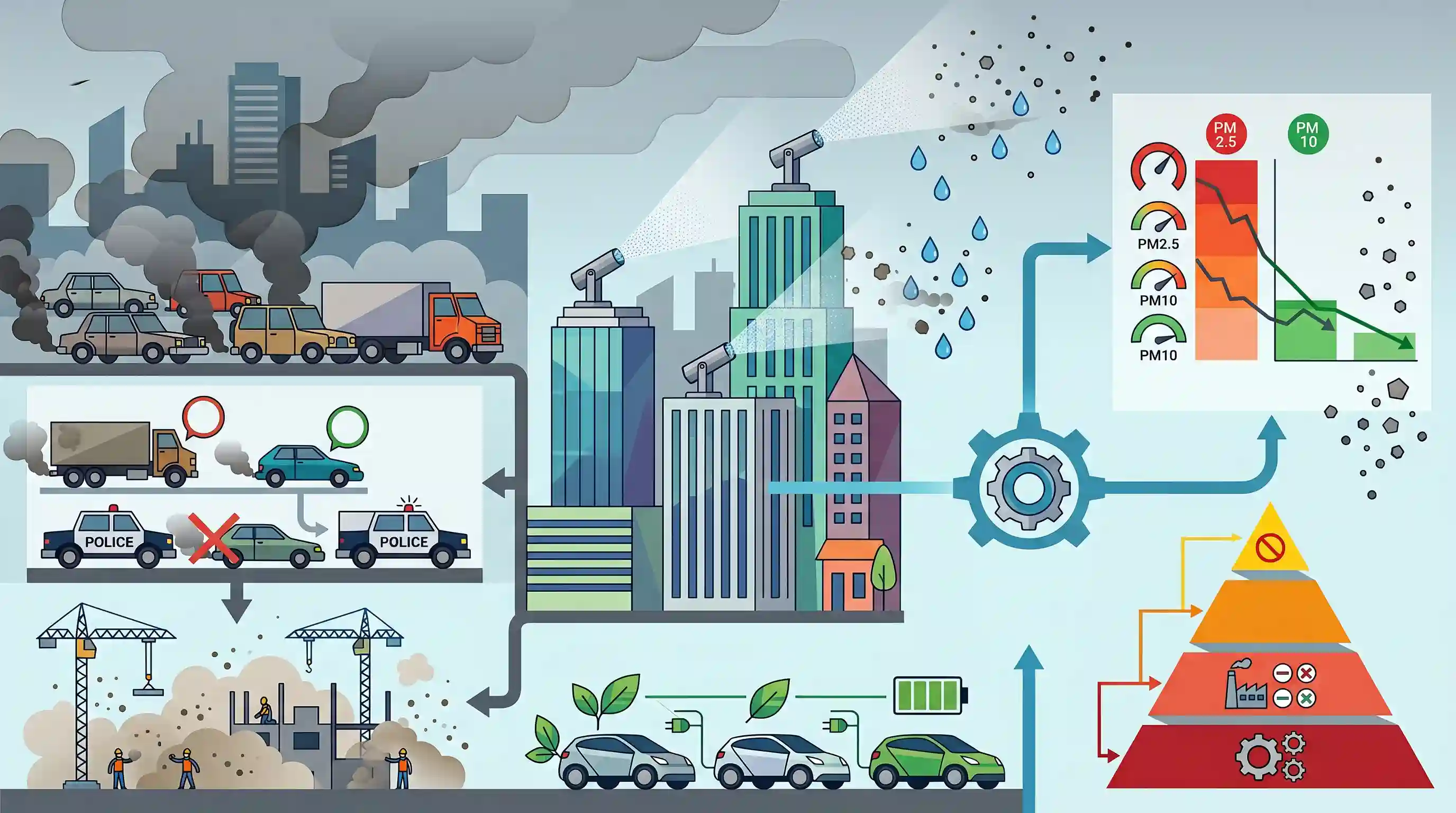
Ahead of the high-pollution winter season, the Delhi government has outlined targeted strategies to curb air pollution, focusing primarily on vehicular emissions and urban dust. Key initiatives include a severe crackdown on over-aged vehicles (10-year-old diesel and 15-year-old petrol cars) and the novel deployment of anti-smog guns on high-rise buildings. These measures are integrated into the city's broader Winter Action Plan to control PM2.5 and PM10 levels, complementing the Graded Response Action Plan (GRAP) enforced across the National Capital Region.
Key Points
- The Delhi government is implementing strict enforcement measures against end-of-life vehicles (diesel vehicles older than 10 years and petrol vehicles older than 15 years) to curb vehicular emissions.
- To combat suspended dust and pollutants, anti-smog guns are being deployed atop high-rise buildings to spray atomized water and settle particulate matter (PM2.5 and PM10) over larger urban areas.
- These technological and administrative interventions are central to Delhi's annual Winter Action Plan, designed to mitigate the severe smog episodes triggered by winter temperature inversions and regional pollution.
- The strategy functions in tandem with the Graded Response Action Plan (GRAP), which outlines emergency measures based on real-time Air Quality Index (AQI) thresholds.
Important Terms
Graded Response Action Plan (GRAP)

An emergency framework for Delhi-NCR that activates stage-wise mitigation measures (e.g., construction bans) based on Air Quality Index (AQI) levels to prevent severe pollution spikes.
UPSC context
GS3: Environment & Ecology (Pollution Control). Tests knowledge of emergency mitigation frameworks and judicial interventions in environmental governance.
Commission for Air Quality Management (CAQM)
A statutory body established in 2021 to coordinate and implement air quality strategies across Delhi-NCR and adjoining states, possessing overarching enforcement and penal powers.
UPSC context
GS2: Statutory Bodies; GS3: Environment. Evaluates understanding of centralized governance and inter-state coordination for regional pollution management.
National Clean Air Programme (NCAP)
India’s 2019 flagship program targeting a 40% reduction in particulate matter (PM10/PM2.5) by 2026 in "non-attainment" cities that fail national air quality standards.
UPSC context
GS3: Environment (Government Policies). Focuses on national air quality targets and the role of "non-attainment cities" in pollution mitigation.
National Vehicle Scrappage Policy
A 2021 policy to phase out unfit, polluting vehicles (older than 15-20 years) through mandatory fitness tests and financial incentives to reduce emissions and promote recycling.
UPSC context
GS3: Environment & Economy. Relevant for sustainable infrastructure, circular economy, and vehicular emission standards.
Central Pollution Control Board (CPCB)
A statutory body under the Ministry of Environment that monitors air and water quality, sets national standards, and coordinates State Pollution Control Boards (SPCBs).
UPSC context
GS2: Statutory Bodies; GS3: Environmental Pollution. Essential for understanding the institutional framework for environmental protection in India.
Winter Action Plan
A seasonal mitigation strategy by the Delhi government featuring targeted interventions like smog guns, drone surveys, and hot-spot monitoring to curb severe winter pollution.
UPSC context
GS3: Environment (Urban Pollution). Tests knowledge of local-level mitigation strategies for particulate matter in metropolitan areas.
Prelims Trap
The ban on 10-year-old diesel and 15-year-old petrol vehicles is mandated nationwide under the Motor Vehicles Act.
This specific ban applies only to Delhi-NCR based on a 2015 NGT directive. It is not a nationwide statutory ban, which instead relies on the National Vehicle Scrappage Policy's fitness tests.
Static Concepts Connected
What is the statutory status and jurisdiction of the CAQM?
- Statutory Origin: It is a statutory body established by the CAQM Act 2021, replacing the Supreme Court-appointed Environment Pollution (Prevention and Control) Authority (EPCA).
- Jurisdiction: It covers Delhi, Punjab, Haryana, Rajasthan, and Uttar Pradesh specifically for air quality management in the National Capital Region (NCR) and adjoining areas.
- Overriding Powers: Its directives and orders override those of state governments and State Pollution Control Boards in case of any conflict regarding air quality.
How does the Graded Response Action Plan (GRAP) operate?
- Emergency Framework: It is a set of emergency measures triggered dynamically based on Air Quality Index (AQI) thresholds, not a year-round pollution mitigation strategy.
- Stage-wise Triggers: Currently enforced by CAQM, it is divided into four stages (Poor, Very Poor, Severe, and Severe Plus), progressively restricting construction, vehicles, and industries.
Cross-Topic Patterns
Vehicle Scrappage Policy + Circular Economy
Phasing out old vehicles connects to the National Vehicle Scrappage Policy, linking urban air quality mitigation with the formalization of the economic recycling sector and circular economy principles.
Winter Smog + Temperature Inversion
Urban pollution measures are often tested alongside physical geography, specifically winter temperature inversions and the 'subsiding air' that blocks pollutant dispersion over the Indo-Gangetic plain.

Expect a multi-statement question combining CAQM's statutory powers, GRAP AQI thresholds, and the revised WHO PM2.5/PM10 limits.
Linked PYQs · 4
Linked PYQs · 4
- 2021MainsGS3
Describe the key points of the revised Global Air Quality Guidelines (AQGs) recently released by the World Health Organisation (WHO). How are these different from its last update in 2005? What changes in India's National Clean Air Programme are required to achieve these revised standards?
- 2020MainsGS3
What are the key features of the National Clean Air Programme (NCAP) initiated by the Government of India?
- 2022PrelimsGS1
In the context of WHO Air Quality Guidelines, consider the following statements: 1. The 24-hour mean of PM2.5 should not exceed 15 µg/m³ and annual mean of PM2.5 should not exceed 5 µg/m³. 2. In a year, the highest levels of ozone pollution occur during the periods of inclement weather. 3. PM10 can penetrate the lung barrier and enter the bloodstream. 4. Excessive ozone in the air can trigger asthma. Which of the statements given above are correct?
- 2025PrelimsGS1
Artificial way of causing rainfall to reduce air pollution makes use of
