Opposition Strategy and Parliamentary Proceedings for Monsoon Session
Source:The Hindu ↗
Why It Matters
The article covers multiple core Polity themes relevant for GS Paper 2, including the constitutional procedure for the impeachment of High Court judges, parliamentary conventions regarding the Deputy Speaker, and the Election Commission's role in electoral roll revisions. It offers practical examples of how legislative mechanisms hold other branches accountable.
Summary
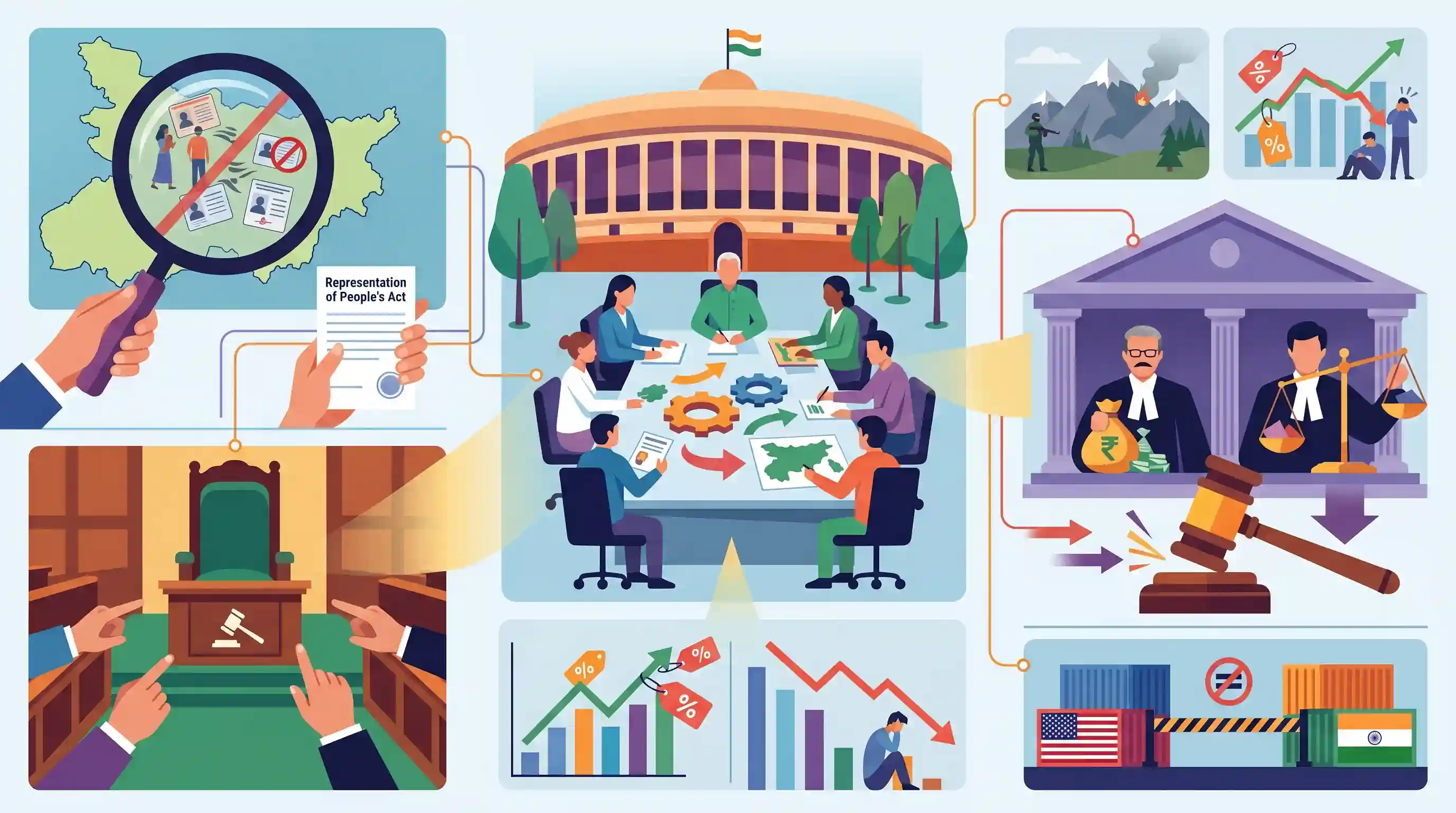
Ahead of the Parliament's Monsoon Session, the Congress Parliamentary Party (CPP) scheduled a strategy meeting to finalize the opposition's agenda. Key focus areas include challenging the Election Commission's Special Intensive Revision of electoral rolls in Bihar over fears of mass disenfranchisement, and demanding the Deputy Speaker's post in the Lok Sabha. The opposition also plans to introduce impeachment motions against two Allahabad High Court judges for alleged corruption and communal bias. Broader issues such as national security (Pahalgam terror attack), the economy (inflation and unemployment), and U.S. tariffs on Indian goods will also be highlighted.
Key Points
- The Congress Parliamentary Party (CPP), chaired by Sonia Gandhi, called a strategy meeting to outline its agenda for the Parliament's Monsoon Session.
- Congress intends to challenge the Election Commission's Special Intensive Revision (SIR) of electoral rolls in Bihar, claiming it could disenfranchise up to 2 crore voters.
- The opposition plans to press for the Deputy Speaker's post in the Lok Sabha, citing parliamentary conventions.
- Impeachment motions are proposed against two Allahabad High Court judges—Justice Shekhar Kumar Yadav and Justice Yashwant Varma—over alleged communal remarks and corruption.
- Other key issues to be raised include the recent Pahalgam terror attack, inflation, unemployment, and the impact of U.S. tariffs on Indian exports.
Important Terms
Election Commission of India (ECI)

A permanent constitutional body (Article 324) responsible for conducting free and fair elections to India's Parliament, State Legislatures, and the offices of the President and Vice-President.
UPSC context
GS Paper II: Constitutional Bodies. Tests understanding of electoral management, independence, and powers of superintendence.
Special Intensive Revision (SIR)
A comprehensive door-to-door voter verification process under Section 21(3) of the Representation of the People Act, 1950, to ensure 'purity' of electoral rolls by weeding out ineligible names.
UPSC context
GS Paper II: Representation of People’s Act. Crucial for understanding electoral roll integrity and potential issues of disenfranchisement.
Lok Sabha
The lower house of India's bicameral Parliament, representing the people directly through universal adult suffrage; it holds primary authority over money bills and the Council of Ministers' accountability.
UPSC context
GS Paper II: Parliament structure and functioning. Fundamental for understanding legislative processes and democratic representation.
Deputy Speaker of Lok Sabha
The second-highest presiding officer of the Lok Sabha, mandated by Article 93, who performs the Speaker’s duties during vacancies or absences and holds an independent constitutional status.
UPSC context
GS Paper II: Parliament and Presiding Officers. Significant due to constitutional mandates vs. recent delays in appointment.
Removal of Judges (Impeachment)
The formal process (Article 124(4) and 218) to remove a judge on grounds of "proved misbehaviour" or "incapacity," requiring a special majority in both Houses of Parliament.
UPSC context
GS Paper II: Judiciary structure and independence. Tests knowledge of judicial accountability mechanisms and constitutional safeguards.
Allahabad High Court
The apex judicial body at the state level (Article 214); the Allahabad High Court is one of India's oldest and largest, exercising jurisdiction over Uttar Pradesh.
UPSC context
GS Paper II: Structure and functioning of the Judiciary. Relevant for understanding state-level judicial hierarchy and legal precedents.
Congress Parliamentary Party (CPP)
A formal organization of Indian National Congress members in Parliament, responsible for deciding the party's legislative agenda, floor strategy, and leadership in both Houses.
UPSC context
GS Paper II: Parliament—Conduct of business. Illustrates the role of parliamentary groups in shaping opposition strategy and floor management.
Prelims Trap
"The Constitution mandates a specific time limit of six months to elect the Deputy Speaker of the Lok Sabha."
Article 93 states the Lok Sabha shall choose a Deputy Speaker "as soon as may be," but deliberately omits any strict constitutional deadline or timeframe.
Static Concepts Connected
What is the constitutional and statutory process to remove a High Court Judge?
- Grounds for removal: Strictly limited to "proved misbehaviour" or "incapacity" under Article 218 read with Article 124(4) of the Constitution.
- Initiation threshold: Requires signatures of 100 Lok Sabha or 50 Rajya Sabha members. The presiding officer (Speaker/Chairman) holds discretionary power to admit or reject the motion.
- Investigative committee: Under the Judges (Inquiry) Act 1968, a three-member panel (SC Judge, HC Chief Justice, distinguished jurist) investigates the admitted charges.
- Final passage: Requires a special majority in both Houses of Parliament during the same session, followed by the President's formal removal order.
How is the Deputy Speaker of the Lok Sabha elected?
- Constitutional mandate: Article 93 requires the Lok Sabha to elect a Deputy Speaker "as soon as may be," without stipulating a time limit.
- Established convention: By parliamentary tradition, rather than constitutional law, the post is typically offered to a member of the principal opposition party.
- Independence: The Deputy Speaker is not subordinate to the Speaker; they hold independent power and are directly responsible to the House.
Cross-Topic Patterns
Judicial impeachment & separation of powers
Using impeachment motions against judges as political tools tests the delicate balance between judicial independence and parliamentary oversight, highlighting potential vulnerabilities in the Judges (Inquiry) Act, 1968.
Electoral roll revisions & RPA 1950
Political disputes over Special Intensive Revisions (SIR) of electoral rolls frequently invoke the Representation of the People Act, 1950, which operationalizes the Election Commission's mandate under Article 324.

Expect a multi-statement Prelims question in 2026 contrasting the constitutional mandate of the Deputy Speaker vs established conventions.
Linked PYQs · 3
Linked PYQs · 3
- 2019PrelimsGS1
Consider the following statements: 1. The motion to impeach a Judge of the Supreme Court of India cannot be rejected by the Speaker of the Lok Sabha as per the Judges (Inquiry) Act, 1968. 2. The Constitution of India defines and gives details of what constitutes 'incapacity and proved misbehaviour' of the Judges of the Supreme Court of India. 3. The details of the process of impeachment of the Judges of the Supreme Court of India are given in the Judges (Inquiry) Act, 1968. 4. If the motion for the impeachment of a Judge is taken up for voting, the law requires the motion to be backed by each House of the Parliament and supported by a majority of total membership of that House and by not less than two-thirds of total members of that House present and voting. Which of the statements given above is/are correct?
- 2022MainsGS2
Discuss the role of the Election Commission of India in the light of the evolution of the Model Code of Conduct.
- 2020MainsGS2
Once a Speaker, Always a Speaker' ! Do you think this practice should be adopted to impart objectivity to the office of the Speaker of Lok Sabha ? What could be its implications for the robust functioning of parliamentary business in India?
