Enforcement Directorate prosecution powers against political parties
Source:Indian Express ↗
Why It Matters
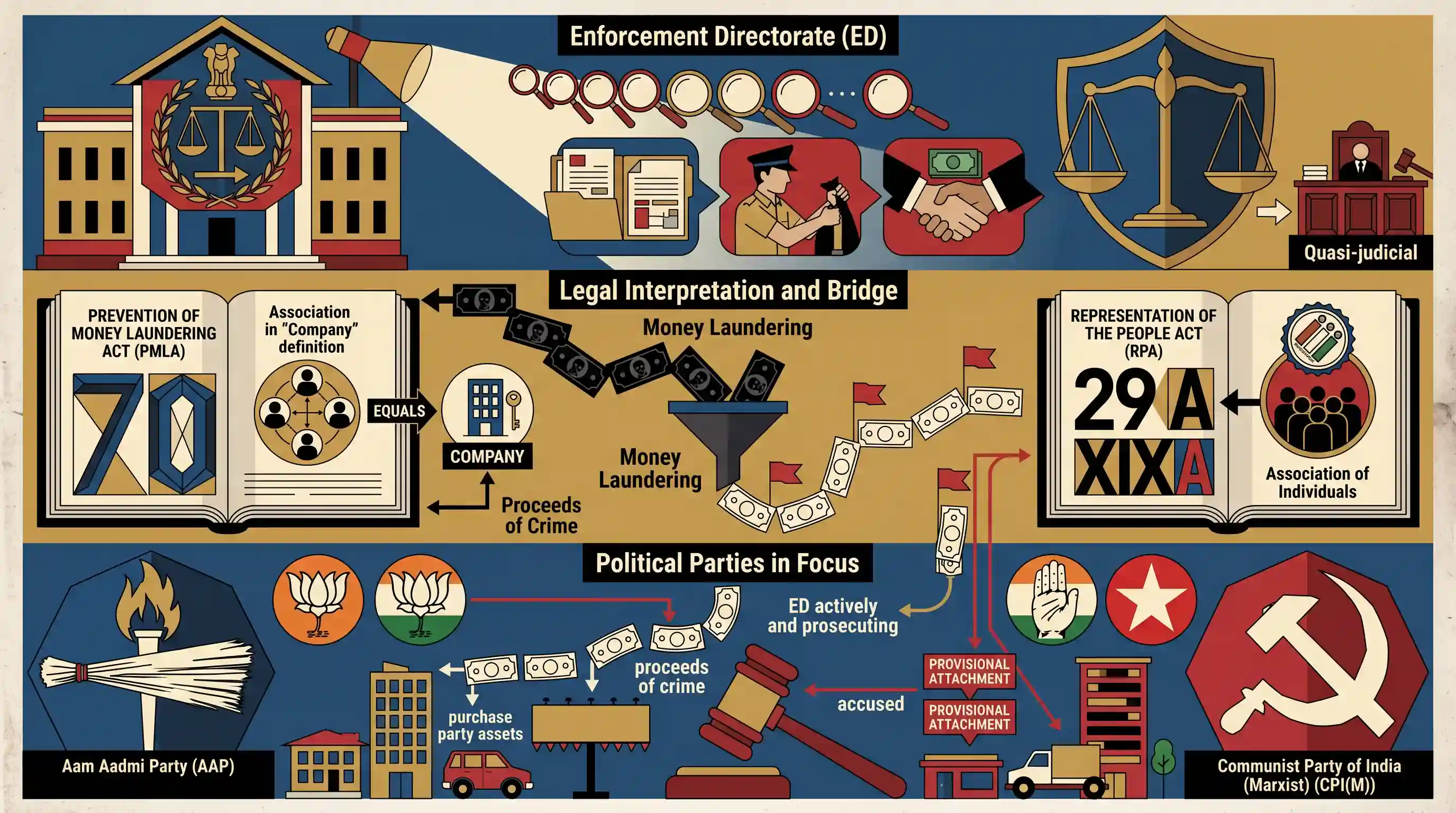
This development highlights a critical intersection between electoral politics and financial law enforcement. Understanding whether political parties can be treated as corporate entities under PMLA is crucial for questions regarding political funding, institutional accountability, the Representation of the People Act, and the expanding scope of the Enforcement Directorate.
Summary
The article examines the legal framework allowing the Enforcement Directorate (ED) to name a political party as an accused in money laundering cases. Recently, the CPI(M) was implicated in a PMLA case, following a precedent set by the naming of the Aam Aadmi Party (AAP). The ED's rationale is based on Section 70 of the Prevention of Money Laundering Act (PMLA), which extends liability to "companies," defined broadly to include an "association of individuals." Because political parties are registered under Section 29A of the Representation of the People Act (RPA) as associations of individuals, the ED argues they can be prosecuted if they generate or use proceeds of crime. This legal interpretation bridges electoral laws and stringent anti-money laundering provisions, raising significant implications for the accountability and financial transparency of political entities in India.
Key Points
- The Enforcement Directorate (ED) named the CPI(M) as an accused in a money laundering case linked to the Karuvannur Cooperative Bank, marking the second time a political party has been named under PMLA (after AAP).
- The legal basis for this action is Section 70 of the Prevention of Money Laundering Act (PMLA), 2002, which deals with "Offences by Companies".
- Section 70(2) of the PMLA broadly defines a "company" to include a firm or an "association of individuals".
- Political parties are registered under Section 29A of the Representation of the People Act (RPA), 1951, as an "association or body of individual citizens of India".
- The core legal contention is that since political parties are essentially associations of individuals, they fall under the definition of a "company" in the PMLA and can thus be prosecuted for utilizing proceeds of crime.
Important Terms
Prevention of Money Laundering Act (PMLA), 2002

A 2002 Indian law enacted to prevent money laundering, provide for the confiscation of proceeds of crime, and establish the legal framework for prosecuting financial offenses.
UPSC context
GS Paper III: Internal Security/Economy. Tests knowledge of anti-money laundering frameworks and the powers of investigative agencies.
Representation of the People Act (RPA), 1951
A landmark act governing the conduct of elections, registration of political parties (Section 29A), and qualifications/disqualifications of candidates in India.
UPSC context
GS Paper II: Salient features of the RPA. Crucial for topics related to electoral reforms and political accountability.
Enforcement Directorate (ED)
A specialized financial law enforcement agency under the Department of Revenue, Ministry of Finance, mandated to enforce PMLA, FEMA, and the Fugitive Economic Offenders Act.
UPSC context
GS Paper II: Statutory/quasi-judicial bodies. Tests understanding of the executive’s role in curbing economic offenses.
Section 70 of PMLA
A specific PMLA provision that establishes vicarious liability for 'companies,' broadly defined to include any 'association of individuals' or body corporate.
UPSC context
GS Paper II: Government Policies. Tests the legal interpretation of 'juristic persons' in the context of political party accountability.
Association of Individuals
A legal classification for groups of people formed for a common purpose; under PMLA, this allows political parties to be prosecuted as 'companies.'
UPSC context
GS Paper II: Polity. Relevant for legal debates on the status of political parties under criminal law.
Karuvannur Service Cooperative Bank Scam
A major financial fraud in Kerala involving illegal loans and money laundering, leading to the first instance of the CPI(M) being named as an accused.
UPSC context
GS Paper III: Internal Security. A case study for challenges in cooperative federalism and financial regulation.
Prelims Trap
The PMLA 2002 explicitly categorizes registered political parties as 'companies' liable for prosecution.
PMLA defines 'companies' to include an 'association of individuals'. It does not explicitly mention political parties. The ED bridges this by reading PMLA alongside RPA Section 29A.
Static Concepts Connected
How are political parties legally defined and registered under the RPA, 1951?
- Section 29A: Parties must apply to the Election Commission of India for registration within 30 days of their formation.
- Legal definition: The Act specifically defines a political party as an 'association or body of individual citizens of India'. This definition is crucial for the ED's PMLA application.
- Mandatory allegiance: The party's memorandum must declare true faith and allegiance to the Constitution, socialism, secularism, and democracy.
What are the core mechanisms of the Prevention of Money Laundering Act (PMLA)?
- Proceeds of crime: Property derived or obtained, directly or indirectly, as a result of criminal activity relating to a scheduled offence.
- Burden of proof: Unlike general criminal law, Section 24 of the PMLA places the burden of proof on the accused to prove that the alleged proceeds are untainted property.
- Attachment powers: The Enforcement Directorate can provisionally attach properties suspected to be involved in money laundering for up to 180 days, pending adjudication.
Cross-Topic Patterns
Political Funding & PMLA Overlap
Following the Supreme Court striking down Electoral Bonds, tracking 'proceeds of crime' via PMLA offers an alternate route to enforce financial accountability and transparency upon political entities.
ECI Deregistration Limits vs PMLA
The ECI lacks the explicit power to deregister a political party for routine financial irregularities. ED prosecution under PMLA establishes a parallel punitive mechanism outside the Election Commission's direct purview.

Conjoint reading of RPA Sec 29A and PMLA Sec 70 to prosecute political parties is highly likely to appear in a 2026 Prelims statement.
Linked PYQs · 4
Linked PYQs · 4
- 2025PrelimsGS1
With reference to the Government of India, consider the following information: Organization Some of its functions It works under I. Directorate of Enforcement Enforcement of the Fugitive Economic Offenders Act, 2018 Internal Security Division-I, Ministry of Home Affairs II. Directorate of Revenue Intelligence Enforces the Provisions of the Customs Act, 1962 Department of Revenue, Ministry of Finance III. Directorate General of Systems and Data Management Carrying out big data analytics to assist tax officers for better policy and nabbing tax evaders Department of Revenue, Ministry of Finance In how many of the above rows is the information correctly matched?
- 2025MainsGS2
Discuss the 'corrupt practices' for the purpose of the Representation of the People Act, 1951. Analyze whether the increase in the assets of the legislators and/or their associates, disproportionate to their known sources of income, would constitute 'undue influence' and consequently a corrupt practice.
- 2021MainsGS3
Discuss how emerging technologies and globalisation contribute to money laundering. Elaborate measures to tackle the problem of money laundering both at national and international levels.
- 2013MainsGS3
Money laundering poses a serious security threat to a country's economic sovereignty. What is its significance for India and what steps are required to be taken to control this menace?
