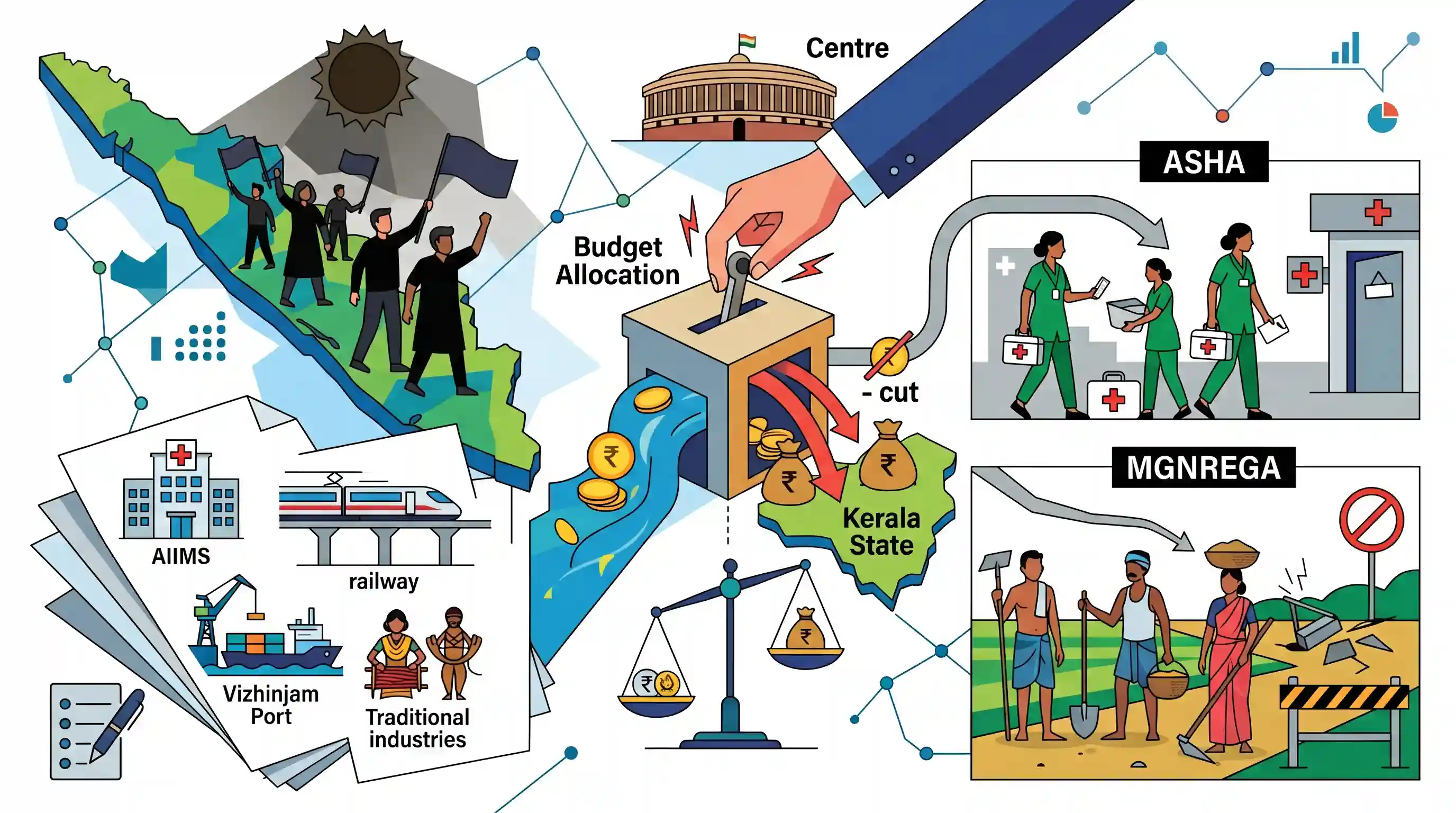
Kerala political party protest against Union Budget fiscal allocations
Source:The Hindu ↗
Why It Matters
Highlights the contemporary challenges in Centre-State financial relations and cooperative federalism, particularly how political differences and budgetary allocations for Centrally Sponsored Schemes (like MGNREGA) can become flashpoints between the Union government and State governments.
Summary
The CPI(M) State secretariat has announced a 'black day' on February 3 in Kerala to protest the Union Budget, which they claim severely neglects the State's development and welfare needs. The party cited the Centre's failure to address 29 pre-submitted demands, including the allocation of an AIIMS, a high-speed railway, and a special package for the Vizhinjam port. They also criticized the lack of support for scheme workers such as ASHAs and traditional industries. Furthermore, the CPI(M) highlighted that drastic cuts to the MGNREGA budget would significantly disrupt the implementation of the rural employment guarantee program in Kerala, reflecting ongoing tensions regarding fiscal federalism and resource allocation between the Centre and the States.
Key Points
- The CPI(M) in Kerala announced a "black day" protest on February 3 against the Union Budget, alleging it grossly neglected the State's needs.
- The Centre allegedly ignored 29 specific demands raised by Kerala during pre-budget discussions with the Union Finance Minister.
- Key projects denied or overlooked include an AIIMS for the State, a high-speed railway, and a financial package for the Vizhinjam port.
- The party strongly criticized significant cuts to the MGNREGA scheme budget, which they argue will disrupt its effective implementation and harm rural employment.
- There was a lack of support or provisions for scheme workers (like ASHA workers) and traditional industries in the Budget.
Important Terms
Fiscal Federalism

The system managing financial relations between government levels, focusing on revenue collection, resource distribution, and expenditure responsibilities within a federal structure.
UPSC context
GS Paper 2 & 3: Tests understanding of state autonomy and financial devolution mechanisms.
Union Budget
Mandated by Article 112 as the Annual Financial Statement, it details the government's estimated receipts and expenditures for the upcoming fiscal year.
UPSC context
GS Paper 3: Crucial for analyzing fiscal policy, deficit trends, and sectoral priorities.
MGNREGA
A 2005 law guaranteeing 100 days of unskilled manual wage employment annually to every rural household, aiming to enhance livelihood security.
UPSC context
GS Paper 2 & 3: Key welfare scheme testing rural poverty and employment policies.
ASHA (Accredited Social Health Activist)
Trained female community health volunteers who act as a bridge between rural populations and the public health system under the National Health Mission.
UPSC context
GS Paper 2: Essential for questions on healthcare delivery and scheme worker rights.
Cooperative Federalism
A governance model where the Centre and States collaborate as partners to achieve national developmental goals through shared policy implementation.
UPSC context
GS Paper 2: Evaluates the evolving horizontal relationship between Union and State governments.
Prelims Trap
"ASHA workers are contractual government employees receiving a fixed monthly salary under the National Health Mission."
ASHAs are classified as honorary community volunteers, not government employees. They receive performance-based task incentives rather than fixed salaries.
Static Concepts Connected
What are the constitutional provisions for Union grants to States?
- Article 275: Provides for statutory grants-in-aid charged to the Consolidated Fund of India, based strictly on Finance Commission recommendations.
- Article 282: Allows both the Union and States to make discretionary grants for any public purpose, historically used for scheme-based funding.
How is the financial burden shared under the MGNREGA scheme?
- Unskilled Wages: The Central Government bears 100% of the wage cost for unskilled manual labour.
- Material Costs: The cost of materials is shared in a 75:25 ratio between the Centre and the respective State Government.
- Unemployment Allowance: State Governments must bear 100% of the allowance if work cannot be provided within 15 days of demand.
Cross-Topic Patterns
Fiscal federalism & discretionary grants
Protests over Union budget allocations often highlight the tension between discretionary central grants (Article 282) and state-level infrastructure autonomy, linking polity to macroeconomic planning.
Maritime infra & strategic autonomy
State-level funding demands for Vizhinjam overlap with India's broader geopolitical maritime strategy to build domestic deep-water capacity and reduce reliance on foreign transshipment hubs like Colombo.

Expect a multi-statement Prelims question comparing statutory (Art 275) vs discretionary (Art 282) grants alongside MGNREGA cost-sharing.
Linked PYQs · 4
Linked PYQs · 4
- 2025MainsGS2
Examine the evolving pattern of Centre-State financial relations in the context of planned development in India. How far have the recent reforms impacted the fiscal federalism in India?
- 2024MainsGS2
What changes has the Union Government recently introduced in the domain of Centre-State relations ? Suggest measures to be adopted to build the trust between the Centre and the States and for strengthening federalism.
- 2015MainsGS2
The concept of cooperative federalism has been increasingly emphasized in recent years. Highlight the drawbacks in the existing structure and the extent to which cooperative federalism would answer the shortcomings.
- 2019MainsGS2
Performance of welfare schemes that are implemented for vulnerable sections is not so effective due to absence of their awareness and active involvement at all stages of policy process. Discuss.
