Political Critique of Indo-US Interim Trade Agreement
Source:The Hindu ↗
Why It Matters
Demonstrates the intersection of foreign policy, international trade deals, and domestic economic security. It highlights the challenges of balancing bilateral strategic partnerships with the need to protect vulnerable domestic sectors like agriculture from foreign competition.
Summary
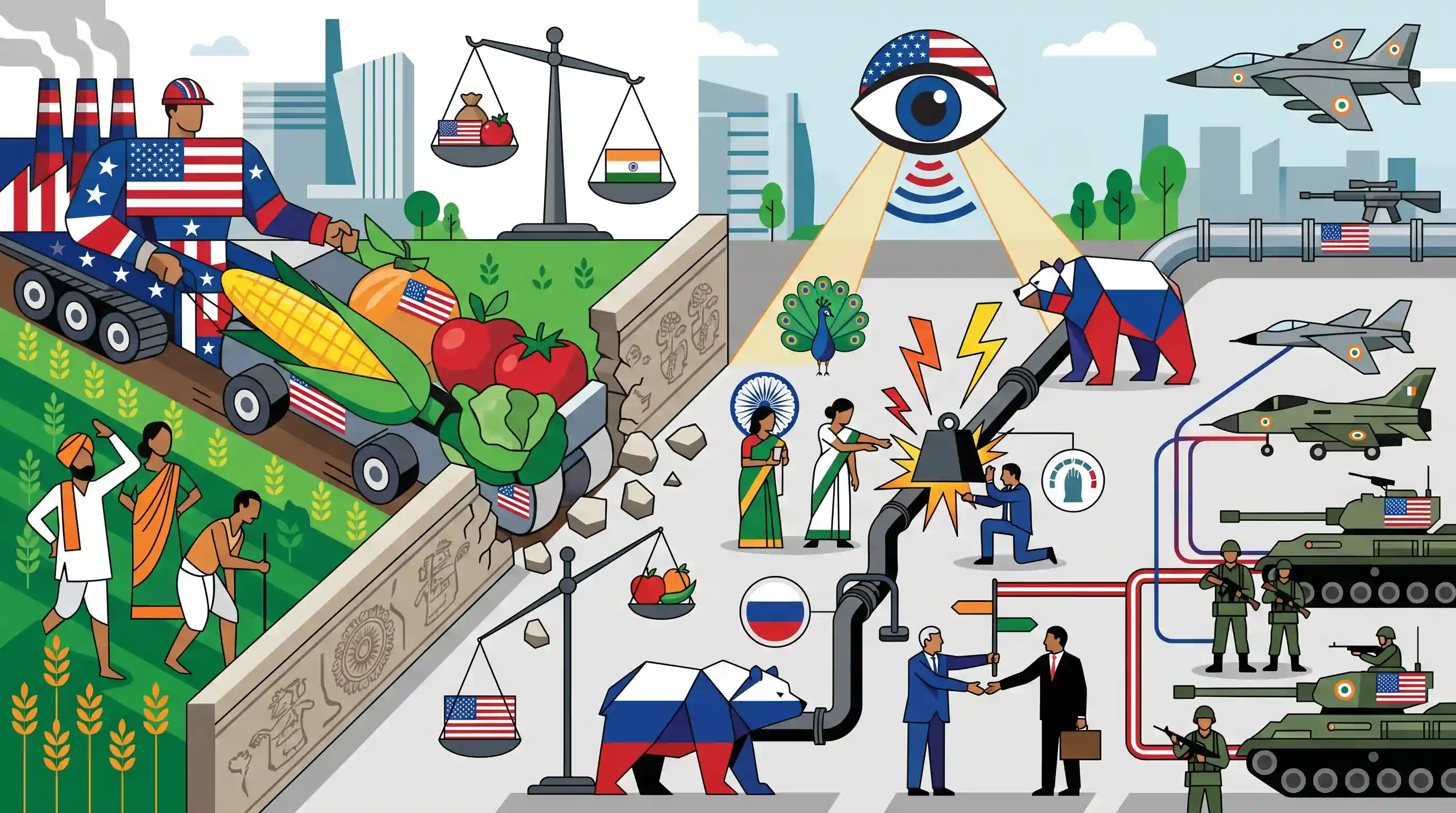
The Communist Party of India (Marxist) has strongly opposed the Indo-U.S. interim trade agreement, labelling it a 'shameful surrender' that compromises India's economic security and strategic autonomy. The party alleges the deal permits zero-tariff access for U.S. agricultural products and dismantles non-tariff barriers, thereby endangering domestic farmers and eroding vital farm subsidies. Additionally, the CPI(M) criticised the U.S. mechanism monitoring India's compliance—which threatens punitive tariffs if India pursues independent policies like purchasing Russian oil—and warned against the increasing reliance on U.S. defence supplies.
Key Points
- The CPI(M) has strongly criticised the Indo-U.S. interim trade deal, calling it a threat to India's sovereignty and economic security.
- The agreement reportedly provides zero-tariff access to U.S. agricultural exports like fruits, cotton, and soybean oil, potentially devastating domestic farmers.
- Concerns were raised over the dismantling of non-tariff barriers and farm support, making Indian agriculture vulnerable to heavily subsidised U.S. imports.
- The party flagged a U.S. executive order establishing a compliance-monitoring mechanism that uses punitive tariffs to enforce conditions, such as restricting Indian oil purchases from Russia.
- The CPI(M) also warned that India's deepening dependence on U.S. defence supplies undermines the country's strategic autonomy.
Important Terms
Indo–U.S. Interim Trade Agreement (2026)

A 2026 bilateral pact reducing US tariffs on Indian goods to 18% in exchange for India lowering barriers on US industrial and agricultural products and committing to $500bn in purchases.
UPSC context
GS Paper II: Bilateral agreements. Tests understanding of trade diplomacy, tariff structures, and economic impact on domestic sectors.
Strategic Autonomy
India’s foreign policy principle of maintaining independent decision-making in international affairs, avoiding alignment with major power blocs to protect sovereign national interests.
UPSC context
GS Paper II: India’s Foreign Policy. Tests the ability to analyze how bilateral deals impact sovereign policy space.
Polit Bureau
The highest executive body of the CPI(M), comprising top leadership who direct party policy and political stance on national issues between Central Committee sessions.
UPSC context
GS Paper II: Political Parties. Understanding the internal structure and influence of national parties on foreign policy discourse.
Non-Tariff Barriers (NTBs)
Trade restrictions other than customs duties, such as quotas, licensing, or sanitary standards, used to protect domestic industries from foreign competition.
UPSC context
GS Paper III: Indian Economy and Trade. Tests knowledge of trade policy instruments and global market integration challenges.
Agricultural Subsidies
Financial assistance provided by the government to farmers to support their income, reduce production costs, and ensure domestic food security.
UPSC context
GS Paper III: Issues related to direct and indirect farm subsidies and WTO-related trade disputes.
Defence Procurement
The acquisition of military hardware and technology by the state; critics argue over-reliance on a single foreign supplier can limit strategic flexibility.
UPSC context
GS Paper III: Security and Indigenization of Technology. Tests understanding of self-reliance (Atmanirbharta) versus strategic partnerships.
Prelims Trap
"Non-Tariff Barriers (NTBs) are strictly prohibited under WTO agreements for developing nations."
WTO allows specific NTBs like Sanitary and Phytosanitary (SPS) measures and Technical Barriers to Trade (TBT) to protect health, provided they aren't arbitrary discrimination.
Static Concepts Connected
What is an Early Harvest Scheme (Interim Trade Agreement)?
- Definition: A precursor to a comprehensive Free Trade Agreement (FTA) where partners reduce tariffs on a limited set of goods first.
- WTO Compliance: Under Article XXIV of GATT, it must eventually lead to a full FTA; otherwise, it violates the Most-Favoured-Nation (MFN) principle.
How do U.S. and Indian agricultural subsidies differ under WTO rules?
- India (Trade-distorting): Relies on price support (MSP) and input subsidies (fertilizers, power), which fall under the 'Amber Box' and are subject to strict reduction limits.
- U.S. (Non-distorting): Uses direct income support decoupled from production, falling under the 'Green Box', which is largely exempt from WTO reduction commitments.
Cross-Topic Patterns
Trade weaponisation and Strategic Autonomy
The U.S. linking tariff access to India's Russian oil imports exemplifies 'economic statecraft', merging International Relations (Strategic Autonomy) with Economics (Free Trade agreements).
Defence interoperability vs sovereign foreign policy
Increasing reliance on U.S. platforms enhances Quad interoperability (LEMOA, COMCASA) but risks supply-chain blackmail when geopolitical interests (like the Russia partnership) diverge.

Expect a 2026 multi-statement question linking Early Harvest Schemes, WTO agricultural subsidies (Amber vs Green), and US-India trade.
Linked PYQs · 3
Linked PYQs · 3
- 2023MainsGS3
What are the direct and indirect subsidies provided to farm sector in India? Discuss the issues raised by the World Trade Organization (WTO) in relation to agricultural subsidies.
- 2013MainsGS3
What are the different types of agriculture subsidies given to farmers at the national and at state levels ? Critically analyse the agricultural subsidy regime with reference to the distortions created by it.
- 2020MainsGS2
What is the significance of Indo-US defence deals over Indo-Russian defence deals? Discuss with reference to stability in the Indo-Pacific region.
