CPI(M) MP urges restoration of SC ST quota in four medical colleges
Source:theprint ↗
Why It Matters
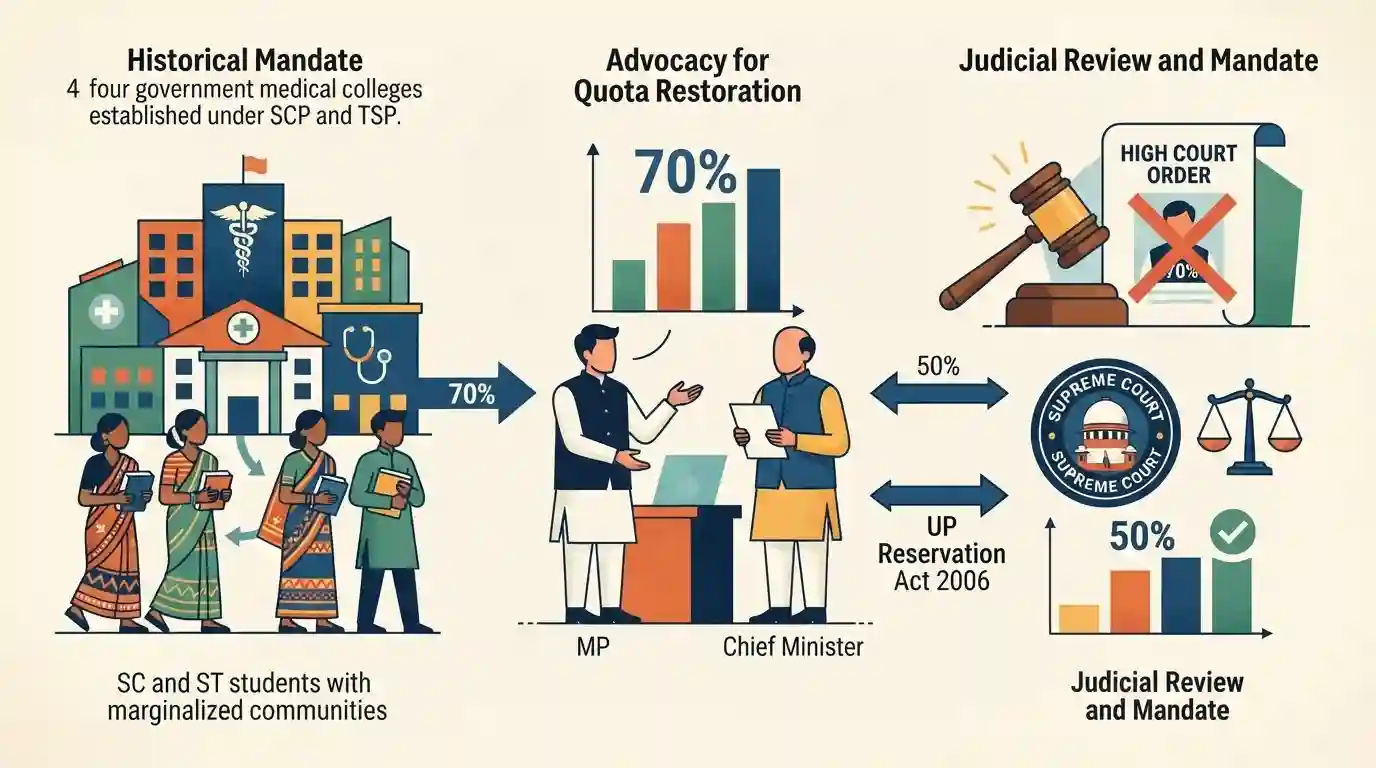
Illustrates the critical legal conflict between state-sponsored targeted affirmative action (such as institutions funded under the SCP/TSP) and the rigid 50% reservation ceiling enforced by the judiciary. It is relevant for understanding Article 15(4) and the broader debate on reservation caps in India.
Summary
CPI(M) MP K Radhakrishnan has appealed to UP Chief Minister Yogi Adityanath to restore a 70% reservation quota for SC/ST students in four government medical colleges. These institutions were originally established under the Special Component Plan (SCP) and Tribal Sub-Plan (TSP) to prioritize marginalized communities. However, the Allahabad High Court recently quashed the state government's orders allowing this high quota, ruling that it violates the Supreme Court's mandate capping reservations at 50%. The court directed that future admissions must adhere to the standard UP Reservation Act of 2006.
Key Points
- CPI(M) MP K Radhakrishnan urged the UP CM to restore a 70% SC/ST reservation quota in four state medical colleges.
- The medical colleges, located in Kannauj, Jalaun, Ambedkar Nagar, and Saharanpur, were built using funds from the Special Component Plan (SCP) and Tribal Sub-Plan (TSP) specifically to benefit marginalized communities.
- The Allahabad High Court struck down the UP government's previous orders that maintained the >70% quota, citing a violation of the 50% maximum reservation limit established by the Supreme Court.
- The High Court has directed the state to admit students according to the provisions of the UP Reservation Act of 2006.
Important Terms
Special Component Plan (SCP)

A planning strategy requiring governments to allocate funds proportionate to the SC population for targeted welfare schemes and socio-economic development, ensuring these funds are non-divertible.
UPSC context
GS Paper 2: Welfare schemes for vulnerable sections. It tests understanding of targeted budgeting mechanisms for marginalized communities.
Tribal Sub-Plan (TSP)
A sub-plan approach that mandates channelling benefits and financial allocations from general state plans specifically for the development of tribal populations in proportion to their numbers.
UPSC context
GS Paper 2: Mechanisms, laws, institutions and bodies constituted for the protection and betterment of vulnerable sections.
UP Reservation Act, 2006
State legislation that formally dictates standard reservation quotas in Uttar Pradesh's educational institutions, currently capping SC reservations at 21%, ST at 2%, and OBC at 27%.
UPSC context
GS Paper 2: Social justice and government policies. Essential for questions on state-level implementation of quota ceilings versus special provisions.
Indra Sawhney Case
The landmark 1992 Supreme Court judgment that upheld 27% OBC reservation but established the rule that total reservations should not exceed 50% under normal circumstances.
UPSC context
GS Paper 2: Structure, organization and functioning of the Judiciary. Fundamental for all constitutional debates regarding affirmative action ceilings.
Prelims Trap
The Tribal Sub-Plan (TSP) is a specific Central Sector Scheme for tribal development.
TSP (now DAPST) is a broad budgeting strategy, not a single scheme. It mandates ministries to earmark a proportion of their total plan outlay equal to the ST population percentage.
Static Concepts Connected
What is the 50% ceiling rule on reservations?
- Indra Sawhney (1992): The Supreme Court ruled that total reservations should not exceed 50%, except in 'extraordinary circumstances' for marginalized people in remote areas.
- EWS Exception: The SC upheld the 103rd Amendment, ruling the 10% EWS quota is a distinct category not constrained by the 50% ceiling established for SEBCs/SCs/STs.
- 9th Schedule Shield: Tamil Nadu placed its 69% reservation law in the 9th Schedule (76th Amendment) to shield it from judicial scrutiny regarding the 50% limit.
What are the SCP and TSP budgeting strategies?
- Core Mechanism: A planning mechanism that earmarks plan funds in strict proportion to the SC and ST populations by both Central Ministries and State Governments.
- Plan Origins: TSP was introduced during the 5th Five-Year Plan (1974-75), while SCP was launched in 1979 for Scheduled Castes.
- Current Nomenclature: SCP is now the Developmental Action Plan for SCs (DAPSC), and TSP is the Developmental Action Plan for STs (DAPST).
Cross-Topic Patterns
TSP/SCP and Gender Budgeting
Similar to how TSP/SCP mandates proportionate financial allocation for SC/STs, Gender Budgeting applies a ring-fencing mechanism in the Union Budget to ensure targeted resource allocation for women's empowerment.
Judicial Review of 9th Schedule
States trying to breach the 50% quota often seek 9th Schedule protection. Post-I.R. Coelho (2007), laws added after April 1973 remain open to judicial review if they violate the Basic Structure.

Expect a mixed Polity/Economy question testing the Indra Sawhney 50% ceiling alongside the exact budgeting mechanisms of TSP and SCP.
Linked PYQs · 3
Linked PYQs · 3
- 2024UPPSC_PRELIMSGS1
Which one of the following is correctly matched? Constitutional Body — Constitutional Article
- 2023UPPSC_PRELIMSGS1
Match List-I with List-II and select the correct answer using the code given below the lists. List-I: (A) Article - 324 (B) Article - 315 (C) Article - 280 (D) Article - 338 List-II: 1. National Commission for Scheduled Castes 2. Finance Commission 3. Public Service Commission 4. Election Commission Code -
- 2022UPPSC_PRELIMSGS1
Right to Education has been included into the Fundamental Rights by the
