Right to Disconnect Private Members Bill Introduced in Rajya Sabha
Source:The Hindu ↗
Why It Matters
It highlights the legal gaps in India's labor laws regarding the evolving nature of digital workspaces and employee mental health, while also demonstrating the role of Private Member's Bills in bringing contemporary societal and economic issues to the forefront of parliamentary debate.
Summary
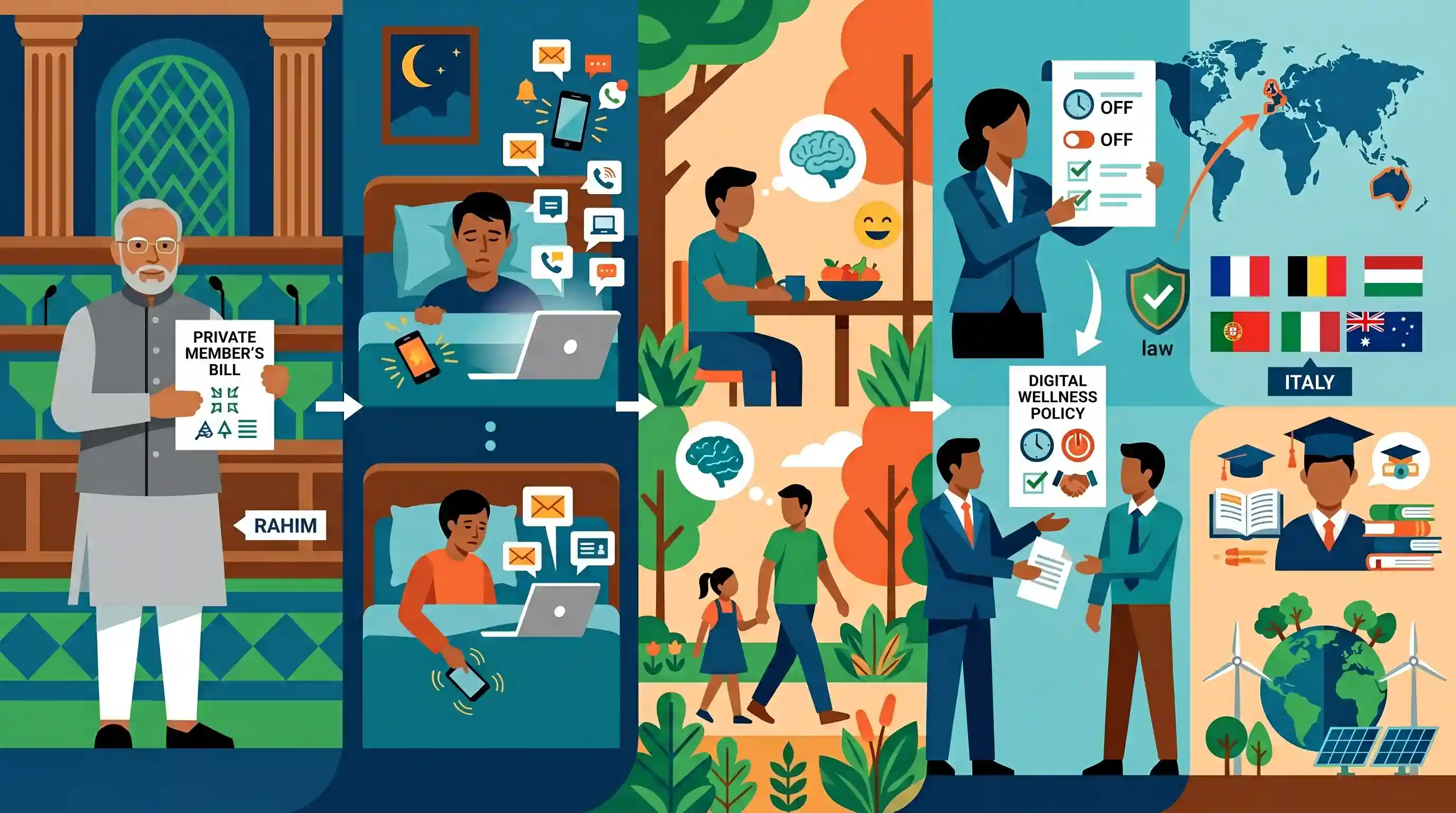
CPI(M) MP A.A. Rahim introduced the Right to Disconnect Bill in the Rajya Sabha as a Private Member's Bill. The proposed legislation seeks to protect employees from an 'always-on' digital work culture by granting them the right to ignore work-related communications outside official working hours without facing retaliation. Designed to improve work-life balance and mitigate mental health concerns, the bill would require companies to draft clear digital wellness policies and emergency protocols in consultation with employee representatives. The MP noted that similar labor protections have already been adopted in countries like France, Belgium, Portugal, and Australia. Additionally, he introduced two other Private Member's Bills concerning educational consultancies and environmental protection.
Key Points
- The Right to Disconnect Bill was introduced in the Rajya Sabha as a Private Member's Bill by CPI(M) MP A.A. Rahim.
- It seeks to grant employees the right to disengage from work-related communications outside official working hours to tackle the 'always-on' digital work culture.
- The legislation aims to address worsening work-life balance and rising mental health concerns among the workforce.
- The bill mandates employers to frame a Right to Disconnect policy in consultation with trade unions, detailing emergency protocols and digital wellness measures.
- The legislation takes inspiration from similar progressive labor laws enacted in countries like France, Belgium, Portugal, and Australia.
Important Terms
Private Member's Bill

A legislative proposal introduced in Parliament by any member who is not a Minister. Such bills are typically discussed on Friday afternoons and rarely become law.
UPSC context
GS Paper II: Parliament and State Legislatures—structure, functioning, and conduct of business.
Right to Disconnect Bill
A proposed law granting employees the legal right to ignore work-related digital communications outside official hours without facing disciplinary action or retaliation from employers.
UPSC context
GS Paper III: Labour reforms, employment, and social security.
Rajya Sabha
The Upper House of India's bicameral Parliament, representing States and UTs. It acts as a revising chamber and a forum for state interests.
UPSC context
GS Paper II: Constitutional bodies and the structure of Parliament.
Labour Reforms
Structural changes to laws governing employment, wages, and social security to balance industrial productivity with workers' rights and mental well-being.
UPSC context
GS Paper III: Indian Economy and issues relating to employment.
Digital Wellness Policy
Organizational guidelines designed to manage digital overload, set boundaries for technology use, and prevent employee burnout in an 'always-on' work culture.
UPSC context
GS Paper II: Social Justice—issues relating to health and human resources.
Prelims Trap
"A Private Member's Bill can only be introduced by Members of Parliament belonging to the opposition parties."
Any MP who is not a Minister is a Private Member. Even an MP from the ruling party can introduce a Private Member's Bill.
Static Concepts Connected
What are the unique characteristics of a Private Member's Bill?
- Introducer: Any Member of Parliament who is not a Minister (even from the ruling party).
- Drafting: The responsibility of drafting rests with the member, whereas Public Bills are drafted by the Law Ministry.
- Notice & Schedule: Requires a one-month notice period and is conventionally discussed only on Fridays in the House.
- Government Stability: Its rejection does not implicate a loss of parliamentary confidence, unlike a defeated Public Bill.
Which constitutional provisions implicitly support concepts like the 'Right to Disconnect'?
- Article 21: The Right to Life has been interpreted to include the right to health, right to sleep (Ramlila Maidan case), and the right to privacy (Puttaswamy).
- Article 42 (DPSP): Directs the State to secure just and humane conditions of work.
- Article 43 (DPSP): Directs the State to secure conditions of work ensuring a decent standard of life and full enjoyment of leisure.
Cross-Topic Patterns
Gig Economy & OSH Code 2020
The push for digital disconnect mirrors demands for gig worker protections, contrasting with the current Occupational Safety, Health and Working Conditions Code's silence on remote digital labor.
Right to Privacy jurisprudence
Post-Puttaswamy, the 'Right to Disconnect' is being debated globally as a natural extension of an individual's right to privacy and right to leisure under Article 21.

Expect a Mains GS2 question linking the 'Right to Disconnect' with evolving gig-economy labor laws, mental health, and Article 21.
Linked PYQs · 2
Linked PYQs · 2
- 2017PrelimsGS1
With reference to the Parliament of India, consider the following statements: 1. A private member's bill is a bill presented by a Member of Parliament who is not elected but only nominated by the President of India. 2. Recently, a private member's bill has been passed in the Parliament of India for the first time in its history. Which of the statements given above is/are correct?
- 2024MainsGS3
Discuss the merits and demerits of the four 'Labour Codes' in the context of labour market reforms in India. What has been the progress so far in this regard?
