Parliamentary Oversight and Executive Accountability Regarding Funds
Source:The Hindu ↗
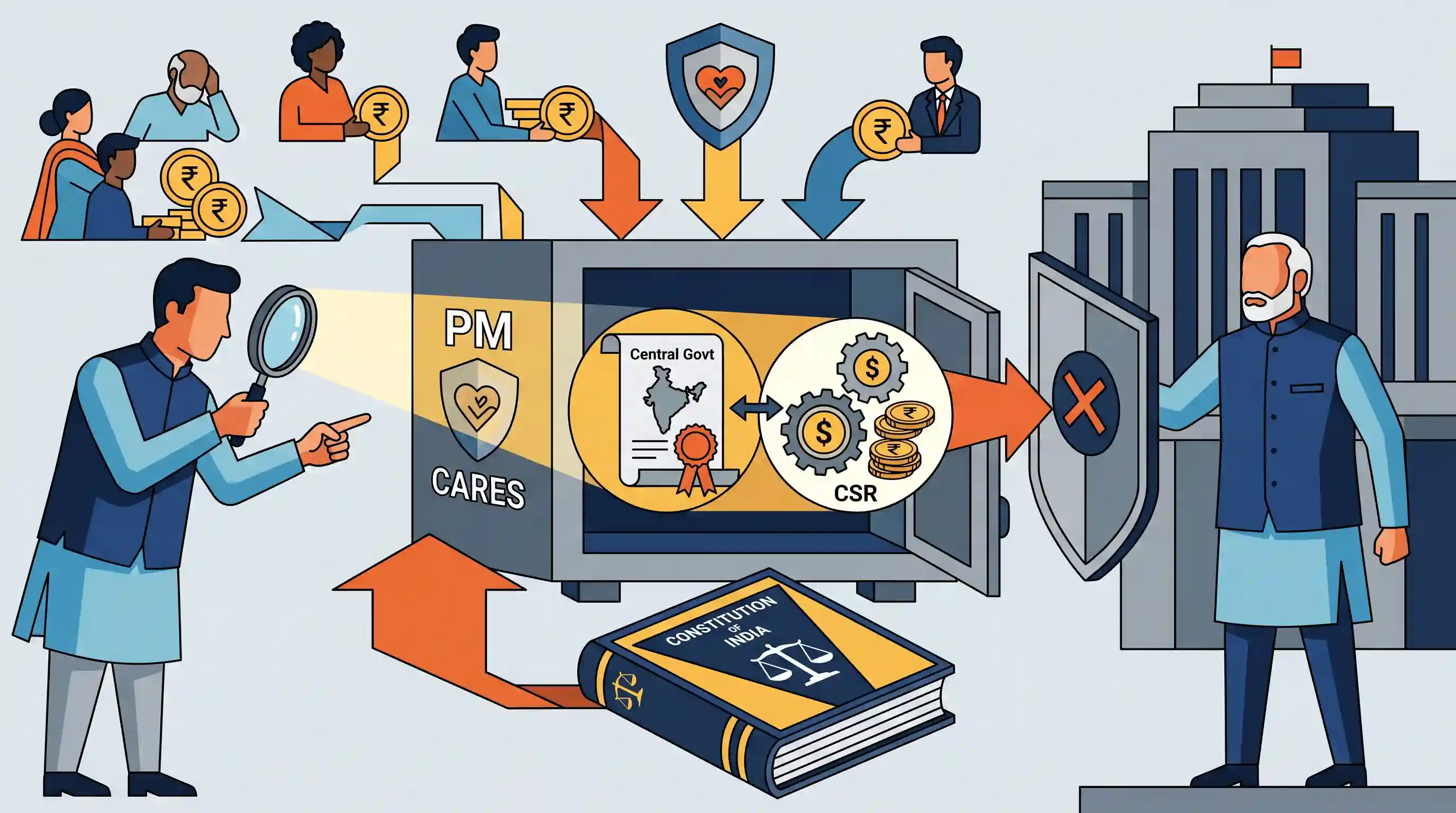
Why It Matters
The controversy highlights a critical debate over executive accountability, parliamentary oversight mechanisms (like Question Hour), and the transparency of large public-facing financial vehicles such as the PM CARES Fund. It serves as a strong case study for GS2 answers on the balance of power and transparency in Indian democracy.
Summary
CPI(M) MP John Brittas has strongly objected to the Prime Minister's Office's (PMO) directive preventing the admission of parliamentary questions regarding the PM CARES Fund. While the government maintains that the fund relies on voluntary contributions and is thus outside standard parliamentary scrutiny, Brittas argues this stance undermines Constitutional governance and executive accountability. He cited a 2020 Ministry of Corporate Affairs memo and amendments to the Companies Act that legally classified PM CARES as a fund established by the Central Government to qualify it for Corporate Social Responsibility (CSR) contributions, exposing contradictions in the government's defense.
Key Points
- CPI(M) MP John Brittas protested the PMO's directive to the Lok Sabha Secretariat to bar parliamentary questions regarding the PM CARES Fund.
- The PMO's rationale is that the fund consists of voluntary public contributions, not government budget allocations.
- Brittas argued this move creates a 'zone of opacity', circumventing parliamentary scrutiny and violating the principle of executive accountability to the legislature.
- He highlighted a 2020 MCA memo and a Companies Act amendment that explicitly recognized PM CARES as a Central Government-established fund eligible for CSR donations, contradicting the government's stance on its non-governmental nature.
Important Terms
PM CARES Fund

A public charitable trust established in 2020 for disaster relief (e.g., COVID-19). It relies on voluntary contributions rather than the Consolidated Fund of India and is chaired by the Prime Minister.
UPSC context
GS Paper II: Transparency & Accountability. Relates to the debate on 'public authority' status under the RTI Act and parliamentary oversight.
Corporate Social Responsibility (CSR)
A legal mandate under the Companies Act, 2013, requiring certain profitable companies to spend 2% of their average net profit on social development activities listed in Schedule VII.
UPSC context
GS Paper II & IV: Governance and Ethics. Tests knowledge of state-led social welfare funding and corporate governance.
Companies Act, 2013
The foundational legislation regulating the incorporation, responsibilities, and dissolution of companies in India. Section 135 and Schedule VII specifically govern CSR obligations and eligible recipients.
UPSC context
GS Paper III: Indian Economy. Important for understanding the regulatory framework for businesses and their contribution to national development.
Executive Accountability
The constitutional principle that the Council of Ministers is collectively responsible to the Lok Sabha, ensuring the government remains answerable to the legislature for its actions and expenditures.
UPSC context
GS Paper II: Parliament and State Legislatures. A core theme regarding checks and balances and the 'Question Hour' mechanism.
Ministry of Corporate Affairs (MCA)
The nodal ministry for the administration of the Companies Act, responsible for regulating the corporate sector and issuing clarifications on CSR-eligible funds like PM CARES.
UPSC context
GS Paper II: Statutory, regulatory and various quasi-judicial bodies. Tests understanding of ministerial jurisdiction in economic governance.
Lok Sabha Secretariat
The administrative office that assists the Speaker and MPs in the conduct of House business, including the processing and admission of parliamentary questions under Rule 41.
UPSC context
GS Paper II: Functioning of Parliament. Relevant to the procedural rules governing debates and information disclosure in the House.
Prelims Trap
"The PM CARES Fund is a Public Authority under the RTI Act and is audited by the CAG."
Aspirants assume that because the PM is the ex-officio chairman and it accepts CSR funds, it falls under standard public scrutiny. It is exempt from both.
Static Concepts Connected
What are the grounds for inadmissibility of a Parliamentary Question?
- Ministerial Responsibility: Under Lok Sabha Rule 41, questions must strictly relate to the public duties of the concerned Minister.
- Non-Government Bodies: Questions regarding matters or bodies outside the direct administrative control or primary concern of the Government of India are inadmissible.
- Sub-judice Matters: Issues pending before a court of law or under consideration by a parliamentary committee cannot be asked.
Which major public funds are eligible for mandatory CSR contributions under the Companies Act?
- Schedule VII Mandate: Section 135 and Schedule VII of the Companies Act, 2013 list the approved activities and funds eligible for corporate CSR expenditure.
- Eligible Funds: Contributions to the PM National Relief Fund (PMNRF), PM CARES Fund, Swachh Bharat Kosh, and Clean Ganga Fund qualify as valid CSR spending.
- State Funds Exclusion: Direct contributions to State Chief Minister's Relief Funds do not automatically qualify under Schedule VII without specific alignment to authorized activities.
Cross-Topic Patterns
Executive Accountability vs. Public Trusts
The tension between executive-headed voluntary funds (like PM CARES and PMNRF) and constitutional accountability mechanisms (CAG, RTI, Parliamentary Questions) is a high-yield GS-2 theme on transparency.
CSR Contributions as Para-State Finance
Amending the Companies Act to classify PM CARES as a Central fund highlights the increasing use of corporate CSR obligations to directly finance state-administered relief bodies.

Expect a tricky 2026 Prelims statement mixing PM CARES' RTI exemption, CAG audit status, and its legal classification for CSR eligibility.
Linked PYQs · 4
Linked PYQs · 4
- 2021MainsGS2
To what extent, in your view, the Parliament is able to ensure accountability of the executive in India?
- 2020PrelimsGS1
A Parliamentary System of Government is one in which
- 2017PrelimsGS1
The main advantage of the parliamentary form of government is that
- 2024MainsGS2
Public charitable trusts have the potential to make India's development more inclusive as they relate to certain vital public issues. Comment.
