Polavaram project displacement rehabilitation and water release
Source:The Hindu ↗
Why It Matters
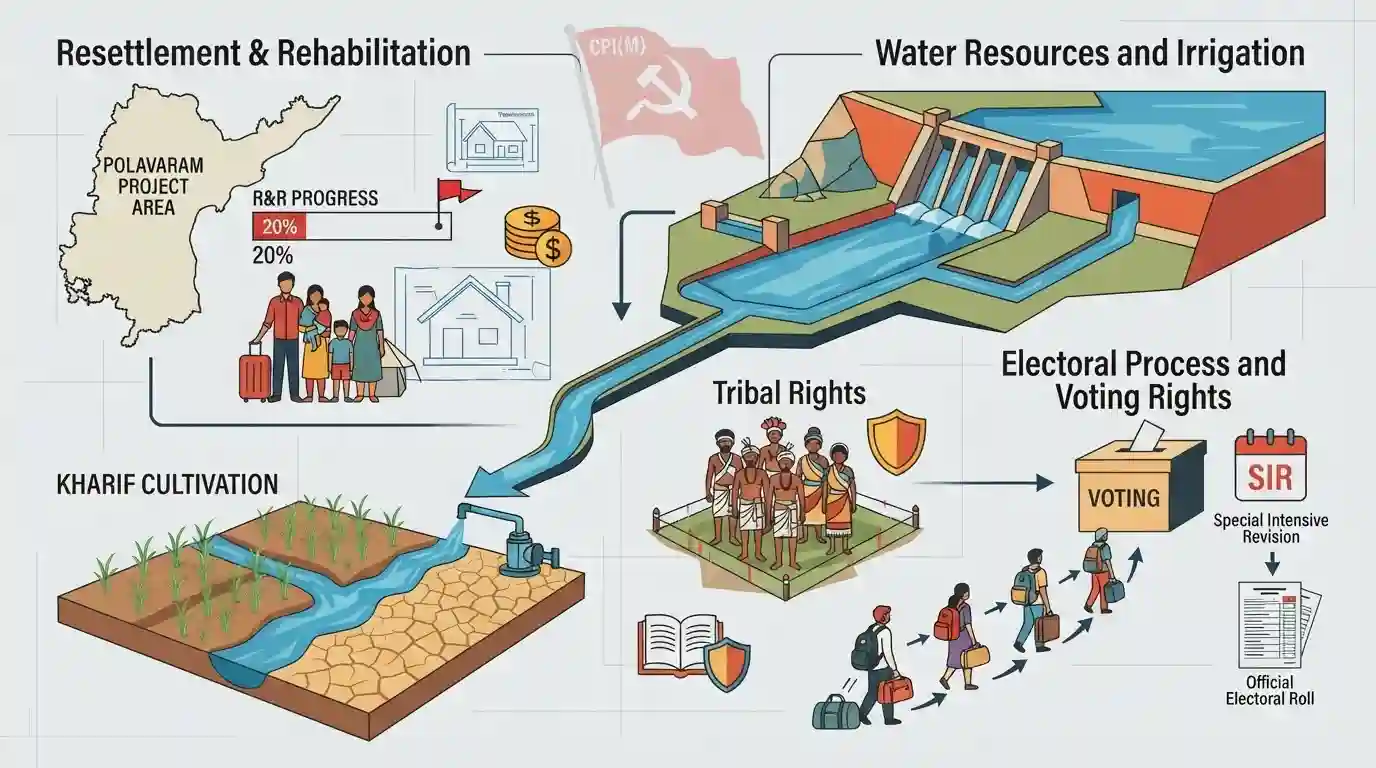
The Polavaram project is a flagship national irrigation project crucial to Andhra Pradesh's agrarian economy. The article highlights the complex socio-economic challenges surrounding such mega-projects, including tribal displacement, inadequate rehabilitation, agrarian distress, and the safeguarding of constitutional voting rights, which are key themes in APPSC syllabus.
Summary
The CPI(M) has urged the state and central governments to expedite the rehabilitation and resettlement of families displaced by the Polavaram irrigation project in Andhra Pradesh. Despite assurances to complete the project by 2027, the party highlighted that only 20% of the rehabilitation is complete, leaving many without proper compensation or housing. Additionally, the CPI(M) urged the Election Commission to ensure displaced individuals do not lose their voting rights during the Special Intensive Revision (SIR) of electoral rolls. They also demanded the release of Godavari water to support Kharif cultivation in drought-affected Eluru district and called for the protection of tribal lands.
Key Points
- The CPI(M) has demanded immediate and comprehensive rehabilitation for families displaced by the Polavaram national irrigation project, noting only 20% of the process is complete.
- Chief Minister N. Chandrababu Naidu and Union Minister Bhupathiraju Srinivasa Varma have stated a target to complete the Polavaram project by 2027.
- Concerns were raised that displaced families might lose their voting rights during the ongoing Special Intensive Revision (SIR) of electoral rolls by the Election Commission of India.
- Inadequate rainfall has severely impacted Kharif crop cultivation in Eluru district, prompting demands to release Godavari water to mitigate drought conditions.
- The CPI(M) also called for the repeal of G.O. No. 97, which allegedly allows non-tribals to purchase tribal lands, violating the Land Transfer Regulation Act.
Important Terms
Land Transfer Regulation Act (1 of 70)

The Andhra Pradesh Scheduled Areas Land Transfer Regulation, 1959, amended in 1970 ("1 of 70"). It prohibits the transfer of land in Scheduled Areas to non-tribals, protecting tribal land rights under the Fifth Schedule.
UPSC context
Relevant to Polity (Paper II) and Social Justice. Tests knowledge of the Fifth Schedule and legal safeguards for Scheduled Tribes.
G.O. No. 97
A 2015 government order in Andhra Pradesh that permitted bauxite mining in the Visakha Agency area, which was strongly opposed by tribal groups and left-wing parties for violating tribal land rights.
UPSC context
Important for Environment (Paper III) and Tribal Rights (Paper II). Tests understanding of resource extraction conflicts in Scheduled Areas.
Polavaram Irrigation Project
A major multi-purpose irrigation and hydroelectric project on the Godavari River in Andhra Pradesh. It has caused large-scale displacement, making rehabilitation and resettlement a significant governance challenge.
UPSC context
Crucial for Geography (Paper I) and Governance (Paper II). Tests knowledge of major infrastructure projects, interstate water disputes, and R&R policies.
Special Intensive Revision (SIR)
An exercise by the Election Commission of India to comprehensively update electoral rolls, typically involving house-to-house verification, to add eligible voters and remove incorrect entries.
UPSC context
Relevant for Polity (Paper II). Tests understanding of the Representation of the People Act and the Election Commission's mandate.
Election Commission of India
A constitutional body established under Article 324 of the Indian Constitution, responsible for the superintendence, direction, and control of elections to Parliament, State Legislatures, and the offices of President and Vice-President.
UPSC context
Fundamental to Polity (Paper II). Tests knowledge of constitutional bodies, democratic processes, and electoral governance.
Prelims Trap
In Fifth Schedule areas of Andhra Pradesh, land transfers between two non-tribal individuals are legally permitted as long as tribal land is not alienated.
AP's Land Transfer Regulation (1/70 Act), upheld by the Supreme Court, absolutely prohibits any land transfer to a non-tribal in Scheduled Areas, even from another non-tribal.
Static Concepts Connected
How do the Fifth Schedule and Samatha ruling protect tribal land from transfer?
- Absolute Prohibition: The AP 1/70 Act completely bars land transfers to non-tribals, including transfers between non-tribal parties, to prevent indirect tribal displacement.
- State as 'Person': The landmark Samatha judgement (1997) ruled that the State itself is a 'person' and cannot lease Scheduled Area lands to private entities for mining.
- Rebuttable Presumption: Any land in Scheduled Areas in possession of a non-tribal is presumed to have been acquired through unlawful transfer unless the contrary is proved.
What are the statutory R&R safeguards for Scheduled Tribes under the LARR Act 2013?
- Gram Sabha Consent: Section 41 mandates that land acquisition in Scheduled Areas must be a last resort, requiring prior consent from the local Gram Sabha.
- Tribal Development Plan: If 100 or more ST families are displaced, a specialized Tribal Displacement Plan must be prepared, detailing R&R and restoration of forest rights.
- Land-for-Land Compensation: Affected ST families must receive alternative agricultural land (minimum 2.5 acres or equivalent) in the resettlement zone, along with resettlement benefits.
Cross-Topic Patterns
Development Displacement vs. Voting Rights
Delays in resettlement disenfranchise displaced tribal voters under RPA 1950, as they struggle to satisfy the 'ordinarily resident' clause during intensive electoral roll revisions.
Federalism and National Project R&R
Declaring a project 'National' under Reorganisation Acts shifts capital costs to the Centre, but leaves politically sensitive, complex rehabilitation to the financially strained State.

LARR 2013 tribal consent clauses, Samatha ruling on land transfers, and AP Reorganisation Act provisions will feature in a 2026 polity question.
Linked PYQs · 3
Linked PYQs · 3
- 2023APPSC_PRELIMSGS1
Polavaram Project is a
- 2023APPSC_PRELIMSGS1
The powers of the Election Commission include which of the following? I. The Election Commission takes decisions on every aspect of conduct and control of elections from the announcement of elections to the declaration of results. II. During the election period, the Election Commission can order the Government to dismiss some government officials. III. When on election duty, Government officers work under the control of the Election Commission. Choose the correct answer using the codes given below:
- 2024APPSC_PRELIMSGS1
Consider the following statements with reference to the Election Commission of India : I. The Constitution of India has debarred the retiring Election Commissioners from any further appointment by the government. II. In 'Anoop Baranwal Case' (2023), the Supreme Court has directed the Government to treat the Regional Commissioners on par with the Election Commissioners (other than the Chief Election Commissioner), as far as removal from office is concerned. III. Since its inception, the Election Commission had functioned as a multi-member body. IV. The power of superintendence, direction and control of elections to the office of Vice-President of India is vested in the Election Commission. Which of the above statement/statements is/are valid ?
