CPIM Criticism of Supreme Court Opinion on Governor Powers
Source:The Hindu ↗
Why It Matters
This issue is central to Indian federalism, highlighting the friction between elected state governments and centrally appointed Governors. It tests the boundaries of Article 200, the scope of judicial review over gubernatorial inaction, and the balance of power between the Centre and States.
Summary
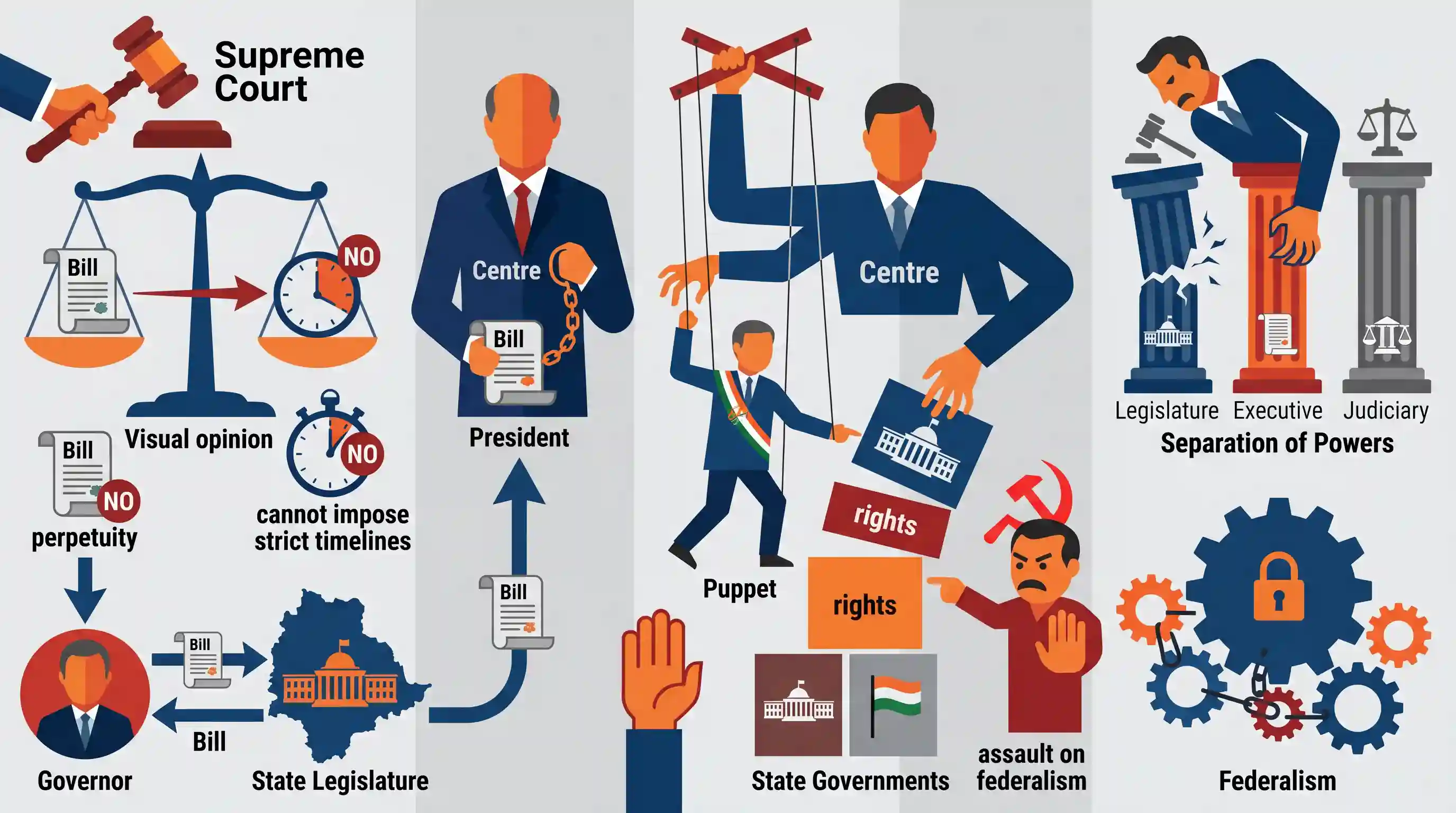
The CPI(M) has criticized the Supreme Court's advisory opinion on a Presidential Reference concerning the powers of Governors under Article 200 of the Constitution. While the Court ruled that Governors cannot sit on Bills in perpetuity, it also held that it cannot impose strict timelines for granting assent and that a Governor can refer a reconsidered Bill to the President. The CPI(M) contends this stance removes constitutional checks on Governors, allowing them to act as political agents for the Centre, thereby undermining federalism and the rights of States.
Key Points
- The Supreme Court issued an advisory opinion on a Presidential Reference, stating it cannot dictate constitutional timelines for Governors or the President to grant assent to Bills.
- The Court noted that Governors do not have unfettered powers to sit on Bills indefinitely, allowing for limited judicial intervention in cases of prolonged inaction.
- The CPI(M) strongly criticized the opinion, arguing it provides an unconstitutional veto to Governors, enabling them to act as political agents of the Centre and delay State legislation.
- The ruling permits a Governor to refer a Bill to the President even after it has been reconsidered and readopted by the State legislature, which critics say severely undermines States' rights and federalism.
Important Terms
Article 200 of the Constitution

Constitutional provision outlining the Governor's options regarding Bills passed by the State Legislature: granting assent, withholding it, returning it for reconsideration, or reserving it for the President’s consideration.
UPSC context
GS Paper II (Indian Constitution). Essential for understanding the legislative process and friction points in Centre-State relations.
Article 143 (Presidential Reference)
Empowers the President to seek the Supreme Court's advisory opinion on questions of law or fact of public importance. The Court’s response is not a binding judgment but an advisory opinion.
UPSC context
GS Paper II (Judiciary). Tests knowledge of the Supreme Court's advisory jurisdiction and the consultative mechanism between the President and Judiciary.
Article 201 of the Constitution
Governs the procedure when a Governor reserves a State Bill for the President's consideration. The President may then grant or withhold assent, or direct the Governor to return the Bill.
UPSC context
GS Paper II (Polity). Relevant for analyzing the President's role in State legislation and the link between State and Union executives.
Federalism
A constitutional principle where power is shared between the Centre and States. Indefinite delay of State Bills by Governors is often criticized as undermining this federal balance.
UPSC context
GS Paper II (Structure and Functioning). Fundamental theme for questions on constitutional disputes and the "quasi-federal" nature of the Indian polity.
Separation of Powers
A doctrine ensuring that the Legislature, Executive, and Judiciary function independently. The Supreme Court used this principle to rule against judicially-mandated timelines for gubernatorial assent.
UPSC context
GS Paper II (Constitutional Scheme). Crucial for discussing the boundaries of judicial intervention in legislative and executive processes.
Discretionary Powers of the Governor
Authority of the Governor to act independently of the Council of Ministers' advice. The SC's 2025 opinion clarified that this discretion applies to options under Article 200.
UPSC context
GS Paper II (Polity/Executive). Examines the nuances of constitutional versus situational discretion in the Governor’s office.
Prelims Trap
A Governor is constitutionally bound to give assent if a returned Bill is readopted by the Legislature.
While Article 200 says the Governor "shall not withhold assent" on readopted Bills, the SC clarified they can still reserve such reconsidered Bills for the President.
Static Concepts Connected
What are a Governor's constitutional options under Article 200 when presented with a State Bill?
- Grant Assent: The Governor can formally approve the legislation, transforming the State Bill into an Act.
- Withhold and Return: The Governor can withhold assent and return the Bill (if not a Money Bill) to the State legislature with a message for reconsideration.
- Reserve for President: The Governor can reserve the Bill for the President's consideration (mandatory if it derogates High Court powers; discretionary for other specific issues).
How does the Supreme Court's advisory jurisdiction function under Article 143?
- Presidential Reference: The President can refer a question of law or fact of substantial public importance to the Supreme Court for its consideration.
- Non-binding Nature: The opinion provided by the Supreme Court is advisory. It carries significant persuasive authority but is not legally binding on the President.
- Constitution Bench: Under Article 145(3), any reference made under Article 143 must be heard by a Constitution Bench comprising at least five judges.
Cross-Topic Patterns
Governor's Discretion & Federalism
Links Article 200 controversies directly to GS2 Centre-State relations, recalling Sarkaria and Punchhi Commission recommendations to curb discretionary delays in State legislation.
Separation of Powers vs Article 142
The Court's refusal to use 'complete justice' powers to bypass executive assent highlights judicial restraint and strict adherence to the separation of powers in law-making.

A 2026 Prelims multi-statement question will likely test the nuanced interplay of Article 200, readopted Bills, and Presidential reserves.
Linked PYQs · 2
Linked PYQs · 2
- 2023PrelimsGS1
Consider the following statements: 1. If the election of the President of India is declared void by the Supreme Court of India, all acts done by him/her in the performance of duties of his/her office of President before the date of decision become invalid. 2. Election for the post of the President of India can be postponed on the ground that some Legislative Assemblies have been dissolved and elections are yet to take place. 3. When a Bill is presented to the President of India, the Constitution prescribes time limits within which he/she has to declare his/her assent. How many of the above statements are correct?
- 2022MainsGS2
Discuss the essential conditions for exercise of the legislative powers by the Governor. Discuss the legality of re-promulgation of ordinances by the Governor without placing them before the Legislature.
