Supreme Court Intervention on Electoral Roll Exclusion
Source:The Hindu ↗
Why It Matters
This case illustrates the practical challenges in maintaining accurate electoral rolls without inadvertently disenfranchising vulnerable groups, particularly internal migrants. It highlights the intersection of Election Commission procedures, judicial oversight, and political accountability, making it highly relevant for GS2 questions on electoral reforms and the Representation of the People Act.
Summary
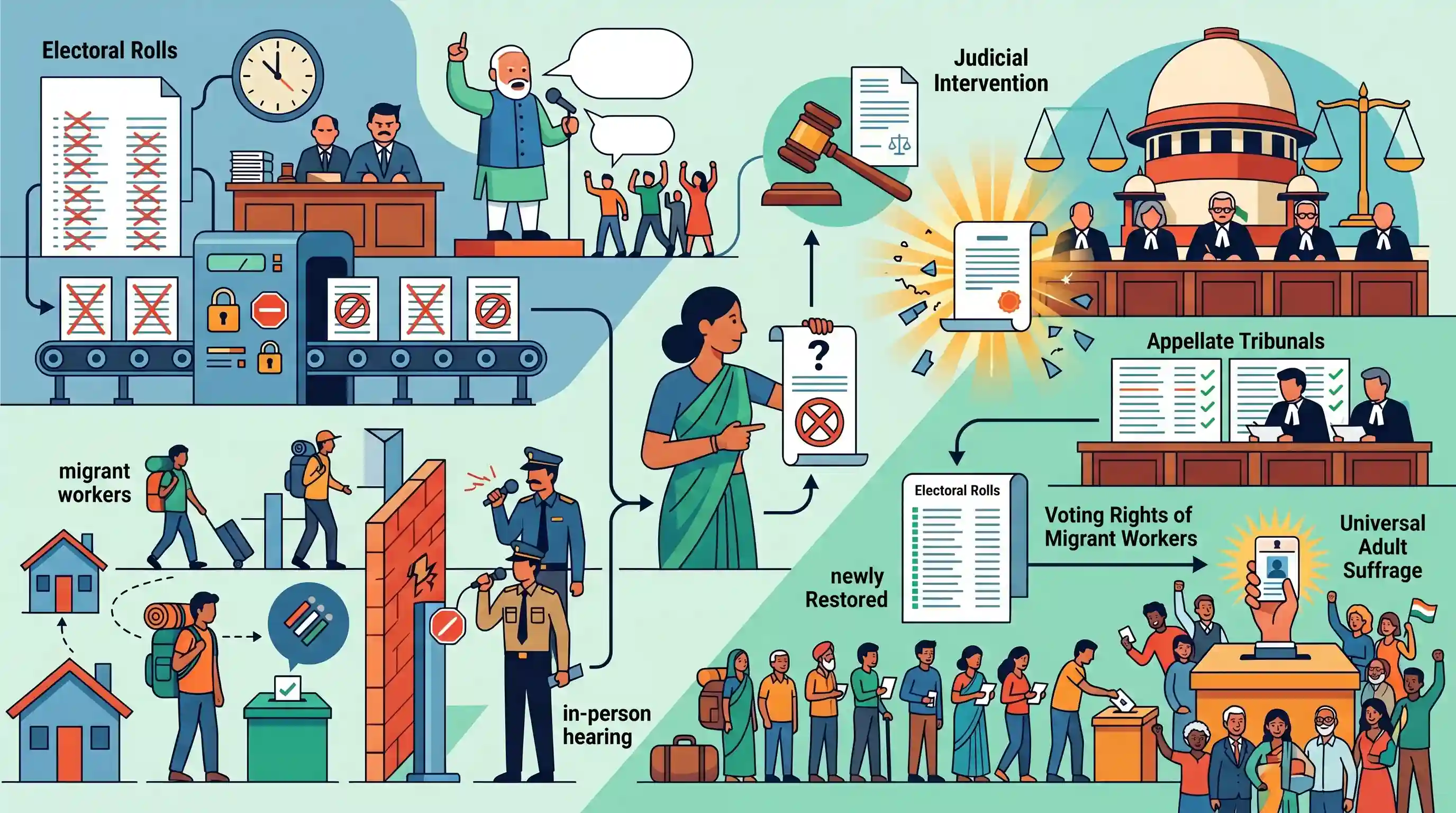
A CPI(M) activist from Murshidabad, Mostari Banu, has countered claims by West Bengal Chief Minister Mamata Banerjee regarding credit for a recent Supreme Court order granting voting rights to individuals excluded from the state's electoral rolls. Banu stated that her earlier petition highlighted the flaws in the Special Intensive Revision (SIR) process, specifically how the requirement for in-person hearings systematically disenfranchised migrant workers unable to return home. The Supreme Court's intervention ultimately directed that individuals whose names were cleared by appellate tribunals be permitted to vote, underscoring the critical role of the judiciary in safeguarding universal adult suffrage and addressing systemic barriers faced by internal migrants.
Key Points
- CPI(M) activist Mostari Banu asserts her Supreme Court petition secured voting rights for citizens excluded during the Special Intensive Revision (SIR) of electoral rolls in West Bengal.
- The Election Commission's requirement for in-person hearings during the revision process disproportionately disenfranchised internal migrant workers who could not travel back home.
- A recent Supreme Court directive ruled that voters whose appeals against their exclusion were cleared by appellate tribunals must be allowed to vote in the upcoming elections.
- The event highlights the political contestation over credit for legal victories, with the ruling Trinamool Congress and CPI(M) both claiming responsibility for the judicial relief.
Important Terms
Special Intensive Revision (SIR) of electoral rolls

A comprehensive house-to-house voter verification and revision drive by the Election Commission. It involves full enumeration to ensure roll accuracy by identifying duplicate, deceased, or ineligible entries before major elections.
UPSC context
GS II: Electoral Reforms; tests understanding of ECI's powers and mechanisms for ensuring inclusive universal adult suffrage.
Ordinarily Resident
A legal status under Section 20 of the Representation of the People Act, 1950, defining voter eligibility based on habitual residence rather than mere property ownership or temporary absence.
UPSC context
GS II: Representation of People Act; tests knowledge of residency criteria and disenfranchisement challenges faced by migrant populations.
Article 142 of the Constitution
A constitutional provision granting the Supreme Court extraordinary power to pass any order necessary for "complete justice," used here to restore voting rights to tribunal-cleared citizens.
UPSC context
GS II: Judiciary; tests understanding of the Supreme Court's plenary powers to resolve systemic administrative or legal stalemates.
Election Commission of India (ECI)
The autonomous constitutional body under Article 324 responsible for the superintendence, direction, and control of elections, including the maintenance and intensive revision of electoral rolls.
UPSC context
GS II: Constitutional Bodies; tests roles in maintaining electoral integrity and balancing security concerns with franchise rights.
Migrant Workers' Association of West Bengal
A labor advocacy group representing the rights of internal migrant workers. It highlighted how SIR verification procedures systematically disenfranchise mobile workers who cannot return for in-person hearings.
UPSC context
GS I/II: Social Justice/Migrants; tests awareness of barriers to political participation and the role of civil society advocacy.
Representation of the People Act, 1950
The 1950 legislation providing for the allocation of seats and the registration of electors, establishing the "ordinarily resident" criterion and the legal framework for voter rolls.
UPSC context
GS II: Parliament and State Legislatures; tests statutory knowledge of the legal basis for India's electoral system.
Supreme Court of India
The highest judicial authority in India which, in this case, exercised oversight over the ECI's administrative processes to safeguard the constitutional/statutory right to vote.
UPSC context
GS II: Judiciary; tests knowledge of judicial intervention and the protection of constitutional rights during electoral processes.
Prelims Trap
The preparation of electoral rolls and determination of "ordinarily resident" status is governed by the Representation of the People Act, 1951.
Electoral roll preparation, allocation of seats, and delimitation fall under RPA 1950. RPA 1951 governs the actual conduct of elections and candidate qualifications.
Static Concepts Connected
What dictates the "Right to Vote" framework in India?
- Article 326: Guarantees universal adult suffrage, establishing the foundational Constitutional right for citizens aged 18 or above to participate in Lok Sabha and Assembly elections.
- RPA 1951: Operationalizes the voting process as a statutory right under Section 62, laying down conditions under which a person is entitled to cast a vote.
- SC Interpretation: The apex court has repeatedly clarified that voting is a statutory/constitutional right, not a Fundamental Right under Part III of the Constitution.
How is the "Ordinarily Resident" criterion defined and applied?
- Legal Basis: Governed by Sections 19 and 20 of the RPA 1950, requiring a person to normally reside at a specific place to be registered in its electoral roll.
- Migrant Challenge: Temporary absence does not strip resident status, yet physical verification rules often lead to the arbitrary deletion of circular migrants unable to attend in-person hearings.
- Appellate Finality: Decisions of Appellate Officers regarding inclusion or exclusion are final and binding on Electoral Registration Officers under the Registration of Electors Rules, 1960.
Cross-Topic Patterns
Migrant Voting & Remote Voting Machines
The disenfranchisement of internal migrants during physical roll revisions directly ties into the Election Commission's recent proposals for Multi-Constituency Remote Electronic Voting Machines (RVMs) to facilitate domestic migrant voting.
Judicial oversight of Article 324 powers
The Supreme Court directing voters cleared by appellate tribunals to vote demonstrates constitutional courts using judicial review as a necessary check on the Election Commission's sweeping administrative powers under Article 324.

Expect a 2026 question linking RPA 1950's 'ordinarily resident' criteria with domestic migrant disenfranchisement and ECI's proposed RVMs.
Linked PYQs · 2
Linked PYQs · 2
- 2022MainsGS2
Discuss the procedures to decide the disputes arising out of the election of a Member of the Parliament or State Legislature under The Representation of the People Act, 1951. What are the grounds on which the election of any returned candidate may be declared void ? What remedy is available to the aggrieved party against the decision ? Refer to the case laws.
- 2015MainsGS1
Discuss the changes in the trends of labour migration within and outside India in the last four decades.
