Pulichintala Project and Inter State Lift Irrigation Disputes
Source:The Hindu ↗
Why It Matters
Highlights the ongoing inter-state water sharing friction between Andhra Pradesh and Telangana, emphasizing the significance of statutory bodies like the KRMB and the Apex Council, and the critical provisions of the AP Reorganisation Act, 2014 in managing shared resources.
Summary
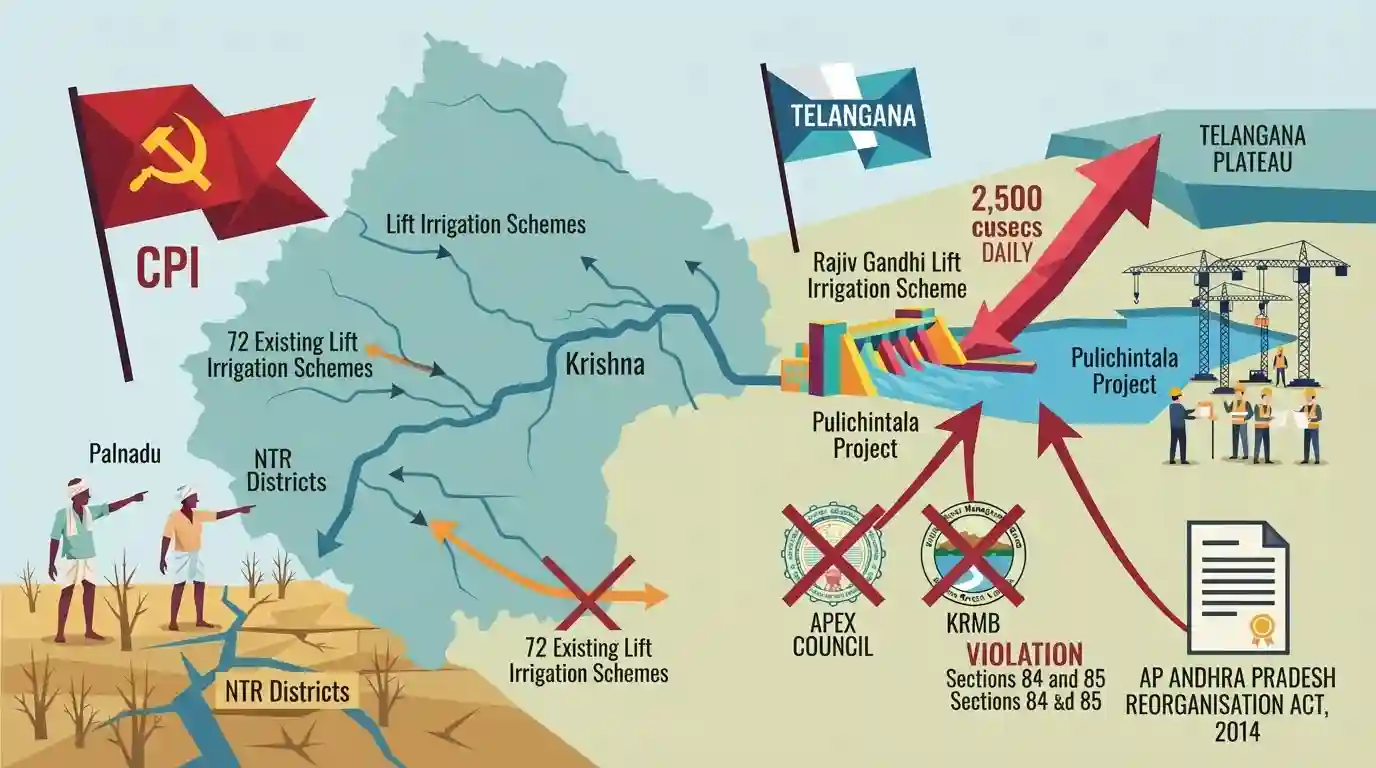
The Communist Party of India (CPI) has appealed to Andhra Pradesh Chief Minister N. Chandrababu Naidu to halt Telangana's construction of the Rajiv Gandhi Lift Irrigation Scheme near the Pulichintala project on the Krishna River. The CPI argues that the ₹394-crore scheme, which aims to lift 2,500 cusecs of water daily for Telangana, will severely impact farmers in AP's Palnadu and NTR districts who depend on 72 existing lift irrigation schemes tied to the Pulichintala reservoir. Furthermore, the party contends that proceeding with the project without approval from the Apex Council and the Krishna River Management Board (KRMB) is a violation of Sections 84 and 85 of the Andhra Pradesh Reorganisation Act, 2014.
Key Points
- The CPI urged the Andhra Pradesh government to block Telangana's ₹394-crore Rajiv Gandhi Lift Irrigation Scheme near the Pulichintala project.
- The project is designed to draw 2,500 cusecs of water daily to irrigate 14,000 acres in Telangana.
- CPI warns that the project will adversely affect 72 existing lift irrigation schemes in Palnadu and NTR districts that rely on the Pulichintala reservoir.
- CPI asserts that initiating the project without clearance from the Apex Council and KRMB violates Sections 84 and 85 of the Andhra Pradesh Reorganisation Act, 2014.
Important Terms
Rajiv Gandhi Lift Irrigation Scheme

A ₹394-crore lift irrigation project built by Telangana on the Krishna River near the Pulichintala project. It is designed to lift 2,500 cusecs of water daily to irrigate 14,000 acres.
UPSC context
Relevant to GS3 (Water Resources) and GS2 (Inter-State Disputes), highlighting practical friction points in river basin water sharing.
Andhra Pradesh Reorganisation Act, 2014
The parliamentary act that bifurcated Andhra Pradesh to create Telangana. Under Sections 84 and 85, it establishes statutory rules and specific boards to govern the equitable sharing of common river resources.
UPSC context
Core GS2 topic (Federalism/State Reorganization). Tests how statutory frameworks manage the distribution of inter-state assets and natural resources.
Apex Council
A dispute resolution body established under the AP Reorganisation Act, 2014. Chaired by the Union Jal Shakti Minister with AP and Telangana CMs as members, it must approve new irrigation projects.
UPSC context
Crucial for GS2 (Inter-State Relations), testing mechanisms of cooperative federalism and the Centre\'s role in mitigating state conflicts.
Krishna River Management Board (KRMB)
An autonomous statutory body under the Ministry of Jal Shakti, mandated by the AP Reorganisation Act, 2014, to regulate, administer, and maintain the Krishna River\'s waters between Andhra Pradesh and Telangana.
UPSC context
Important for GS2 (Statutory Bodies & Federalism). Illustrates specific institutional efforts established to resolve complex inter-state water sharing challenges.
Prelims Trap
The Apex Council managing Krishna and Godavari river waters under the AP Reorganisation Act is headed by the Prime Minister of India.
Under Section 84 of the AP Reorganisation Act, 2014, the Apex Council is headed by the Union Minister of Water Resources, not the PM.
Static Concepts Connected
What is the statutory framework for resolving inter-state river water disputes?
- Constitutional Basis: Article 262 empowers Parliament to provide for the adjudication of any dispute regarding the use, distribution, or control of inter-state river waters.
- Statutory Acts: Parliament enacted the River Boards Act (1956) and Inter-State Water Disputes Act (1956), establishing ad-hoc tribunals whose awards hold the same force as a Supreme Court decree.
- Judicial Bar: The Supreme Court generally lacks jurisdiction over these specific water disputes once a tribunal is constituted, though Special Leave Petitions (Article 136) are sometimes invoked.
What are the key geographical features of the Krishna River Basin?
- Origin: The river rises from Mahabaleshwar in the Western Ghats (Maharashtra) and flows eastwards to join the Bay of Bengal.
- Key Tributaries: Major tributaries include the Tungabhadra, Bhima, Musi, Ghataprabha, Malaprabha, and Munneru.
- Basin States: The basin's catchment area spans across four states: Maharashtra, Karnataka, Telangana, and Andhra Pradesh.
Cross-Topic Patterns
River Boards vs ISWD Tribunals
KRMB is formed under a state reorganization act, unlike tribunals under the ISWD Act 1956. This highlights the complex, fragmented statutory nature of India's river basin governance.
Lift Irrigation in Peninsular India
Because peninsular rivers flow through undulating Deccan plateau terrain, states increasingly rely on energy-intensive lift irrigation schemes rather than traditional gravity-fed canals, impacting state energy footprints.

Expect a Prelims 2026 paired-matching question linking specific River Management Boards or Tribunals to their parent Acts or basin states.
Linked PYQs · 3
Linked PYQs · 3
- 2023APPSC_PRELIMSGS1
Part V of the Andhra Pradesh Reorganisation Act deals with
- 2023APPSC_PRELIMSGS1
Polavaram Project is a
- 2023APPSC_PRELIMSGS1
How many Schedules are there in the Andhra Pradesh Reorganisation Act?
