CPI Nationwide Campaign on Federalism and Constitutional Rights
Source:The Hindu ↗
Why It Matters
This article covers ongoing political discourse regarding federalism, specifically focusing on Centre-State financial relations, the introduction of a new rural employment scheme replacing MGNREGA, and demands for statehood. These are critical themes in GS Paper 2 (Polity and Governance).
Summary
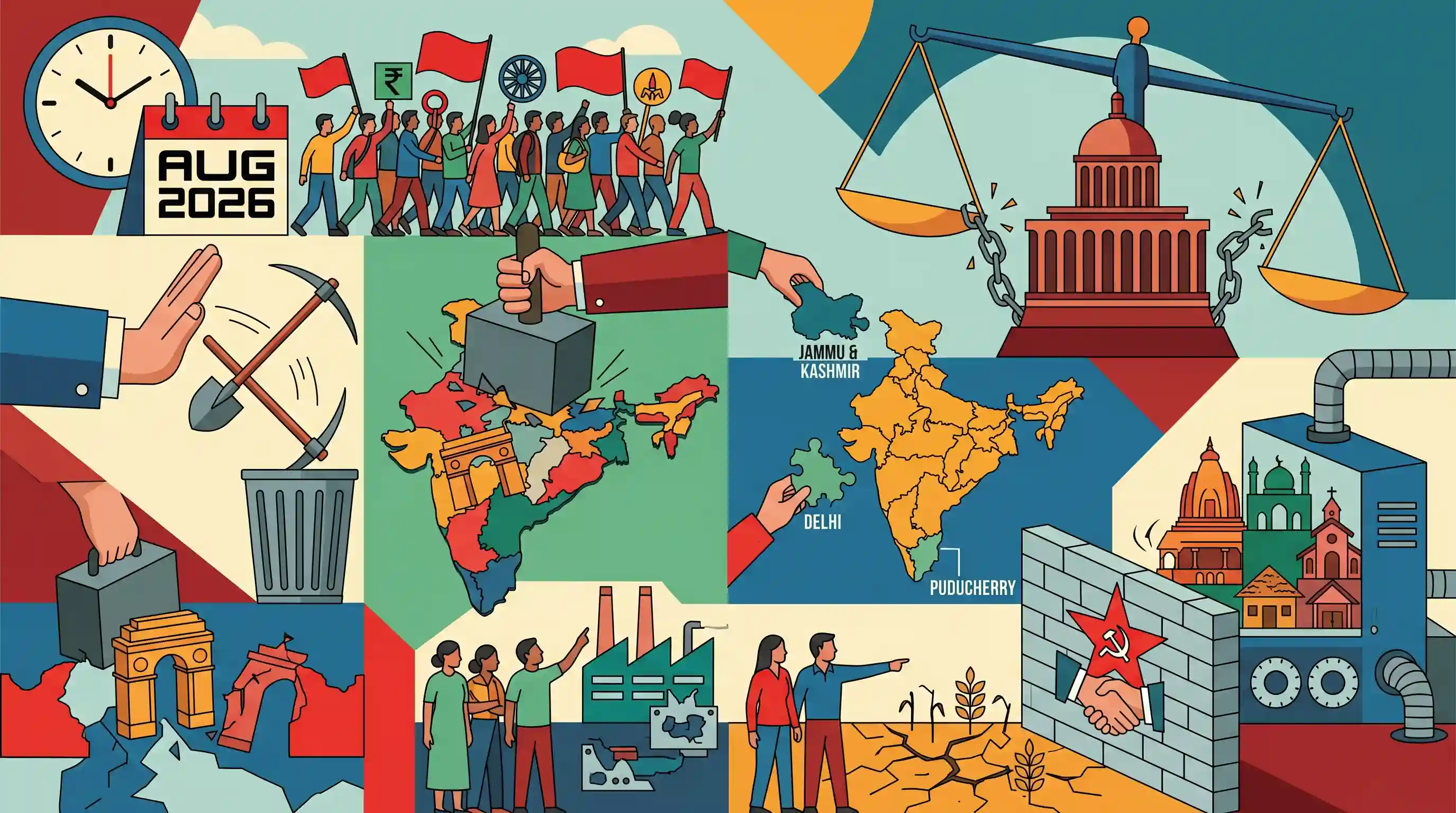
The Communist Party of India (CPI) will launch a nationwide campaign in August 2026 highlighting issues like rural distress, federalism, and electoral reforms. The party heavily criticized the Union government's economic policies, rising unemployment, and the replacement of MGNREGA with the new VB-G RAM G Act, which allegedly burdens state finances. Furthermore, the CPI raised concerns over the erosion of federalism, pushing for statehood for Union Territories like J&K, Delhi, and Puducherry, and opposed the Uniform Civil Code.
Key Points
- The Communist Party of India (CPI) has announced a nationwide campaign from August 6 to 15, 2026, to protest against alleged threats to the Constitution and democracy.
- CPI General Secretary D. Raja criticized the replacement of MGNREGA with the new Viksit Bharat-Guarantee for Rozgar and Ajeevika Mission (Gramin) Act (VB-G RAM G), arguing it shifts the financial burden to States.
- The campaign will also highlight issues of federalism, with states demanding a fairer share of tax revenues and greater authority over examinations.
- The CPI reiterated demands for statehood for Jammu & Kashmir, Puducherry, and Delhi, and opposed the Uniform Civil Code due to a lack of national consensus.
Important Terms
Viksit Bharat-Guarantee for Rozgar and Ajeevika Mission (Gramin) Act (VB-G RAM G Act)

A 2025 legislation (effective 2026) replacing MGNREGA, guaranteeing 125 days of rural manual work. It shifts funding to a 60:40 Centre-State ratio and mandates digital monitoring and asset creation.
UPSC context
GS Paper II (Government policies) and GS Paper III (Employment). Essential for questions on welfare scheme evolution and rural distress.
Mahatma Gandhi National Rural Employment Guarantee Act (MGNREGA)
The 2005 social security law that provided a legal guarantee for 100 days of unskilled work to rural households; it was the predecessor to the VB-G RAM G Act.
UPSC context
GS Paper II/III. Tests understanding of rights-based social security versus mission-mode governance in rural development.
Uniform Civil Code (UCC)
A constitutional principle (Article 44) proposing a common set of personal laws (marriage, divorce, inheritance) for all citizens, replacing diverse religious personal laws.
UPSC context
GS Paper II. Core topic for debates on secularism, fundamental rights, and Directive Principles of State Policy.
Federalism
The constitutional distribution of power between the Union and States. Key issues include fiscal devolution, autonomy of Union Territories, and centralizing policy shifts.
UPSC context
GS Paper II. Tests knowledge of Centre-State relations, the Seventh Schedule, and challenges to regional autonomy.
Electoral Reforms
Proposed changes to the voting system, political funding, and candidate eligibility to ensure free and fair elections and strengthen democratic institutions.
UPSC context
GS Paper II. Relates to the Representation of the People Act, political accountability, and the integrity of the democratic process.
Prelims Trap
The Right to Work under rural employment guarantees like MGNREGA is a Fundamental Right.
The Right to Work is a Directive Principle (Article 41). Rural employment guarantees provide a statutory, not constitutional, right to work.
Static Concepts Connected
What is the constitutional framework governing Union Territories with legislatures?
- Art 239A & 239AA: Puducherry (239A) and Delhi (239AA) have distinct provisions for assemblies. J&K's framework is established via the J&K Reorganisation Act, 2019.
- Restricted Powers: Delhi's assembly explicitly cannot legislate on Public Order, Police, and Land (State List entries 1, 2, 18).
- Parliamentary Supremacy: Under Article 246(4), Parliament retains overriding powers to legislate on any subject for all UTs.
How is scheme funding divided between Center and States?
- Central Sector Schemes: Fully funded and directly implemented by the Union Government. Often relates to Union List subjects.
- Centrally Sponsored Schemes: Jointly funded (e.g., 60:40 or 90:10 for Himalayan/NE states) but implemented by State machinery.
- Core of the Core: Umbrella schemes for social protection (like MGNREGA) requiring mandatory state participation and rigid funding matching from states.
Cross-Topic Patterns
Fiscal Federalism & Scheme Restructuring
Shifting the fiscal load of welfare schemes to States tightens their borrowing limits under Article 293, making it a critical issue for the Finance Commission's devolution formulas.
Concurrent List & Exam Centralisation
Education's shift to the Concurrent List via the 42nd Amendment is consistently tested alongside state demands to control exams like NEET to protect regional autonomy.

CSS funding restructuring (VB-G RAM G) and UT legislative powers (Delhi/J&K) are highly likely to merge in a 2026 Polity MCQ.
Linked PYQs · 5
Linked PYQs · 5
- 2025MainsGS2
Examine the evolving pattern of Centre-State financial relations in the context of planned development in India. How far have the recent reforms impacted the fiscal federalism in India?
- 2024MainsGS2
What changes has the Union Government recently introduced in the domain of Centre-State relations ? Suggest measures to be adopted to build the trust between the Centre and the States and for strengthening federalism.
- 2015MainsGS2
Discuss the possible factors that inhibit India from enacting for its citizens a uniform civil code as provided for in the Directive Principles of State Policy.
- 2024MainsGS2
The Doctrine of Democratic Governance makes it necessary that the public perception of the integrity and commitment of civil servants becomes absolutely positive. Discuss.
- 2020MainsGS2
Micro-Finance as an anti-poverty vaccine, is aimed at asset creation and income security of the rural poor in India". Evaluate the role of the Self Help Groups in achieving the twin objectives along with empowering women in rural India.
