Kerala political row erupts over PM SHRI scheme implementation MoU
Source:The Hindu ↗
Why It Matters
This case study is highly relevant for GS2, illustrating practical challenges in Centre-State relations, particularly how tied grants in Centrally Sponsored Schemes can infringe upon federalism. It also provides a contemporary example of intra-state governance issues regarding collective Cabinet responsibility and protocol in executive actions.
Summary
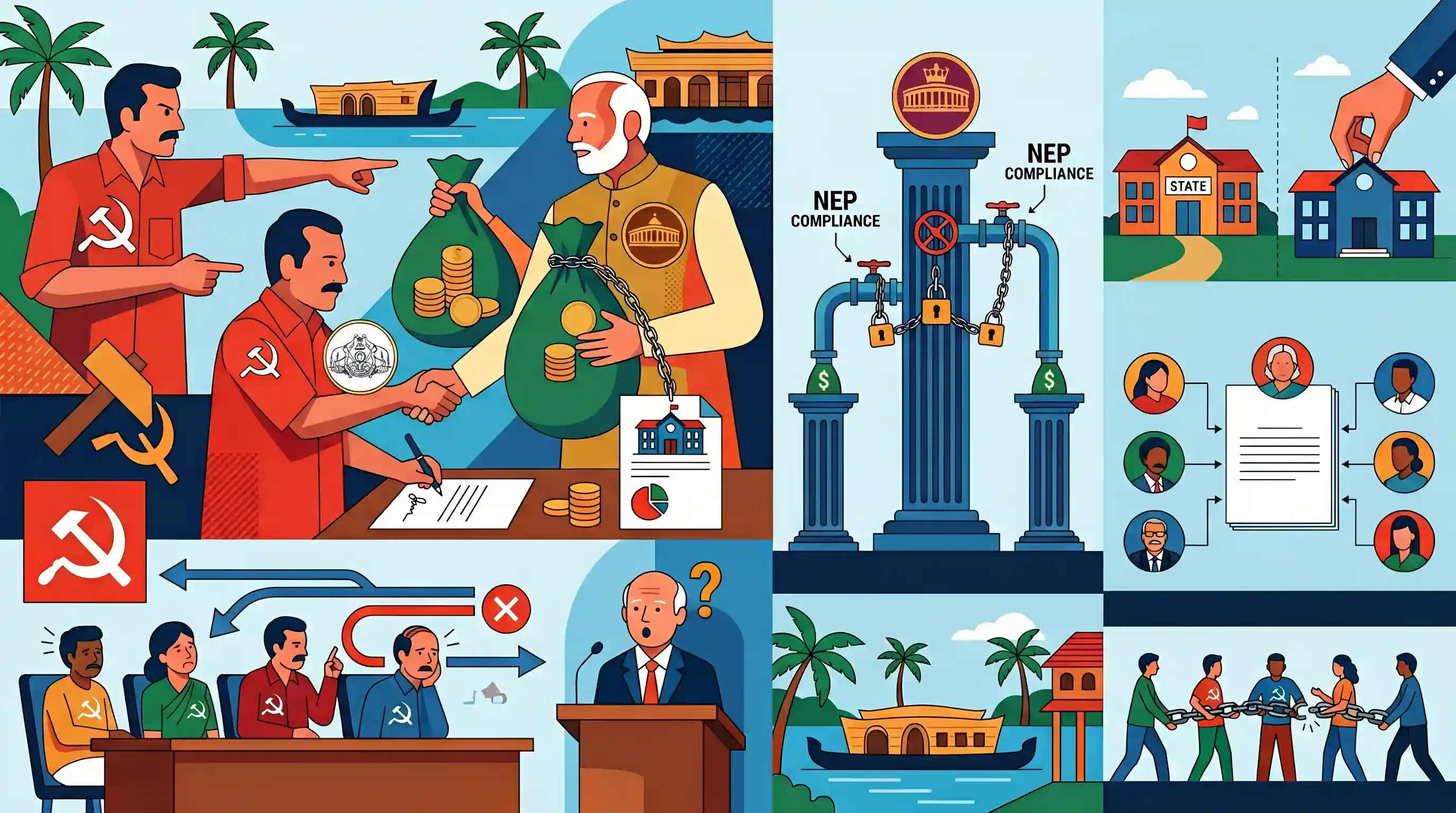
A political row has emerged in Kerala as the CPI criticized its ally, the ruling CPI(M), for signing an MoU with the Central Government to implement the PM SHRI school scheme. The CPI argued that the MoU, which ties the release of Samagra Shiksha Abhiyan (SSA) funds to the state's compliance with the National Education Policy (NEP) 2020, was signed without consulting the State Cabinet or the Left Democratic Front (LDF). The party asserted that such actions violate collective responsibility and bypass proper executive protocols, which require significant policy decisions to be approved by the Cabinet and enacted in the name of the Governor. The dispute underscores broader concerns over fiscal federalism and the Centre's use of tied grants to mandate policy compliance in concurrent subjects like education.
Key Points
- The CPI expressed dissatisfaction with the Kerala government for signing a memorandum of understanding (MoU) with the Centre for the PM SHRI scheme without consulting the Cabinet or the LDF.
- The CPI criticized the Union Government for withholding Samagra Shiksha Abhiyan (SSA) funds to coerce states into accepting the National Education Policy (NEP), viewing it as an attempt to saffronise education.
- The party emphasized that executive actions and MoUs with financial implications must have Cabinet approval and should ideally be signed on behalf of the Governor, not merely by a bureaucrat.
- The controversy highlights the persistent friction in Centre-State relations regarding tied grants and the implementation of centrally sponsored schemes in concurrent list subjects like education.
Important Terms
PM SHRI

A Centrally Sponsored Scheme to develop over 14,500 schools as 'exemplar' institutions. These schools showcase the implementation of NEP 2020 through modern infrastructure, green initiatives, and innovative, holistic pedagogy.
UPSC context
GS II (Govt Policies); tests knowledge of Central schemes and their role in standardizing education across States via MoUs.
National Education Policy (NEP) 2020
India's first 21st-century education policy, replacing the 1986 framework. It emphasizes holistic, flexible, and multidisciplinary learning, aiming to transform the system into a global knowledge superpower aligned with SDG-4.
UPSC context
GS II (Social Sector); tests understanding of major policy shifts, the 5+3+3+4 structure, and vocational integration.
Samagra Shiksha Abhiyan (SSA)
An integrated flagship scheme for school education from pre-school to Class 12. It subsumes Sarva Shiksha Abhiyan, RMSA, and Teacher Education to ensure inclusive and equitable quality education nationwide.
UPSC context
GS II (Welfare Schemes); relevant for questions on universal education, the Right to Education (RTE) Act, and social justice.
Fiscal Federalism
The financial relationship and division of resources between different levels of government. It explores how the Centre uses 'tied grants' (Article 282) to influence policy in concurrent subjects like education.
UPSC context
GS II (Centre-State Relations); tests understanding of the financial balance between Central mandates and State autonomy.
Collective Responsibility
A constitutional principle (Articles 75/164) where the Council of Ministers is jointly accountable to the legislature. It mandates that major executive decisions must be approved by the entire Cabinet.
UPSC context
GS II (Indian Polity); crucial for understanding parliamentary governance, executive accountability, and Cabinet-level decision-making protocols.
Left Democratic Front (LDF)
The governing political alliance in Kerala led by the CPI(M). The coalition is central to debates on how regional political priorities interact with national policy frameworks.
UPSC context
GS II (Polity); tests awareness of state-level political dynamics, coalition functioning, and their impact on federal cooperation.
Prelims Trap
"MoUs signed by State bureaucrats with the Centre do not need to be expressed in the name of the Governor."
Under Article 166(1), absolutely all executive actions of a State Government must be formally expressed to be taken in the name of the Governor, even if signed by bureaucrats.
Static Concepts Connected
What is the constitutional basis for Centrally Sponsored Scheme (CSS) tied grants?
- Discretionary Grants: Governed by Article 282, which allows the Union or States to make grants for any public purpose, even outside their respective legislative competencies.
- Outside Finance Commission: Unlike Article 275 statutory grants recommended by the Finance Commission, Article 282 grants are purely discretionary and form the basis of CSS.
- Conditionality (Tied Funds): The Centre often attaches stringent policy conditionalities (like NEP adoption) to these funds, which states argue infringes on fiscal federalism.
How is Executive Action constitutionally conducted in a State?
- Article 166 Mandate: According to Article 166(1), all executive action of the Government of a State shall be expressed to be taken in the name of the Governor.
- Rules of Business: The Governor makes rules for the more convenient transaction of the business of the Government of the State.
- Collective Responsibility: While actions are formalized in the Governor's name, substantive policy decisions require the approval of the Council of Ministers under Article 164(2).
Cross-Topic Patterns
Tied Grants + Concurrent List overlap
The Centre uses Article 282 discretionary grants to mandate policy (like NEP) in Concurrent List subjects (Education), effectively centralizing policy implementation despite shared legislative jurisdiction.
Collective Responsibility vs Bureaucratic Action
Bureaucratic signing of major policy MoUs without State Cabinet approval bypasses the spirit of Article 164(2) collective responsibility, highlighting friction between executive convenience and democratic accountability.

Expect a 2026 prelims statement testing the difference between Art. 282 discretionary tied grants (CSS) and Art. 275 statutory grants.
Linked PYQs · 4
Linked PYQs · 4
- 2025MainsGS2
Examine the evolving pattern of Centre-State financial relations in the context of planned development in India. How far have the recent reforms impacted the fiscal federalism in India?
- 2024MainsGS2
What changes has the Union Government recently introduced in the domain of Centre-State relations ? Suggest measures to be adopted to build the trust between the Centre and the States and for strengthening federalism.
- 2014MainsGS2
Though the federal principle is dominant in our Constitution and that principle is one of its basic features, but it is equally true that federalism under the Indian Constitution leans in favour of a strong Centre, a feature that militates against the concept of strong federalism. Discuss.
- 2020MainsGS2
National Education Policy 2020 is in conformity with the Sustainable Development Goal-4 (2030). It intends to restructure and reorient education system in India. Critically examine the statement.
