Political parties clash over sugar price rise remarks in MP
Source:theprint ↗
Why It Matters
This article highlights the intersection of state politics, public policy (ethanol blending), and inflation. It is relevant for MPPSC Prelims as it touches upon prominent state political figures and economic issues concerning essential commodities like sugar.
Summary
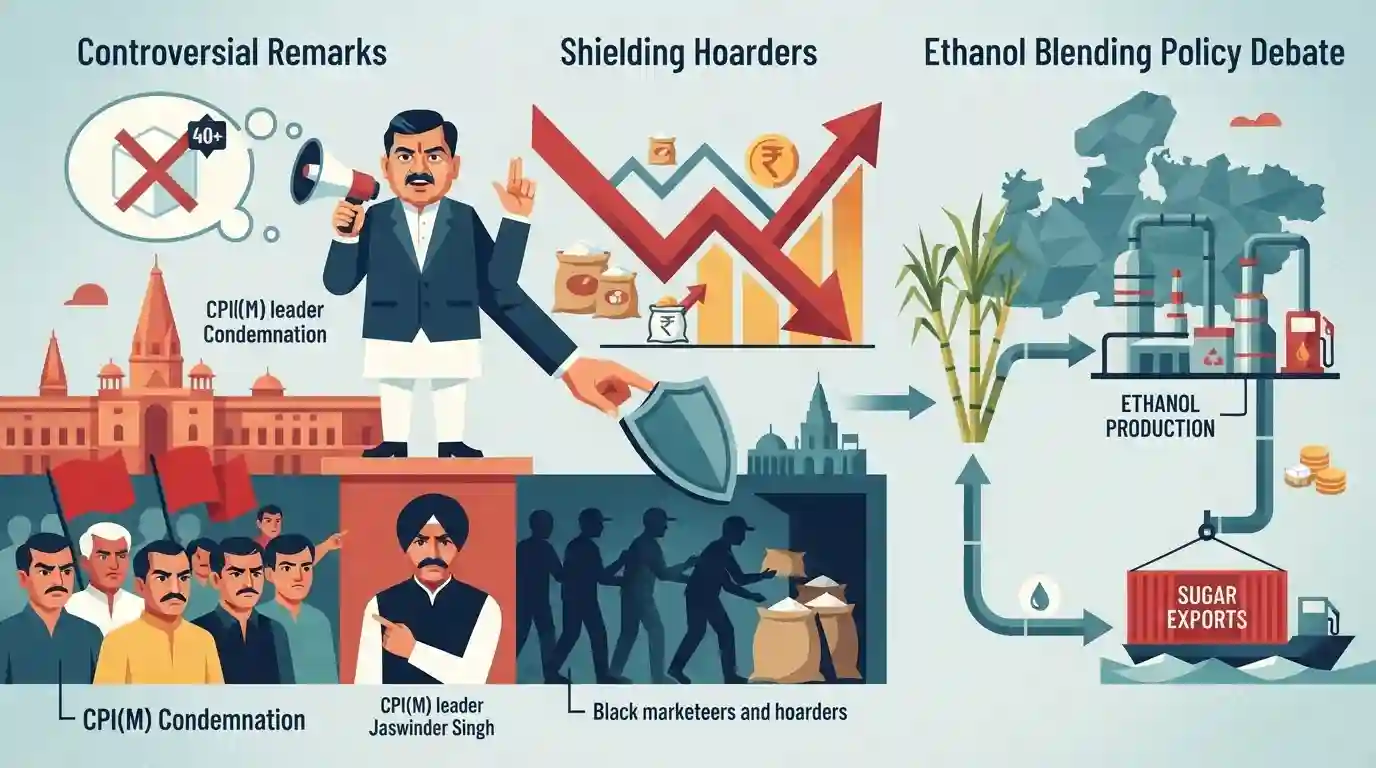
The Communist Party of India (Marxist) strongly condemned Madhya Pradesh Minister Kailash Vijayvargiya's controversial remarks that sugar should become prohibitively expensive and people above 40 should stop consuming it. CPI(M) leader Jaswinder Singh labeled the statement 'insensitive' and accused the BJP-led state government of shielding black marketeers and hoarders. The controversy also highlighted the political debate over inflation, with the opposition blaming the government's ethanol blending policy and sugar exports for rising prices.
Key Points
- Madhya Pradesh Minister Kailash Vijayvargiya sparked controversy by suggesting that sugar should become very expensive and individuals over 40 should stop consuming it.
- CPI (M) state secretary Jaswinder Singh condemned the remarks as insensitive, alleging they expose the BJP government's protection of black marketeers and hoarders.
- The opposition attributes soaring sugar prices to the government's push for ethanol blending in petrol and large-scale exports, whereas the ruling establishment often blames the industry.
Important Terms
CPI (M)

The Communist Party of India (Marxist) is a left-wing, Marxist-Leninist national political party in India, formed in 1964 following a split in the CPI. It advocates for democratic socialism and anti-imperialism.
UPSC context
GS Paper 2 (Polity); essential for understanding India's multi-party system, left-wing political ideologies, and the role of opposition in policy debates.
Bharatiya Janata Party (BJP)
The Bharatiya Janata Party is India's current ruling right-wing national political party, founded in 1980. Rooted in the Bharatiya Jana Sangh, it champions Hindutva, cultural nationalism, and market-oriented economic policies.
UPSC context
GS Paper 2 (Polity); crucial for analyzing the current ruling party's policies, government initiatives, and India's evolving political landscape.
Indian National Congress (Congress)
The Indian National Congress, founded in 1885, is a major center-left national political party in India. It led the independence movement and advocates for democratic socialism, secularism, and social justice.
UPSC context
GS Paper 1 (History) & GS Paper 2 (Polity); vital for topics on the freedom struggle and post-independence Indian political dynamics.
Ethanol Blending Programme
A central government initiative that mixes ethanol—primarily sourced from sugarcane or food grains—with petrol. It aims to reduce imported crude oil dependence, lower carbon emissions, and support agricultural incomes.
UPSC context
GS Paper 3 (Economy & Environment); tests knowledge of renewable energy policies, agricultural impacts, and commodity inflation drivers.
Kailash Vijayvargiya
A prominent Bharatiya Janata Party leader and Cabinet Minister in the Madhya Pradesh state government, currently holding key portfolios including Urban Development & Housing and Parliamentary Affairs.
UPSC context
MP State Specific (GS Paper 2); relevant for state politics, current cabinet ministers, and recent regional governance controversies.
Prelims Trap
"The Fair and Remunerative Price (FRP) for sugarcane is approved by the Commission for Agricultural Costs and Prices (CACP)."
The CACP only recommends the FRP. The actual statutory approval and announcement are done by the Cabinet Committee on Economic Affairs (CCEA).
Static Concepts Connected
What are the key facts about the sugar industry in Madhya Pradesh?
- First Mill: The state's first sugar mill was set up in Jaora (Ratlam district) in 1934.
- Major Hubs: Narsinghpur is the largest producer of sugarcane in MP, with the industry concentrated largely in the Narmada valley and Malwa plateau.
- Economic Impact: It is a critical agro-based cash crop supporting both crystalline sugar production and the emerging ethanol fuel industry.
What are the targets and mechanisms of India's Ethanol Blending Programme (EBP)?
- E20 Target: The Government advanced the target of achieving 20% ethanol blending in petrol (E20) to the Ethanol Supply Year 2025-26.
- Feedstock: Production relies heavily on sugarcane juice, B-heavy molasses, and surplus or damaged food grains like maize and rice.
- Nodal Agency: The Ministry of Petroleum and Natural Gas (MoPNG) coordinates the program to reduce crude import dependence.
Cross-Topic Patterns
Energy Security vs Food Inflation
The trade-off between energy security (E20 targets diverting sugarcane to ethanol) and domestic food inflation (sugar price rise) links agricultural policy directly to macroeconomic stability.
FRP vs SAP Federal Dynamics
While the Centre sets the FRP, states can declare State Advised Prices (SAP) for sugarcane, making sugar pricing a classic example of agricultural federalism and regional politics.

Expect a multi-statement Q on MP's agro-industries (like the 1934 Jaora mill) combined with the preponed 2025-26 E20 blending targets.
Linked PYQs · 2
Linked PYQs · 2
- 2020MPPSC_PRELIMSGS1
Which one of the following is not commercial crop?
- 2012MPPSC_PRELIMSGS1
Who among the following is the chairman of Madhya Pradesh Sports Council at present?
