ICMR Study Finds No Link Between COVID Vaccines and Heart Attacks
Source:The Hindu ↗
Why It Matters
Addresses a prominent public health concern/misinformation regarding COVID-19 vaccines while highlighting the institutional mechanisms (NP-NCD, NHM) in place to manage the growing burden of Non-Communicable Diseases (NCDs) in India. Relevant for GS2 (Health Policy) and GS3 (Science & Tech).
Summary
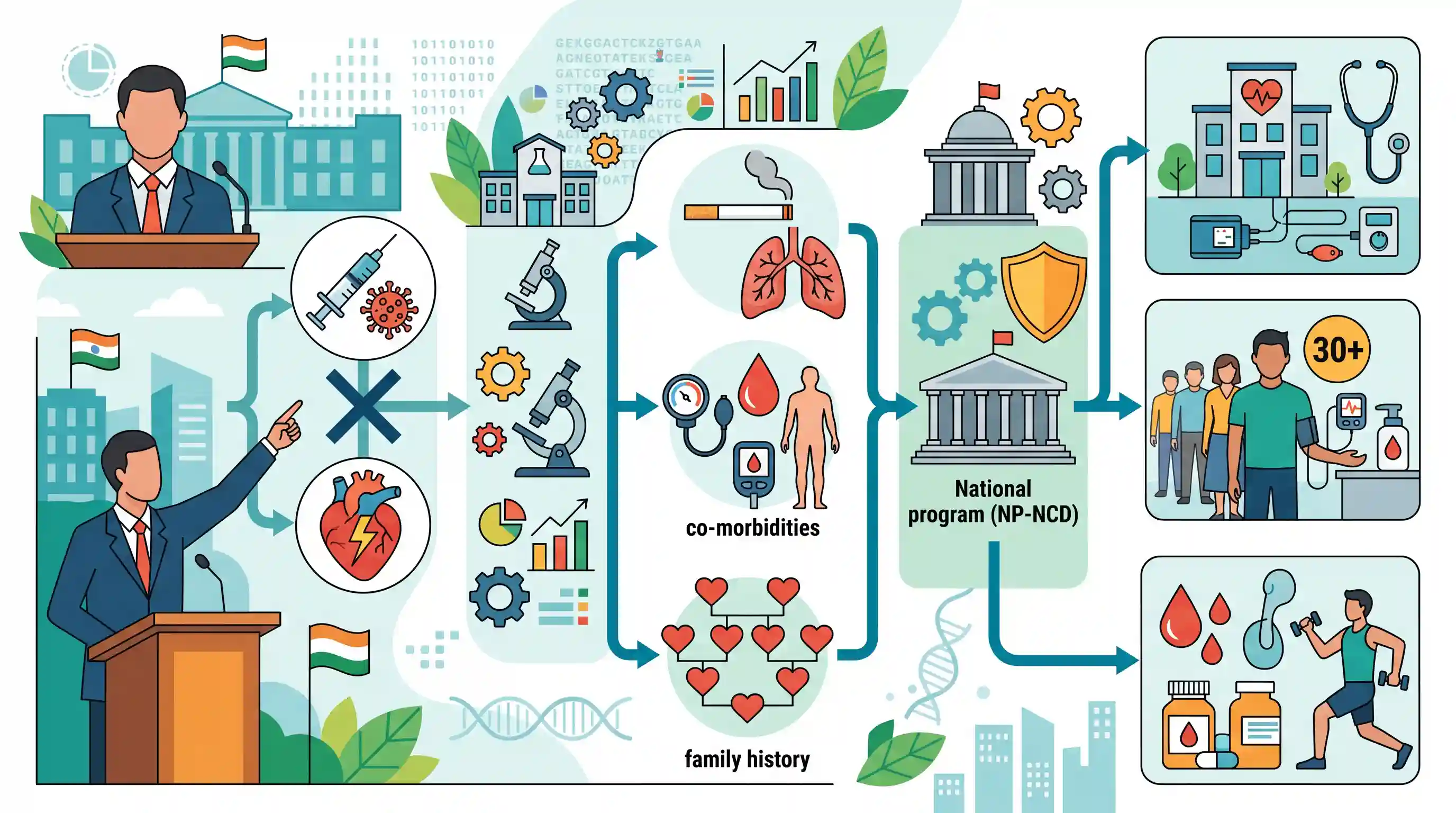
Union Health Minister J.P. Nadda informed the Lok Sabha that there is no scientific evidence linking COVID-19 vaccination to an increased risk of heart attacks. Citing a multi-centric matched case-control study by the ICMR-National Institute of Epidemiology on Acute Myocardial Infarction (AMI) in adults aged 18-45, he clarified that AMI is predominantly associated with co-morbidities, smoking, and family history. The minister also highlighted the government's initiatives for cardiovascular health, which is addressed under the National Programme for Prevention and Control of Non-Communicable Diseases (NP-NCD) as part of the National Health Mission (NHM). This involves setting up specialized clinics and conducting population-based screenings for individuals over 30 to manage prevalent NCDs like diabetes and hypertension.
Key Points
- Health Minister J.P. Nadda clarified in the Lok Sabha that COVID-19 vaccines have no link to an increased risk of heart attacks.
- An ICMR-NIE matched case-control study investigated Acute Myocardial Infarction (AMI) in young patients (18-45 years) and found no association with vaccination.
- AMI cases were instead linked to co-morbidities, smoking, and family history of thrombotic events.
- Cardiovascular diseases and other lifestyle ailments are tackled under the National Programme for Prevention and Control of Non-Communicable Diseases (NP-NCD).
- The National Health Mission (NHM) runs population-based screening for common NCDs (like diabetes and hypertension) for individuals above 30 years old.
Important Terms
National Programme for Prevention and Control of Non-Communicable Diseases (NP-NCD)

A government initiative focusing on infrastructure, screening, and management of chronic diseases like cancer, diabetes, and cardiovascular conditions. It was recently renamed from NPCDCS to cover a broader NCD spectrum.
UPSC context
GS Paper II (Social Justice/Health). Relevant for government schemes and managing India's shifting disease burden.
National Health Mission (NHM)
India's flagship health program (subsuming NRHM and NUHM) that aims to provide universal access to equitable, affordable, and quality healthcare through infrastructure and human resource strengthening.
UPSC context
GS Paper II (Governance). Fundamental framework for public health delivery and welfare interventions.
Indian Council of Medical Research (ICMR)
The apex body in India for formulating, coordinating, and promoting biomedical research, functioning under the Department of Health Research, Ministry of Health and Family Welfare.
UPSC context
GS Paper III (S&T). Essential for understanding India's institutional framework for medical R&D and health crisis management.
National Institute of Epidemiology (ICMR-NIE)
A permanent institute of ICMR based in Chennai, focusing on epidemiological research, public health investigations, and training to support national health policy.
UPSC context
GS Paper III (S&T/Health). Relevant for specialized institutional roles in public health and disease surveillance.
Lok Sabha
The lower house of India's Parliament, composed of directly elected representatives. It serves as the primary forum for holding the executive accountable through questions and debates.
UPSC context
GS Paper II (Polity). Central to parliamentary democracy, legislative procedures, and executive responsibility.
Prelims Trap
Population-based screening under the NP-NCD scheme is conducted for all citizens starting from 18 years of age.
UPSC frequently alters age and eligibility criteria in scheme-based questions. Under NHM, population-based screening for common NCDs strictly targets individuals aged 30 and above.
Static Concepts Connected
What is the NP-NCD scheme and its core focus areas?
- Core Focus: Aims to prevent and control major non-communicable diseases: Cardiovascular Diseases (CVDs), Cancers, Chronic Respiratory Diseases, and Diabetes.
- Implementation Mechanism: Operates under the National Health Mission (NHM), establishing specialized NCD clinics at District and Community Health Centre (CHC) levels.
- Screening Target: Mandates population-based screening for common lifestyle diseases specifically targeting individuals aged 30 years and older.
What causes an Acute Myocardial Infarction (AMI)?
- Mechanism: Occurs due to the abrupt reduction or complete cessation of blood supply to the heart muscle (ischemia), leading to cellular death.
- Primary Triggers: In younger populations, it is strongly associated with lifestyle factors like smoking, hypertension, diabetes, and family history of thrombotic events.
Cross-Topic Patterns
Vaccine Misinformation & Infodemics (GS3)
Debunking vaccine-heart attack linkages illustrates the "infodemic" challenge, bridging GS2 public health initiatives with GS3 internal security and social media regulation.
Evidence-Based Parliamentary Accountability
The Health Minister citing ICMR's matched case-control study data in the Lok Sabha perfectly exemplifies evidence-based policymaking and executive accountability to the legislature.

Expect a multi-statement Prelims question linking NP-NCD screening rules (age 30+) with India's rising lifestyle disease burden.
Linked PYQs · 3
Linked PYQs · 3
- 2022MainsGS3
What is the basic principle behind vaccine development ? How do vaccines work? What approaches were adopted by the Indian vaccine manufacturers to produce COVID-19 vaccines ?
- 2021MainsGS2
“Besides being a moral imperative of a Welfare State, primary health structure is a necessary precondition for sustainable development.” Analyze.
- 2020MainsGS2
In order to enhance the prospects of social development, sound and adequate health care policies are needed particularly in the fields of geriatric and maternal health care. Discuss.
