Tenth Schedule Anti Defection Loopholes and Judicial Time Limits
Source:The Hindu ↗
Why It Matters
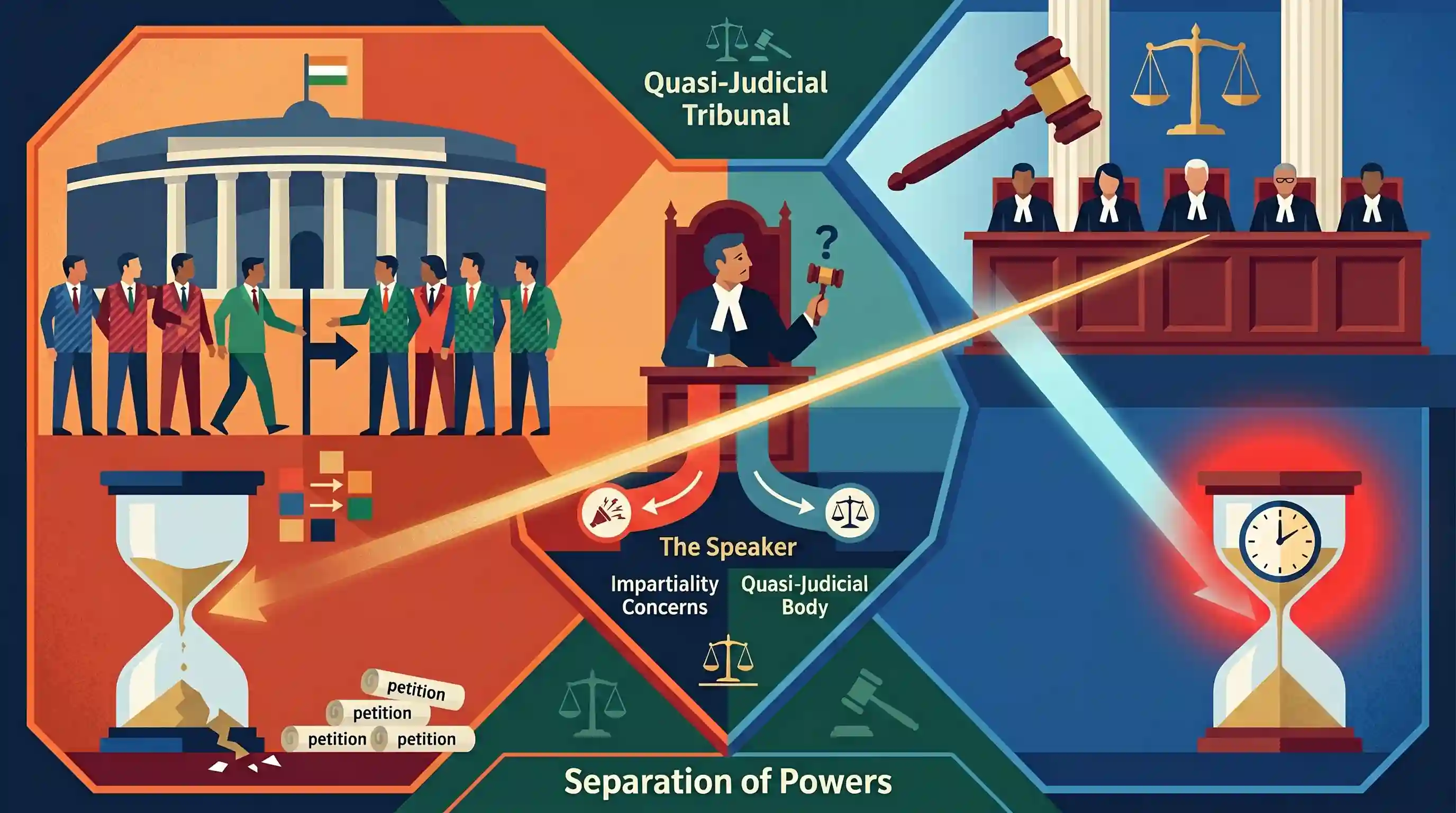
The article highlights a chronic loophole in the anti-defection framework: the lack of a time limit for Speakers to decide disqualification petitions, which is often exploited for political gain. It is highly relevant for GS-2 Polity questions surrounding the Speaker's impartiality, the effectiveness of the Tenth Schedule, and the limits of judicial review over legislative proceedings (echoing debates from the Kihoto Hollohan case).
Summary
The Supreme Court has expressed strong disapproval of legislative Speakers delaying decisions on disqualification petitions under the Tenth Schedule (anti-defection law). Hearing a case involving alleged defections of Bharat Rashtra Samithi (BRS) MLAs to the Congress in Telangana, a Bench led by Justice B.R. Gavai emphasized the Court's power and constitutional duty to ensure the anti-defection law is not rendered a mockery. Discontent with the failure of Speakers to adhere to previous judgments that advised deciding petitions within a "reasonable time," the Court announced its intention to establish a binding, definitive time limit for such adjudications. The case underscores persistent concerns regarding the political impartiality of the Speaker in acting as a quasi-judicial tribunal.
Key Points
- The Supreme Court asserted its duty to prevent the Tenth Schedule (anti-defection law) from being reduced to a "mockery" due to deliberate delays by legislative Speakers.
- A Bench led by Justice B.R. Gavai indicated the Court will lay down a strict, definitive time limit for Speakers to decide on disqualification petitions.
- The observations came during a hearing concerning the Telangana Assembly Speaker's delay in adjudicating disqualification pleas against BRS MLAs who allegedly defected to Congress.
- The Court noted that earlier rulings mandating a "reasonable time" (typically three months as per the Keisham Meghachandra Singh judgment) are often flouted.
Important Terms
Tenth Schedule

Introduced by the 52nd Amendment Act (1985), it provides for the disqualification of legislators (MPs/MLAs) on grounds of defection to prevent political instability and ensure party discipline.
UPSC context
GS Paper II (Polity); critical for understanding the legal framework governing political defections and legislative stability.
Anti-defection law
Legislation aimed at curbing opportunistic floor-crossing by elected members; strengthened by the 91st Amendment (2003) which increased the merger threshold to two-thirds of party members.
UPSC context
GS Paper II; tests knowledge of constitutional amendments and the evolution of parliamentary democracy in India.
Quasi-Judicial Tribunal
The legal status of the Speaker/Chairman when adjudicating disqualification petitions under the Tenth Schedule, requiring them to follow principles of natural justice and impartiality.
UPSC context
GS Paper II (Governance); highlights the separation of powers and the adjudicatory role of legislative presiding officers.
Judicial Review
The power of constitutional courts to examine the Speaker’s final decision under the Tenth Schedule for mala fide intent, perversity, or violation of constitutional mandates.
UPSC context
GS Paper II; concerns the checks and balances between the judiciary and the legislature.
Kihoto Hollohan Judgment
The 1992 Supreme Court ruling that upheld the Tenth Schedule's validity but declared the Speaker's decisions subject to judicial review, as they function as a tribunal.
UPSC context
GS Paper II; a landmark case often cited in questions regarding the Speaker's powers and judicial oversight.
Keisham Meghachandra Singh Case
A 2020 Supreme Court ruling that advised Speakers to decide disqualification petitions within a 'reasonable time' (suggested 3 months) to prevent subversion of the law.
UPSC context
GS Paper II; relevant for discussing reforms in the anti-defection framework and timely adjudication.
Prelims Trap
The Constitution mandates a three-month time limit for the Speaker to decide disqualification petitions under the Tenth Schedule.
The three-month limit is a Supreme Court guideline from the Keisham Meghachandra case (2020), not a Constitutional provision. The Constitution prescribes no time limit.
Static Concepts Connected
How does the Kihoto Hollohan judgment define the Speaker's Tenth Schedule powers?
- Quasi-Judicial Role: When deciding defection cases under the Tenth Schedule, the Speaker or Chairman acts as a statutory tribunal.
- Judicial Review: The Speaker's final decision is subject to judicial review on grounds like mala fides, perversity, or violation of constitutional mandates.
- Timing of Intervention: Courts generally cannot intervene or issue injunctions before the Speaker gives a final decision, except in cases of indefinite delay.
What are the current valid exemptions under the Tenth Schedule?
- Two-Thirds Merger: Disqualification does not apply if an original political party merges with another, and at least two-thirds of the legislative party members agree to the merger.
- Presiding Officers: A member elected as Speaker or Chairman can voluntarily give up party membership without being disqualified, provided they rejoin the party after their tenure.
Cross-Topic Patterns
Separation of Powers & Tribunalisation
The SC's push to establish an independent tribunal for defections highlights the ongoing friction between legislative privilege, tribunalisation, and the need for impartial justice mechanisms.
Discretionary Delays by Constitutional Authorities
The issue of "unreasonable delay" by Speakers closely parallels recent Supreme Court interventions regarding Governors indefinitely withholding assent to State Bills under Article 200.

Expect a 2026 Prelims statement linking the Nabam Rebia and Keisham judgments to the Speaker's discretionary powers and judicial review.
Linked PYQs · 4
Linked PYQs · 4
- 2025PrelimsGS1
Consider the following statements : I. If any question arises as to whether a Member of the House of the People has become subject to disqualification under the 10th Schedule, the President's decision in accordance with the opinion of the Council of Union Ministers shall be final. II. There is no mention of the word 'political party' in the Constitution of India. Which of the statements given above is/are correct?
- 2020MainsGS2
Once a Speaker, Always a Speaker' ! Do you think this practice should be adopted to impart objectivity to the office of the Speaker of Lok Sabha ? What could be its implications for the robust functioning of parliamentary business in India?
- 2019MainsGS2
On what grounds a people's representative can be disqualified under the Representation of Peoples Act, 1951? Also mention the remedies available to such person against his disqualification.
- 2016MainsGS2
What is a quasi-judicial body? Explain with the help of concrete examples.
