Rural health service cadre directive and right to health
Source:Indian Express ↗
Why It Matters
This case illustrates the practical application of the Right to Health under Article 21 and the ongoing challenges in providing adequate healthcare to rural populations. It also provides a clear example of center-state legislative conflicts (federal supremacy), where a state act was struck down for encroaching on central domain (Indian Medical Council Act).
Summary
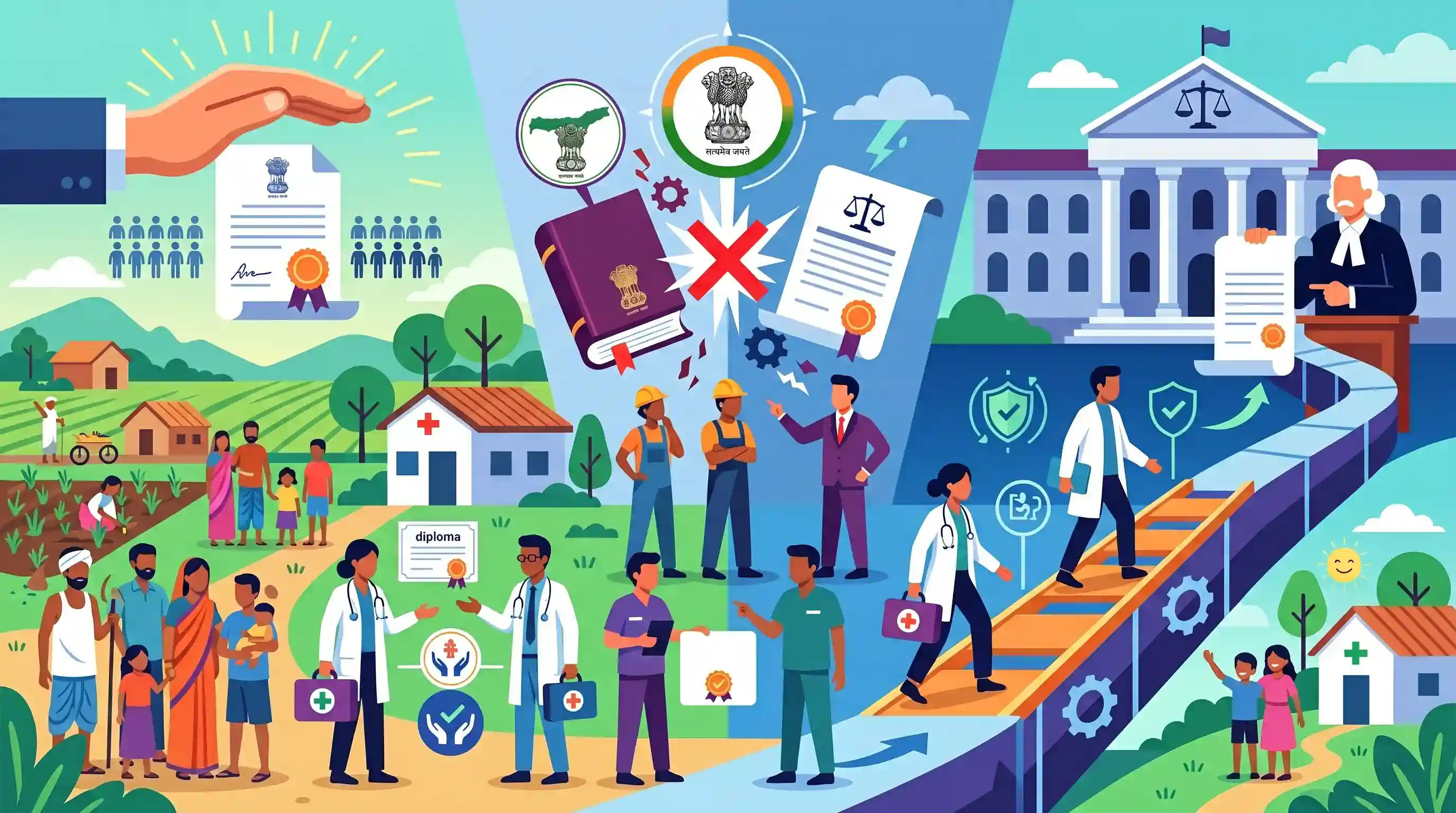
The Gauhati High Court has ordered the Assam government to create a permanent service cadre for rural health professionals holding a Diploma in Medicine and Rural Health Care (DMRHC). Highlighting the fundamental Right to Health under Article 21 of the Constitution, the court noted the critical need for qualified healthcare workers to serve India's 930 million rural residents. The legal dispute stems from the Assam Rural Health Regulatory Authority (ARHRA) Act, 2004, which was struck down in 2014 due to its conflict with the central Indian Medical Council Act, 1956. The state's subsequent attempt to re-categorize these practitioners as paramedical staff was challenged, leading the court to mandate better structural integration and job protection for them to fulfill the state's public healthcare obligations.
Key Points
- The Gauhati High Court directed the Assam government to establish a permanent service cadre for professionals holding a Diploma in Medicine and Rural Health Care (DMRHC).
- The court emphasized that the right to health is an integral part of the right to life guaranteed under Article 21 of the Constitution.
- The ARHRA Act of 2004, which initially created these rural health practitioners, was struck down in 2014 because it conflicted with the central Indian Medical Council Act, 1956.
- The state subsequently reclassified these practitioners as paramedical personnel through the Assam Community Health Officer Act, prompting them to challenge the downgrading of their status.
- The judgment underscores the acute need to secure rural health human resources to cater to the approximately 930 million citizens residing in rural India.
Important Terms
Right to Health (Article 21)

A judicially recognized fundamental right interpreted as an integral part of the Right to Life under Article 21, mandating state-provided medical facilities.
UPSC context
GS II: Constitution/Polity; essential for judicial activism and Directive Principles (Article 47) analysis.
Assam Rural Health Regulatory Authority (ARHRA) Act, 2004
Assam state legislation that created a 3.5-year diploma (DMRHC) to address rural doctor shortages; later struck down for infringing on central legislative powers.
UPSC context
GS II: Federalism; case study on legislative competence conflicts between Union and State lists.
Indian Medical Council Act, 1956
The central law (now replaced by the National Medical Commission Act, 2019) that regulated medical education and professional standards in India.
UPSC context
GS II: Governance/Statutory Bodies; critical for understanding central oversight of professional standards.
Legislative Competence
The constitutional authority of Union or State legislatures to enact laws based on subjects listed in the Seventh Schedule.
UPSC context
GS II: Federal Structure; deals with Entry 66 (Union) vs. Entry 25 (Concurrent) disputes.
Rural Health Practitioners (RHPs)
Diploma in Medicine and Rural Health Care (DMRHC) holders authorized to provide basic allopathic treatment in rural Assam.
UPSC context
GS II: Social Justice/Health; relates to mid-level healthcare providers and universal health coverage.
Indian Medical Association (IMA)
A national professional body of modern medicine doctors that challenged the ARHRA Act to protect standardized medical qualifications.
UPSC context
GS II: Pressure Groups; significant for its role in healthcare policy and professional standard litigation.
Prelims Trap
Public health and sanitation is a Concurrent List subject, allowing both Centre and States to legislate on it.
Public health is purely a State List subject (Entry 6). The Centre regulates medical professions and education via the Concurrent List (Entry 26), which caused the legislative conflict in this Assam case.
Static Concepts Connected
What is the Doctrine of Repugnancy under Article 254?
- Constitutional Mechanism: It resolves legislative conflicts between Central and State laws on Concurrent List subjects.
- Central Supremacy: If a State law contradicts a Central law, the Central law prevails, and the State law becomes void to the extent of its repugnancy.
- Presidential Assent Exception: A repugnant State law can prevail within that specific State only if it was reserved for, and received, the President's assent.
How is 'Health' constitutionally positioned in India?
- Fundamental Rights: The Supreme Court has expansively interpreted the Right to Health as an implicit fundamental right under Article 21 (Right to Life).
- DPSP: Article 47 mandates the State to raise the level of nutrition, standard of living, and improve public health as a primary duty.
- Seventh Schedule: 'Public health and sanitation' is in the State List (Entry 6), while 'Medical professions' is in the Concurrent List (Entry 26).
Cross-Topic Patterns
Seventh Schedule friction in Healthcare
States control "public health" (State List), but the Centre regulates "medical education/professions" (Concurrent List). This dichotomy frequently causes jurisdictional clashes, as seen in NEET controversies and the Assam ARHRA Act repeal.
Intermediate cadres for Rural Health
India's chronic rural doctor shortage connects this judgment directly to the National Health Mission's deployment of Community Health Officers (CHOs) and the creation of intermediate medical cadres to achieve Universal Health Coverage.

Expect a 2026 prelims question testing the exact 7th Schedule entries for public health vs. medical professions alongside Article 254.
Linked PYQs · 3
Linked PYQs · 3
- 2023MainsGS2
“The Constitution of India is a living instrument with capabilities of enormous dynamism. It is a constitution made for a progressive society.” Illustrate with special reference to the expanding horizons of the right to life and personal liberty.
- 2019MainsGS2
From the resolution of contentious issues regarding distribution of legislative powers by the courts, 'Principle of Federal Supremacy' and 'Harmonious Construction' have emerged. Explain.
- 2023MainsGS2
The crucial aspect of development process has been the inadequate attention paid to Human Resource Development in India. Suggest measures that can address this inadequacy.
