Minority Educational Institutions Data and Curriculum Reforms
Source:The Hindu ↗
ఇది ఎందుకు ముఖ్యం
The article provides critical data on minority educational institutions (e.g., student demographics and institutional counts) useful for GS2 answers on minority rights and education. It also connects the broader goals of NEP 2020—such as curriculum reform, AI integration, and entrepreneurial skill development—to real-world implementation in higher educational institutions.
సారాంశం
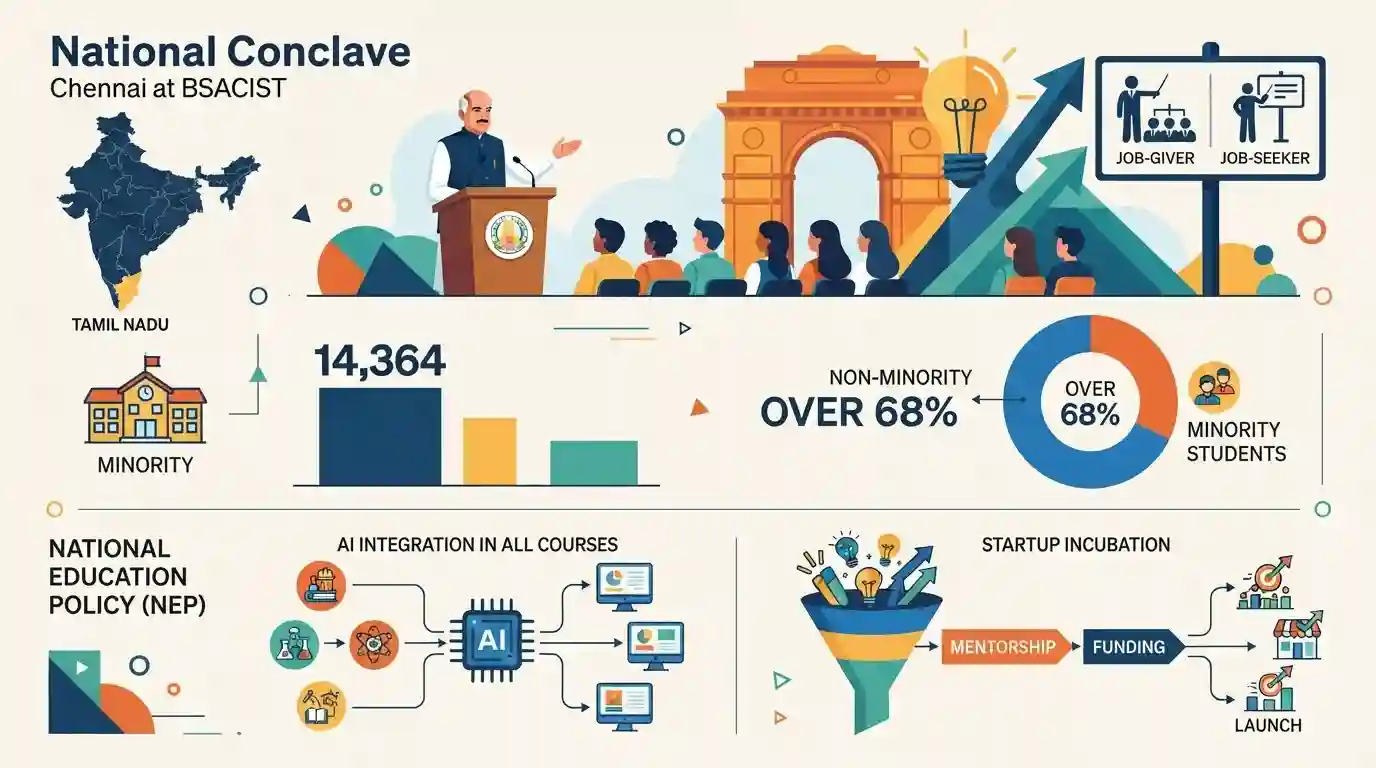
Speaking at a national conclave hosted at BSACIST in Chennai, Tamil Nadu Governor Rajendra Vishwanath Arlekar urged educational institutions to embed the nation's cultural ethos into their curricula and foster an entrepreneurial spirit to create 'job-givers' instead of 'job-seekers'. The event focused on the role of minority educational institutions in nation-building, with NCMEI Member Shahid Akhter noting that 14,364 such institutions exist nationwide, catering predominantly (over 68%) to students from non-minority communities. Discussions also showcased the practical application of the National Education Policy's vision through the integration of AI in all courses and robust startup incubation efforts.
ముఖ్య అంశాలు
- Tamil Nadu Governor emphasized integrating the country's cultural ethos into institutional curricula and transitioning the focus from producing job-seekers to creating job-givers through entrepreneurship development.
- The NCMEI has granted minority educational institution status to 14,364 institutions across India.
- Data collected from sources like the NCPCR shows that over 68% of students studying in minority educational institutions belong to non-minority communities.
- Modern academic adaptations highlighted at the conclave included mandatory entrepreneurship courses for students and the integration of Artificial Intelligence (AI) across various disciplines, such as pharma, law, and architecture.
- Incubation centers in minority institutions are actively contributing to startup ecosystems; BSACIST alone has incubated 158 startups valued at ₹3,200 crore, generating over 1,000 jobs.
ముఖ్యమైన పదాలు
National Commission for Minority Educational Institutions (NCMEI)

A statutory body established under the NCMEI Act, 2004, to safeguard the educational rights of religious minorities in India (Article 30(1)) and resolve disputes regarding minority status and affiliation.
UPSC context
GS Paper II: Polity & Governance (Statutory Bodies). Tests knowledge of constitutional rights (Article 30) and welfare mechanisms for minorities.
National Commission for Protection of Child Rights (NCPCR)
A statutory body established under the CPCR Act, 2005, tasked with protecting child rights and monitoring key child-centric laws like POCSO, RTE, and the JJ Act.
UPSC context
GS Paper II: Social Justice. Tests understanding of institutional mechanisms protecting child rights and statutory oversight of social welfare legislations.
Viksit Bharat @ 2047
The Government of India's long-term roadmap to transform the country into a developed nation by 2047, focusing on economic growth, social equity, modernization, and sustainable development.
UPSC context
GS Paper III: Economic Development. Tests familiarity with national development goals, macro-economic projections, and socio-economic transformation pathways.
ప్రిలిమ్స్ ఉచ్చు
Minority educational institutions are constitutionally bound to implement the 25% reservation for EWS students under the RTE Act.
The Supreme Court in the Pramati case (2014) declared the RTE Act inapplicable to both aided and unaided minority institutions to preserve Article 30 rights.
అనుసంధానమైన స్థిర భావనలు
What constitutional rights protect Minority Educational Institutions (MEIs) under Article 30?
- Establish and Administer: Guarantees religious and linguistic minorities the right to establish and administer educational institutions of their choice.
- Non-discriminatory Aid: Ensures the State does not discriminate in granting aid to any educational institution managed by a minority.
- RTE Exemption: Exempts both aided and unaided minority institutions from the 25% reservation mandate for economically weaker sections.
What is the status and composition of the NCMEI?
- Statutory Status: Established as a statutory, quasi-judicial body under the NCMEI Act of 2004 to safeguard educational rights of minorities.
- Composition: Consists of a Chairperson (who must be a retired High Court Judge) and two members nominated by the Centre.
- Judicial Powers: Vested with civil court powers to decide minority status disputes and address affiliation grievances of MEIs.
అంతర-అంశ నమూనాలు
MEI Autonomy vs. RTE Mandate
Balancing Article 30 rights with Article 21A's universal education goals, particularly when minority institutions serve high percentages of non-minority students.
NEP 2020 and Demographic Dividend
Integrating entrepreneurship and AI in higher education addresses structural unemployment by transforming job-seekers into job-creators.

UPSC may test Article 30 exemptions (RTE, reservation) alongside NCMEI's statutory powers in a multi-statement Polity question.
అనుసంధాన PYQలు · 3
అనుసంధాన PYQలు · 3
- 2023MainsGS2
Skill development programmes have succeeded in increasing human resources supply to various sectors. In the context of the statement analyse the linkages between education, skill and employment.
- 2021MainsGS2
“Earn while you learn' scheme needs to be strengthened to make vocational education and skill training meaningful.” Comment.
- 2020MainsGS2
National Education Policy 2020 is in conformity with the Sustainable Development Goal-4 (2030). It intends to restructure and reorient education system in India. Critically examine the statement.
