Uttarakhand launches Har Ghar Tiranga Yatra for Amrit Kaal
Source:deccan-chronicle ↗
Why It Matters
The article touches upon important state and central government cultural and developmental campaigns (Har Ghar Tiranga, Make in India). For UKPSC, tracking the 150th anniversary of 'Vande Mataram' is crucial as milestone anniversaries of historical elements often translate directly into Prelims questions.
Summary
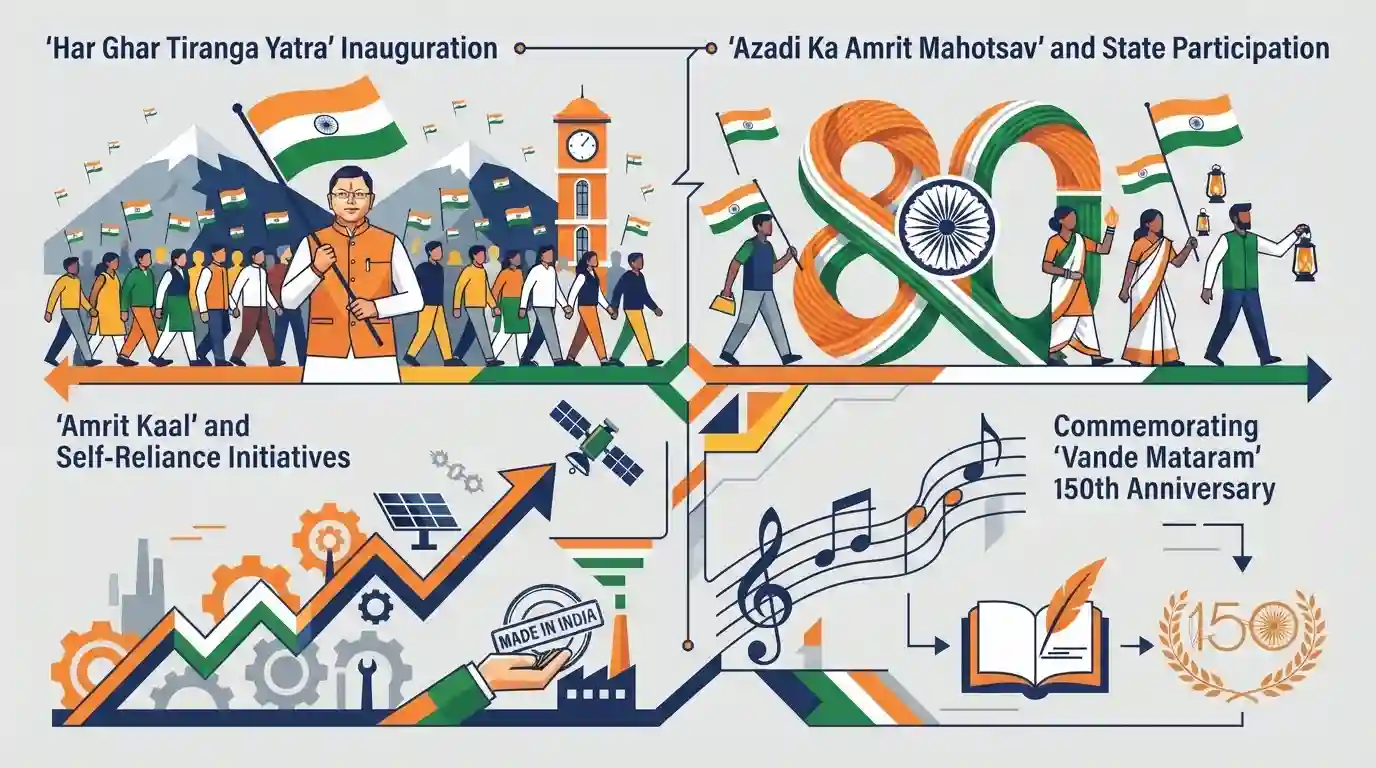
Uttarakhand Chief Minister Pushkar Singh Dhami inaugurated the 'Har Ghar Tiranga Yatra' in Dehradun, emphasizing the state's active participation in the 'Azadi Ka Amrit Mahotsav'. Dhami highlighted that India is advancing through its 'Amrit Kaal' towards complete self-reliance through initiatives like 'Make in India' and 'Aatmanirbhar Bharat'. Crucially, he noted that the 80th Independence Day marks the beginning of the 150th anniversary commemorations for India's national song, 'Vande Mataram'.
Key Points
- Uttarakhand CM Pushkar Singh Dhami flagged off the 'Har Ghar Tiranga Yatra' in Dehradun, urging citizens to hoist the national flag at their homes.
- He stated that India is currently progressing through an 'Amrit Kaal' to emerge as a fully developed, self-reliant nation under 'Make in India'.
- The Chief Minister highlighted that the upcoming 80th Independence Day also initiates the commemoration of 150 years of the national song, 'Vande Mataram'.
- The Tiranga Yatra is part of the broader 'Azadi Ka Amrit Mahotsav' campaign celebrating India's independence and cultural heritage.
Important Terms
Azadi Ka Amrit Mahotsav

A government initiative celebrating 75 years of India's independence, showcasing the nation's socio-cultural, political, and economic progress while honoring its history and unsung heroes.
UPSC context
Relevant to GS Paper 1 and 2, highlighting citizen engagement (Jan Bhagidari) and cultural heritage in national commemorations.
Make in India
An initiative launched in 2014 to boost the domestic manufacturing sector, attract foreign direct investment, and create jobs, aiming to transform India into a global manufacturing hub.
UPSC context
Crucial for GS Paper 3 (Indian Economy), focusing on industrial policy, economic growth, and the structural shift toward domestic manufacturing.
Har Ghar Tiranga
A campaign encouraging citizens to bring the national flag home and hoist it, transforming a formal symbol into a personal expression of national pride and unity.
UPSC context
Relevant for GS Paper 2 (Governance) and Essay papers, testing national integration, fundamental duties, and civic participation.
Aatmanirbhar Bharat
The 'Self-Reliant India' vision launched in 2020, focusing on the economy, infrastructure, systems, demography, and demand to make the nation globally competitive without being protectionist.
UPSC context
Core to GS Paper 3 (Economy), testing economic resilience, domestic capacity building, and post-pandemic recovery strategies.
Prelims Trap
Vande Mataram was first publicly sung during the 1905 Swadeshi Movement by Bankim Chandra Chattopadhyay.
It was first publicly sung by Rabindranath Tagore at the 1896 Calcutta session of the Indian National Congress, though it later became the battle cry of the Swadeshi movement.
Static Concepts Connected
What are the historical origins and constitutional status of Vande Mataram?
- Origins: Composed by Bankim Chandra Chattopadhyay in the 1870s, it was featured prominently in his seminal 1882 novel Anandamath.
- First publicly sung: It was first sung at a political event by Rabindranath Tagore during the 1896 Calcutta session of the Indian National Congress.
- Constitutional status: The Constituent Assembly adopted it as the National Song on January 24, 1950, granting it equal status with the National Anthem, Jana Gana Mana.
What were the 2021 and 2022 amendments to the Flag Code of India (2002)?
- Materials allowed: The 2021 amendment permitted the use of machine-made and polyester flags, removing the strict restriction that required flags to be made only of hand-spun, hand-woven khadi, cotton, or silk.
- Display timings: The 2022 amendment allowed the National Flag to be displayed in the open or at a citizen's house day and night, replacing the previous sunrise-to-sunset rule.
Cross-Topic Patterns
Anandamath, Vande Mataram & Sannyasi Rebellion
The song's origin in the novel Anandamath naturally links to the Sannyasi Rebellion (1770s). UPSC frequently integrates literary milestones with 18th-century peasant and tribal uprisings in Prelims.
Har Ghar Tiranga & Fundamental Duties
Displaying the National Flag connects to Article 51A(a) (Fundamental Duties) and the Prevention of Insults to National Honour Act, blending cultural campaigns with core Constitutional obligations.

Expect a Prelims 2026 history question linking the 150th anniversary of Vande Mataram with Anandamath and the Sannyasi Rebellion.
Linked PYQs · 2
Linked PYQs · 2
- 2021UKPSC_PRELIMSGS1
When the Hindi version of National Anthem Jana-Gana-Mana was adopted by the Constituent Assembly of India ?
- 2025UKPSC_PRELIMSGS1
The craft products of the Uttarakhand state are sold by which brand name?
