IMO Carbon Free Shipping Framework and Climate Finance Delay
Source:The Hindu ↗
Why It Matters
Understanding the decarbonization of international shipping is crucial for evaluating global efforts to mitigate climate change. The postponement underlines the geopolitical tensions and economic hurdles involved in implementing cross-border climate finance mechanisms like a global carbon tax.
Summary
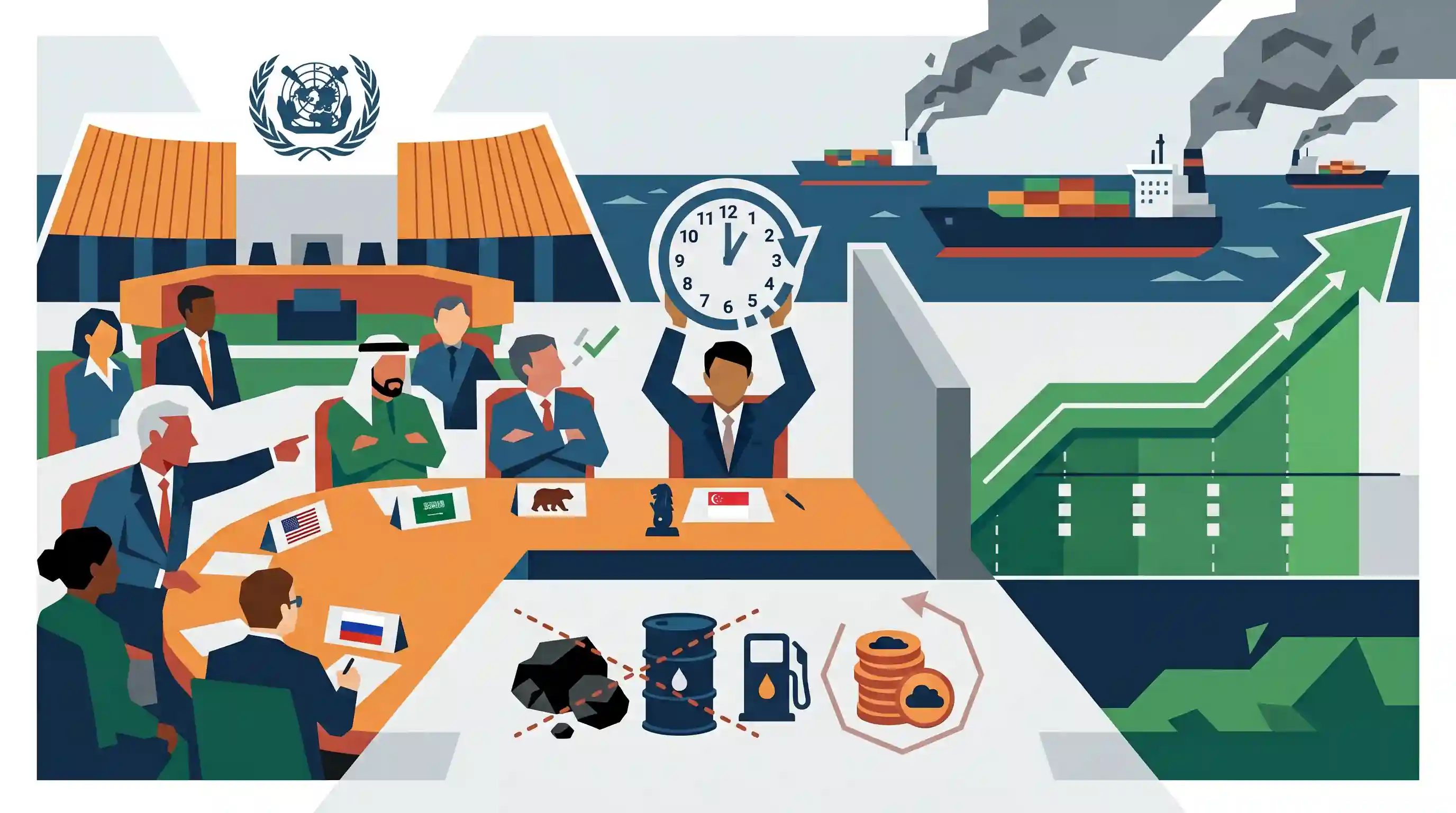
Member countries of the International Maritime Organization (IMO) voted to delay a strategic plan meant to phase out fossil fuels in the shipping industry and establish a global carbon tax. Amidst strong opposition and threats from the U.S., as well as resistance from Saudi Arabia and Russia, the adoption of the framework was delayed by 12 months based on a proposal by Singapore. The postponement deals a blow to the 2023 IMO GHG Strategy, which seeks to reduce carbon intensity by at least 40% by 2030 and achieve net-zero shipping emissions by 2050.
Key Points
- The International Maritime Organization (IMO) postponed a framework for new shipping fuel standards and a global carbon pricing mechanism to 2027.
- The delay was proposed by Singapore and backed by Saudi Arabia and Russia, following threats from U.S. President Donald Trump who vehemently opposed a global carbon tax.
- The 2023 IMO GHG Strategy aims for a minimum 40% reduction in international shipping\'s carbon intensity by 2030 and net-zero emissions by 2050.
- The emission regulations primarily target large ocean-going vessels over 5,000 gross tonnes, which generate about 85% of the shipping industry\'s emissions.
- Global shipping accounts for roughly 1.7% to 2.3% of total anthropogenic carbon dioxide emissions worldwide.
Important Terms
International Maritime Organization (IMO)

A specialized UN agency responsible for regulating global shipping safety, security, and the prevention of marine and atmospheric pollution from ships.
UPSC context
GS Paper II: International Organizations; GS Paper III: Environment and Infrastructure (Ports/Shipping). Essential for understanding global maritime governance.
2023 IMO GHG Strategy
A 2023 revised framework aiming for net-zero shipping emissions by 2050, with interim targets like reducing carbon intensity by 40% by 2030.
UPSC context
GS Paper III: Environment (Climate Change). Tests knowledge of sectoral decarbonization pathways and international environmental targets.
Marine Environment Protection Committee (MEPC)
The primary technical body of the IMO that considers matters related to the prevention and control of pollution from ships.
UPSC context
GS Paper III: Environment. Critical for understanding the specific forum where global maritime environmental laws are negotiated and voted.
Global Carbon Tax (Shipping)
A proposed market-based mechanism to charge ships for their CO2 emissions, incentivizing cleaner fuels and funding the maritime energy transition.
UPSC context
GS Paper III: Economic Development and Environment. Tests understanding of market-based instruments and India’s stance on international climate finance.
Carbon Intensity
A measure of the greenhouse gas emissions per unit of transport work (cargo carried and distance traveled), focused on vessel operational efficiency.
UPSC context
GS Paper III: Environment. A technical metric crucial for evaluating climate mitigation progress in the industrial and transport sectors.
MARPOL Convention
The main international convention covering the prevention of pollution of the marine environment by ships from operational or accidental causes.
UPSC context
GS Paper III: Environment. Key international agreement under which specific GHG regulations and fuel standards are implemented globally.
Prelims Trap
The IMO's Net-Zero Framework applies a mandatory carbon tax to all commercial shipping and fishing vessels globally.
The IMO regulations and proposed carbon pricing exclusively target large ocean-going vessels over 5,000 gross tonnes (responsible for 85% of emissions), not every single ship.
Static Concepts Connected
What is the mandate of the International Maritime Organization (IMO)?
- UN Specialized Agency: It is a specialized UN agency responsible for regulating the safety, security, and environmental performance of international shipping.
- MARPOL Convention: It enforces global marine environmental protections primarily through the MARPOL Convention, aiming to prevent pollution from ships.
How do Carbon Tax and Cap-and-Trade systems differ?
- Carbon Tax: Sets a direct, fixed price on carbon by defining a tax rate on greenhouse gas emissions or the carbon content of fossil fuels.
- Cap-and-Trade: Sets a strict limit (cap) on total aggregate emissions and allows industries to buy and sell limited emission allowances (trade) in a market.
Cross-Topic Patterns
Sectoral taxes vs. Border Carbon mechanisms
While the IMO attempts a unified global carbon tax for shipping, unilateral moves like the EU's Carbon Border Adjustment Mechanism (CBAM) create fragmented, trade-distorting carbon pricing for developing nations.
Green Hydrogen's maritime fuel linkages
Achieving the IMO’s 2050 net-zero shipping goal hinges heavily on adopting alternative fuels like green ammonia and green methanol, directly tying into India's National Green Hydrogen Mission.

Expect a multi-statement 2026 Prelims question comparing IMO's shipping targets with ICAO's aviation emission norms (CORSIA) and EU CBAM.
Linked PYQs · 3
Linked PYQs · 3
- 2024PrelimsGS1
According to the Environmental Protection Agency (EPA), which one of the following is the largest source of sulphur dioxide emissions?
- 2022MainsGS3
Discuss global warming and mention its effects on the global climate. Explain the control measures to bring down the level of greenhouse gases which cause global warming, in the light of the Kyoto Protocol, 1997.
- 2021MainsGS3
Describe the major outcomes of the 26th session of the Conference of the Parties (COP) to the United Nations Framework Convention on Climate Change (UNFCCC). What are the commitments made by India in this conference?
