Debate over making cancer a nationally notifiable disease in India
Source:The Hindu ↗
Why It Matters
This article highlights a critical policy divergence between the Centre and States regarding the classification of non-communicable diseases. It offers essential fodder for GS2 answers on public health governance, emphasizing how data deficits (such as the exclusion of private healthcare databases) hinder evidence-based planning. It also links demographic transitions (such as aging populations and geriatric care) to the rising burden of lifestyle diseases.
Summary
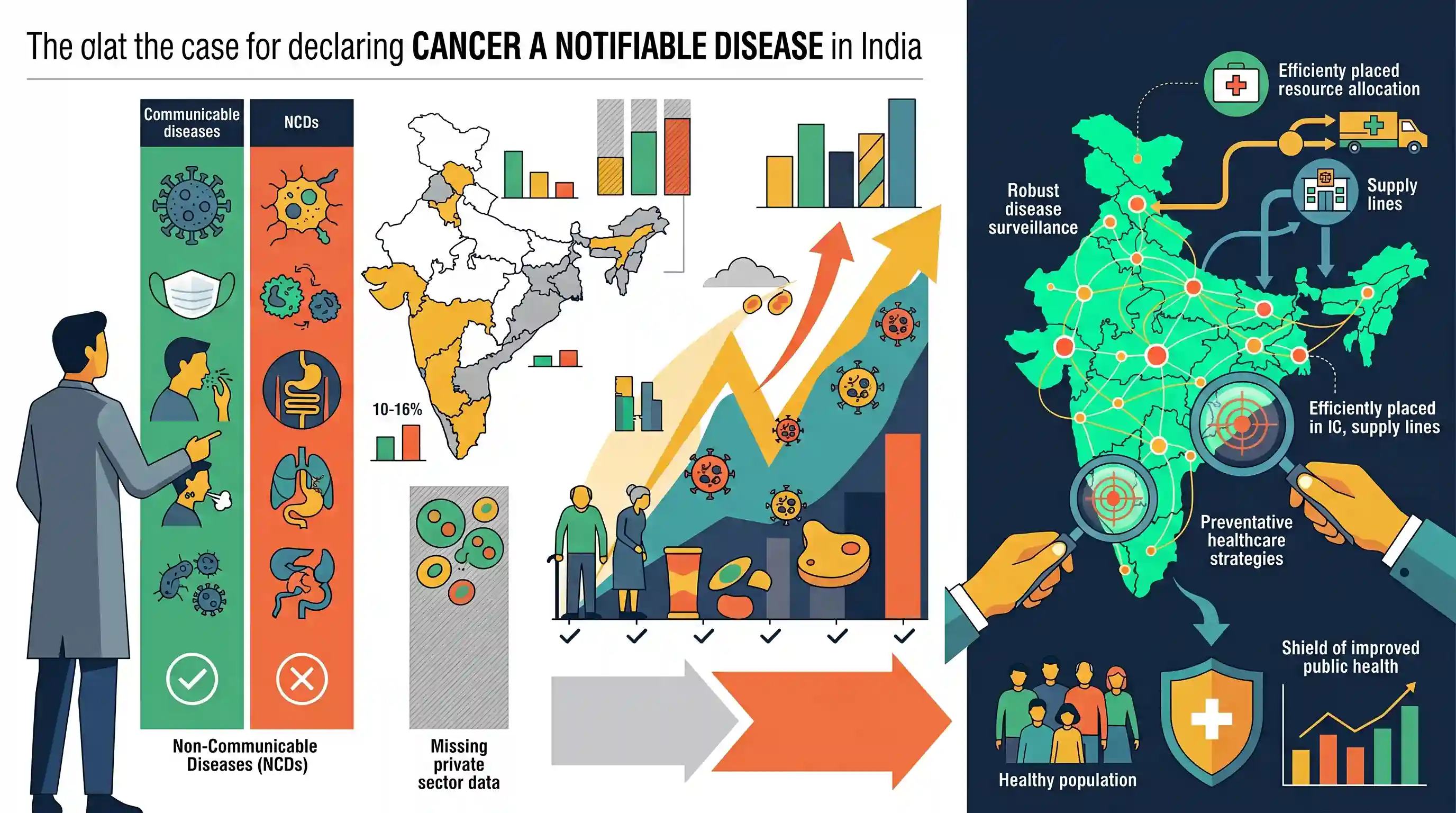
This article makes a strong public health case for declaring cancer a 'notifiable disease' at the national level in India. Although the Union Health Ministry reserves notification for communicable diseases, 17 states (including Telangana) have autonomously declared cancer notifiable. Currently, cancer registries cover only 10%-16% of the population, missing extensive private sector data. With WHO projecting a 74% increase in India's cancer cases by 2045 due to demographic and lifestyle changes, the article argues that comprehensive, mandatory notification is crucial for robust disease surveillance, resource allocation, and targeted preventative healthcare strategies.
Key Points
- In India, cancer is currently not a nationally notifiable disease because the Union Health Ministry maintains that such notification is reserved only for communicable diseases.
- Surveillance of cancer currently relies on population-based and hospital-based registries, which cover only 10%-16% of the population, suffering from a strong urban bias and failing to adequately capture the massive private healthcare sector where a significant volume of care is delivered.
- Seventeen states in India, with Telangana being the latest, have bypassed the national-level restriction and made cancer a notifiable disease within their jurisdictions.
- The Global Cancer Observatory (WHO) projects a 74% surge in India's cancer burden from 1.41 million cases in 2022 to 2.46 million by 2045, driven by an aging demographic, increased lifespan, and lifestyle changes.
- Declaring cancer a notifiable disease at the national level—as recommended by the ICMR-NCDIR—would generate the robust, comprehensive epidemiological data needed to design evidence-based health policies, optimize healthcare infrastructure, and execute targeted public awareness (IEC) campaigns.
Important Terms
Notifiable Disease

A disease that must legally be reported to public health authorities by healthcare facilities upon diagnosis to monitor trends, prevent outbreaks, and plan resource allocation.
UPSC context
GS Paper II: Public Health. Tests knowledge of healthcare governance, legal frameworks for disease surveillance, and federal health jurisdiction.
National Cancer Registry Programme (NCRP)
A landmark nationwide initiative launched by ICMR in 1981 to systematically collect data on cancer patterns, incidence, and mortality across India.
UPSC context
GS Paper II: Social Justice/Health. Tests understanding of data-driven policymaking and non-communicable disease monitoring infrastructure.
National Institute of Noncommunicable Disease Epidemiology (ICMR-NINE)
An ICMR institute (formerly NCDIR, Bengaluru) that utilizes information science to sustain national research databases and coordinate epidemiological studies on non-communicable diseases.
UPSC context
GS Paper II: Health Governance. Tests familiarity with specialized central research bodies driving national public health informatics.
Indian Council of Medical Research (ICMR)
India's apex body for biomedical research formulation and coordination, functioning under the Department of Health Research of the Ministry of Health and Family Welfare.
UPSC context
GS Paper III: Science & Technology. Tests awareness of institutions steering medical innovations, ethics, and guidelines.
Global Cancer Observatory (GCO)
An interactive web platform managed by WHO's International Agency for Research on Cancer that provides global statistics to inform cancer research and control.
UPSC context
GS Paper II: International Relations/Global Health. Tests knowledge of international agencies and global data-sharing health systems.
Ministry of Health and Family Welfare (MoHFW)
The Indian cabinet-level ministry responsible for national healthcare policy, healthcare system regulation, family planning initiatives, and centrally funded health programs.
UPSC context
GS Paper II: Welfare and Governance. Tests comprehension of executive-level institutional structures administering central health interventions.
Prelims Trap
Public health is under the Concurrent List, allowing the Centre to uniformly mandate chronic disease notification across all states.
Under Seventh Schedule List II (Entry 6), Public Health is a State subject. States have autonomous power to declare diseases notifiable within their borders; 17 states have already done so for cancer.
Static Concepts Connected
What is the constitutional and statutory basis of disease notification in India?
- Constitutional domain: Public Health and Sanitation is a State Subject (List II, Entry 6), giving state governments primary legislative power to declare diseases notifiable.
- Central coordination: The Centre coordinates control of infectious diseases under the Concurrent List (List III, Entry 29) but cannot unilaterally mandate notification for non-communicable diseases.
- Legal instruments: States utilize their respective State Public Health Acts or Municipal Corporation Acts, rather than the central Epidemic Diseases Act, to notify chronic illnesses.
What is the National Cancer Registry Programme (NCRP)?
- Nodal agency: Established by the ICMR in 1981 and coordinated by the NCDIR, Bengaluru, to systematically monitor cancer patterns.
- Registry types: Utilizes Population-Based Cancer Registries (PBCR) and Hospital-Based Cancer Registries (HBCR) to capture epidemiological trends.
- Key deficit: Currently covers only about 10% to 16.4% of India's population, showing a severe urban and public-sector bias.
Cross-Topic Patterns
Federalism and public health registry
The separation of health as a State Subject (List II) versus infectious disease control (List III) complicates uniform, nationwide epidemiological data collection.
Digital health and data privacy
Mandatory notification requires linking private clinical data with the Ayushman Bharat Digital Mission, balancing surveillance with patient confidentiality under the DPDP Act.

2026 questions will likely test Seventh Schedule health entries, contrasting state-level public health with central epidemic control acts.
Linked PYQs · 2
Linked PYQs · 2
- 2024MainsGS2
In a crucial domain like the public healthcare system the Indian State should play a vital role to contain the adverse impact of marketisation of the system. Suggest some measures through which the State can enhance the reach of public healthcare at the grassroots level.
- 2020MainsGS2
In order to enhance the prospects of social development, sound and adequate health care policies are needed particularly in the fields of geriatric and maternal health care. Discuss.
