Sriganganagar security operation exposes fake military uniform racket
Source:The Hindu ↗
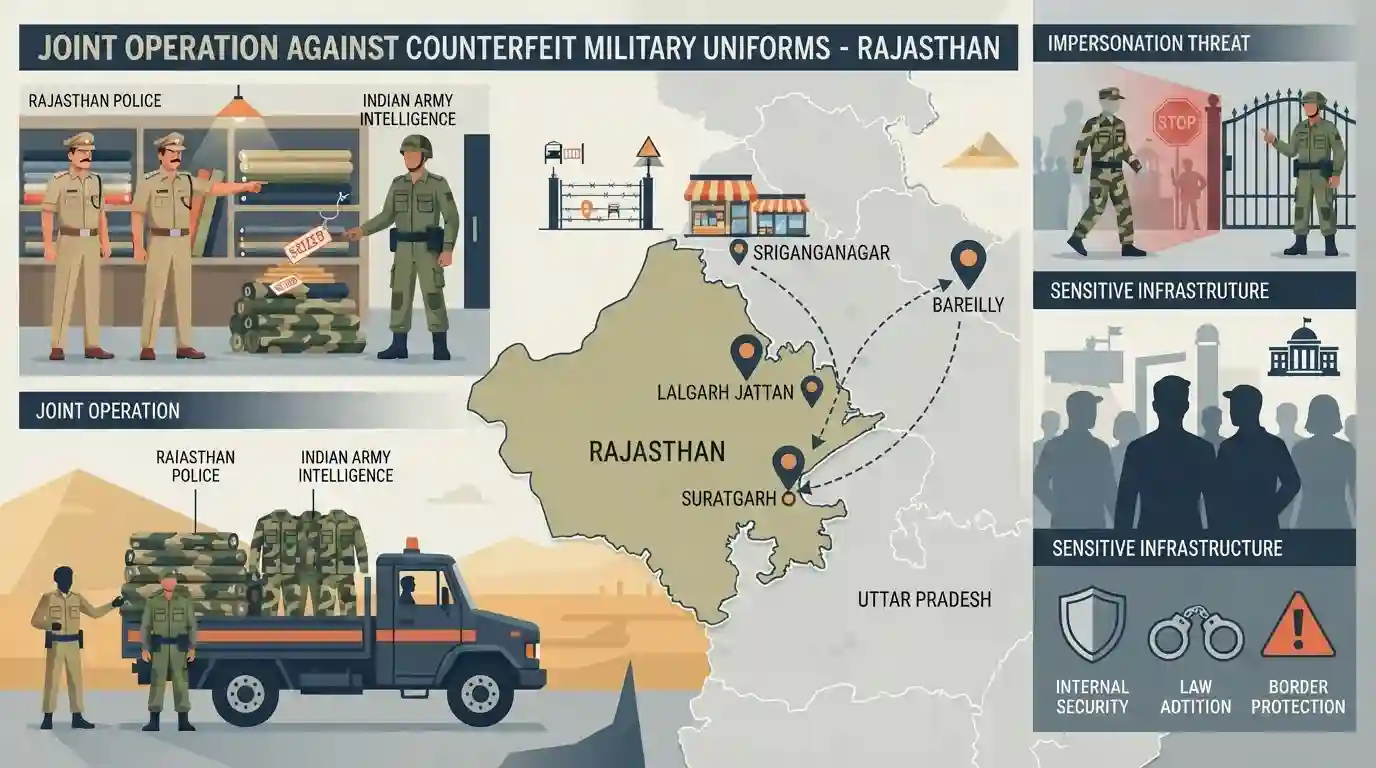
Why It Matters
The unauthorized circulation of military combat uniforms is a critical internal security vulnerability. Hostile actors can misuse these uniforms to disguise themselves as security personnel, bypassing checkpoints and infiltrating sensitive installations. For RPSC RAS Prelims, it is also important as a state-specific internal security event localized in the border district of Sriganganagar.
Summary
A joint operation by Army Intelligence and the Rajasthan Police has dismantled a racket involving the sale of counterfeit military combat uniforms in Rajasthan's Sriganganagar district. Authorities seized over 1,000 metres of unauthorized Army-pattern fabric from shops in Sriganganagar, Lalgarh Jattan, and Suratgarh, tracing the supply chain back to Bareilly. The unauthorized sale and production of military uniforms present a significant internal security threat, as they can be exploited by terrorists and hostile elements to impersonate armed forces personnel and infiltrate secure areas.
Key Points
- A joint operation by Army Intelligence and Rajasthan Police uncovered a counterfeit military combat uniform racket in Sriganganagar district.
- Over 1,000 metres of unauthorized Army-pattern combat cloth, sufficient to make 300 to 400 uniforms, was seized.
- The illicit cloth was traced back to a supplier in Bareilly and distributed through shops in Sriganganagar town, Lalgarh Jattan, and Suratgarh.
- The sale of unauthorized military uniforms poses a severe internal security risk, as terrorists or anti-national elements could use them for impersonation during attacks.
Important Terms
Army Intelligence (Military Intelligence)

The intelligence-gathering and counter-intelligence arm of the Indian Army. It detects and neutralizes internal and external threats, including espionage, subversion, and security risks like the unauthorized production of military equipment and uniform materials.
UPSC context
Relevant to GS Paper 3 (Security Forces and Agencies). Tests knowledge of specialized intelligence mandates and threat detection.
Counterfeit Military Uniform Threat
The illegal manufacturing, sale, and possession of military-pattern camouflage fabric. This constitutes a severe national security vulnerability, as hostile elements or terrorists exploit fake uniforms to impersonate soldiers and breach secure military installations.
UPSC context
Crucial for GS Paper 3 (Internal Security Challenges). Highlights infiltration tactics often used in high-profile terrorist attacks.
Combat Uniform IPR
The legal protection secured by the Indian Army over its specific digital camouflage pattern and uniform design. It prevents unauthorized vendors from manufacturing the fabric, ensuring it is exclusively sold through official military channels.
UPSC context
Bridges GS Paper 3 (Internal Security & IPR). Tests understanding of how intellectual property laws are leveraged for national security.
Unit Run Canteens (URCs)
Official retail outlets operated by the Indian Armed Forces to provide authorized goods, including strictly regulated combat uniform fabric, exclusively to serving military personnel and veterans, preventing civilian misuse and security breaches.
UPSC context
Relevant to GS Paper 3 (Defense Logistics/Internal Security). Tests knowledge of secure military supply chains.
Prelims Trap
"Military uniforms in India cannot be granted Intellectual Property Rights as they are considered state property."
The Indian Army officially secured Intellectual Property Rights (specifically Design Registration) over its new digital camouflage pattern in 2022 to stop unauthorized commercial manufacturing.
Static Concepts Connected
How does Design Registration work under India's IPR regime?
- Statutory Backing: Governed by the Designs Act, 2000, it protects only the visual design (shape, pattern, color) of articles, not their technical functionality.
- Validity Period: Registration is initially valid for 10 years and can be extended for a further period of 5 years.
- Army's Application: The Ministry of Defence used this specific IPR route to legally restrict the open-market production of the Army's new digital combat fabric.
What are the key geographical features of the Indo-Pak border in Rajasthan?
- Border Extent: Rajasthan shares a 1,070 km-long international boundary with Pakistan, falling under the Western Sector of India's border defenses.
- Frontier Districts: The border stretches across four highly sensitive frontier districts: Sriganganagar, Bikaner, Jaisalmer, and Barmer.
- Guarding Force: This specific stretch is primarily guarded by the Border Security Force (BSF), functioning under the Ministry of Home Affairs.
Cross-Topic Patterns
IPR as a National Security Tool
Securing IPR for the digital combat uniform demonstrates a novel overlap where civil commercial law (Designs Act) is utilized to preempt internal security breaches and terrorism.
BNS transition and State Security
The shift from IPC Section 140 to BNS Section 168 highlights the continued legislative focus on penalizing military impersonation, a common tactic in cross-border terror attacks like Pathankot.

A 2026 prelims question may test the novel intersection of IPR (Designs Act) being used to secure military camouflage patterns.
Linked PYQs · 2
Linked PYQs · 2
- 2025RPSC_PRELIMSGS1
Consider the following statements: A. Luni Basin and Shekhawati region are sub-regions of Bhangar in Rajasthan. B. The Ghaggar plain is mostly spread in Hanumangarh and Ganganagar districts. C. Nagaur Uplands have saline lakes and internal drainage. D. The Aravalli ranges are rich in all types of minerals. Select the correct answer from the code given below: Code:
- 2024RPSC_PRELIMSGS1
Which of the following is correct regarding Rajasthan Bharatpur – Rajasthan Berger? A. Luni Basin and Southwest Rajasthan Border are part of Rajasthan Berger. B. Ghagghar Plain covers mainly the North Rajasthan. C. Rajasthan Plain does have salty lakes and inland drainage. D. Bhilwara district is a part of all the above things of Rajasthan. Select the correct answer using the codes given below:
