ISRO LVM3 M6 Commercial Launch for US Communication Satellite
Source:The Hindu ↗
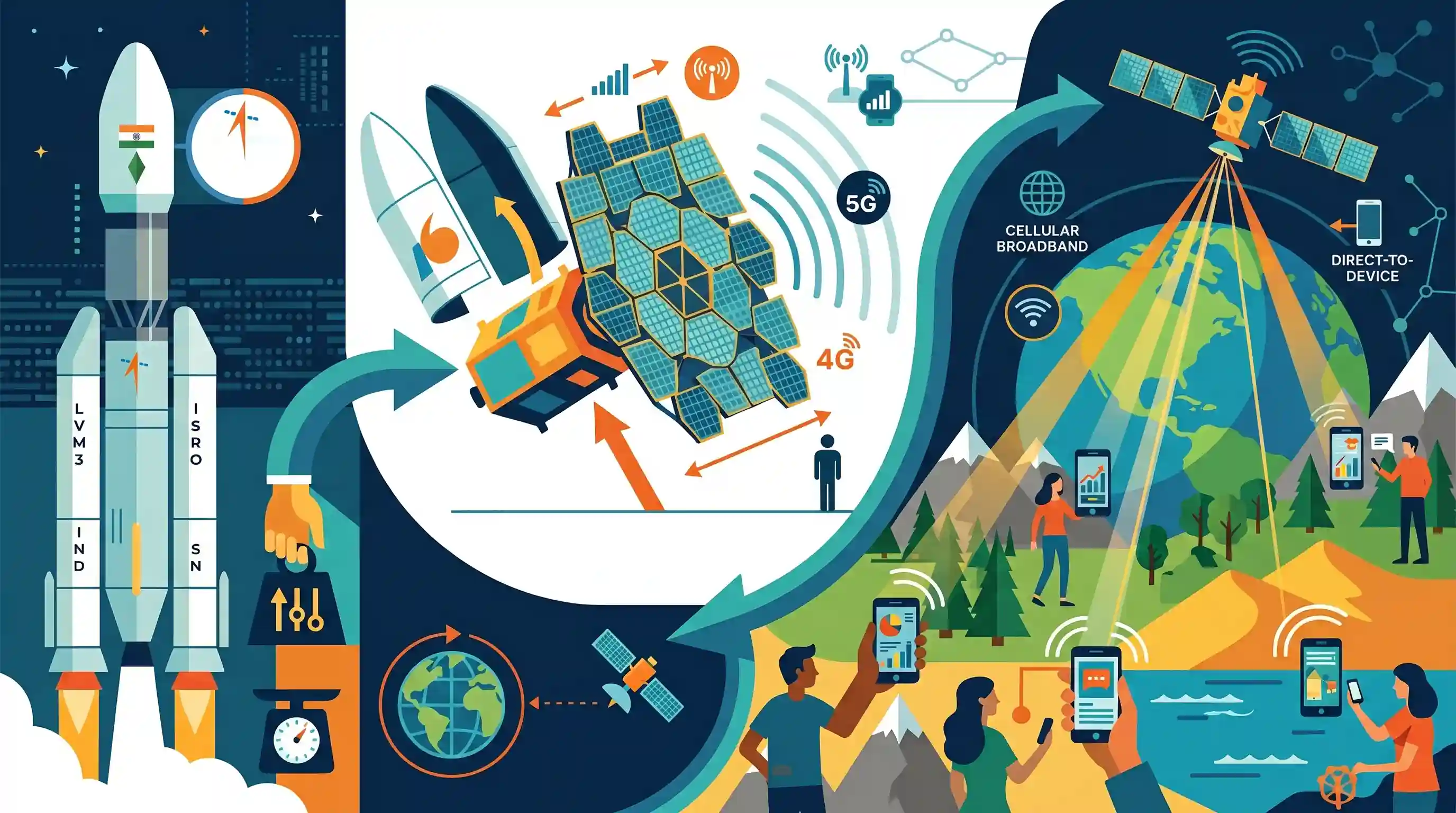
Why It Matters
The mission exemplifies India's expanding footprint in the lucrative global commercial space launch market through NSIL. It also touches upon crucial space tech fundamentals relevant for Prelims (LVM3 stages, LEO vs GEO) and emerging technologies in telecommunications (direct-to-mobile satellite broadband).
Summary
ISRO is preparing to launch the US-based AST SpaceMobile's BlueBird Block-2 satellite via its LVM3-M6 rocket in a dedicated commercial mission arranged by NewSpace India Limited (NSIL). Weighing 6,100 kg, the satellite is the heaviest payload ever deployed to Low Earth Orbit (LEO) by the LVM3. Operating at a 600km altitude with a massive 223 square meter phased array antenna, the satellite acts as a space-based cell tower to deliver direct-to-mobile 4G and 5G cellular broadband globally. The mission highlights ISRO's increasing prowess in heavy-lift commercial space operations and the growing trend of satellite-based direct-to-device communications.
Key Points
- ISRO is set to launch the Bluebird Block-2 mission using its heaviest rocket, LVM3 (formerly GSLV MkIII), from Sriharikota.
- At 6,100 kg, this is the heaviest payload LVM3 has ever placed into Low Earth Orbit (LEO).
- The mission is a dedicated commercial launch facilitated by NewSpace India Limited (NSIL) for US-based AST SpaceMobile.
- The satellite will serve as a cell tower in space, providing 4G/5G space-based cellular broadband directly to standard smartphones globally.
- LVM3 is a three-stage launch vehicle equipped with a cryogenic upper stage and twin S200 solid rocket boosters.
Important Terms
Geosynchronous Satellite Launch Vehicle MkIII (LVM3)

India's most powerful three-stage rocket, designed to carry 4,000 kg to Geosynchronous Transfer Orbit (GTO). It features solid boosters, a liquid core stage, and an indigenous cryogenic upper stage.
UPSC context
GS-3 Space Technology; crucial for heavy-lift missions, human spaceflight (Gaganyaan), and self-reliance in space exploration.
NewSpace India Limited (NSIL)
The commercial arm of ISRO and a Central Public Sector Enterprise. It handles commercial satellite launches, technology transfers to Indian industry, and provides launch services for global customers.
UPSC context
GS-3 Space/Economy; tests knowledge of space sector commercialization and India's competitive positioning in the global launch market.
Bluebird Block-2
A 6,100 kg communication satellite by AST SpaceMobile featuring a massive phased array antenna. It is designed to provide direct 4G/5G cellular broadband to standard, unmodified smartphones.
UPSC context
GS-3 Science & Tech; relevant for emerging telecommunication trends and the use of LEO constellations to bridge the digital divide.
LVM3-M6
The sixth operational flight of the LVM3 rocket. This specific mission deployed the heaviest-ever payload (6,100 kg) into Low Earth Orbit from Indian soil for a US-based client.
UPSC context
GS-3 Space; demonstrates the operational reliability and record-breaking payload capacities achieved by India's heavy-lift launch vehicles.
Direct-to-Device (D2D) Communication
A satellite technology allowing direct communication with standard mobile phones without specialized ground equipment. It bypasses terrestrial towers to provide global cellular broadband coverage in remote areas.
UPSC context
GS-3 Science & Tech/Infrastructure; concerns the evolution of communication networks and their socio-economic impact on global connectivity.
Prelims Trap
Space-based 4G/5G cellular broadband requires specialized satellite phones or customized ground receivers.
This is a trap. Direct-to-Device (D2D) technology, like the BlueBird satellite, functions as a cell tower in space delivering signals directly to standard, unmodified smartphones.
Static Concepts Connected
What are the three stages of the LVM3 rocket?
- Solid Boosters (S200): Twin strap-on solid motors providing massive initial lift-off thrust.
- Liquid Core (L110): Powered by twin Vikas engines using earth-storable liquid propellants.
- Cryogenic Stage (C25): Upper stage powered by the CE-20 engine using highly efficient Liquid Oxygen and Liquid Hydrogen.
What is the mandate of NewSpace India Limited (NSIL)?
- Commercial Arm: Functions as the official commercial arm of ISRO under the Department of Space (CPSE).
- Launch Services: Provides dedicated commercial launch services globally using ISRO's operational launch vehicles like PSLV and LVM3.
- Tech Transfer: Mandated to transfer ISRO technologies to Indian industry to spur domestic space manufacturing capabilities.
Cross-Topic Patterns
D2M tech and disaster resilience
Space-based cell towers bypass vulnerable terrestrial infrastructure (fiber/towers), providing critical communication redundancy during natural disasters, linking directly to GS3 Disaster Management.
Space Commercialization and FDI policies
NSIL's heavy commercial payloads reflect the push to capture >10% of the global space economy, tying directly to the recently liberalized 2024 Space FDI norms.

Expect a 2026 Prelims question distinguishing D2M satellite broadband (works with standard phones) from traditional sat-phones.
Linked PYQs · 2
Linked PYQs · 2
- 2018PrelimsGS1
With reference to India's satellite launch vehicles, consider the following statements: 1. PSLVs launch the satellites useful for Earth resources monitoring whereas GSLVs are designed mainly to launch communication satellites. 2. Satellites launched by PSLV appear to remain permanently fixed in the same position in the sky, as viewed from a particular location on Earth. 3. GSLV Mk III is a four-staged launch vehicle with the first and third stages using solid rocket motors; and the second and fourth stages using liquid rocket engines. Which of the statements given above is/are correct?
- 2016MainsGS3
Discuss India's achievements in the field of Space Science and Technology. How the application of this technology has helped India in its socio-economic development?
