इसरो लॉन्च वाहन क्षमताएं और अर्थ ऑब्जर्वेशन मिशन
स्रोत:द हिंदू ↗
क्यों मायने रखता है
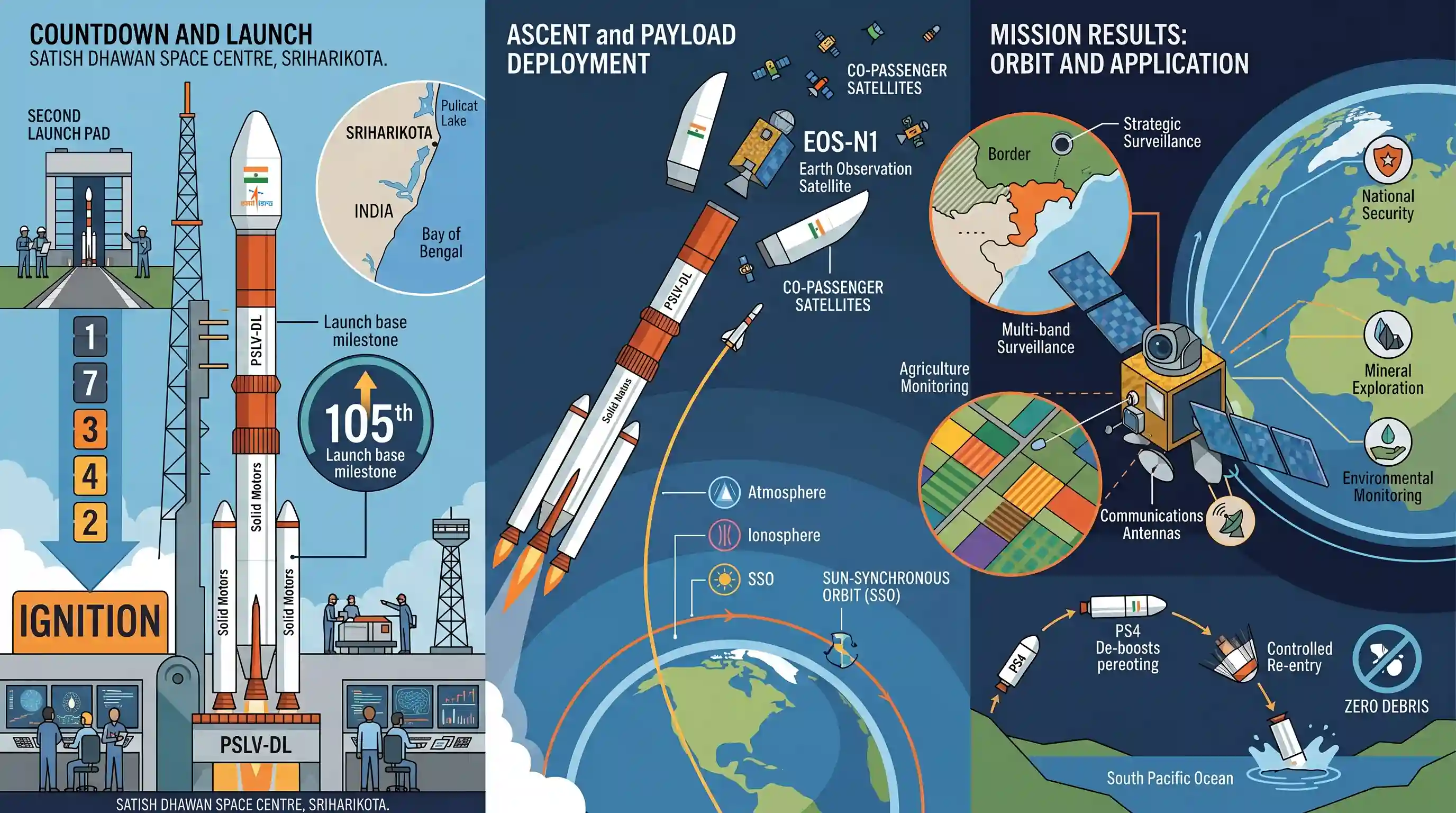
ISRO's launch capabilities, particularly the reliable PSLV and Earth Observation missions, form a core part of India's space technology achievements. This topic is directly relevant to GS3 (Science and Technology) and Prelims queries on space assets.
सारांश
The Indian Space Research Organisation (ISRO) has commenced the countdown for the PSLV-C62/EOS-N1 mission, scheduled to launch from the Satish Dhawan Space Centre in Sriharikota. The launch involves placing an Earth Observation Satellite into orbit and represents the 105th launch from the spaceport.
मुख्य बिंदु
- The 22.5-hour countdown for the launch of the PSLV-C62/EOS-N1 mission has begun at the Satish Dhawan Space Centre (SDSC) in Sriharikota.
- This launch marks the 105th launch from the Sriharikota spaceport.
- The Polar Satellite Launch Vehicle (PSLV) will place the Earth Observation Satellite (EOS-N1) into orbit.
महत्वपूर्ण शब्द
PSLV-C62/EOS-N1 Mission

ISRO’s 64th PSLV flight, intended to deploy the strategic EOS-N1 hyperspectral satellite and 15 commercial payloads. It faced a third-stage (PS3) anomaly, failing to achieve orbit.
UPSC context
GS-III (Space Tech); tests awareness of mission objectives, failure analysis, and satellite-launch vehicle pairings.
ISRO
India's national space agency under the Department of Space, responsible for space exploration, satellite communication, and indigenous launch vehicle development.
UPSC context
GS-III (S&T); core institution for space-related questions, policy, and international space cooperation.
Polar Satellite Launch Vehicle (PSLV)
A third-generation, four-stage launch vehicle using alternating solid and liquid propulsion. Known as ISRO's 'workhorse' for its reliability in delivering satellites to Sun-Synchronous Orbits.
UPSC context
GS-III (Space Tech); frequently tested regarding stage configuration (Solid-Liquid-Solid-Liquid) and historical missions like Chandrayaan-1.
पृथ्वी अवलोकन उपग्रह (EOS)
Satellites designed for remote sensing to monitor Earth's physical, chemical, and biological systems. Applications include agriculture, disaster management, and strategic border surveillance.
UPSC context
GS-III; vital for resource management and disaster mitigation topics. EOS series replaced the earlier IRS nomenclature.
Hyperspectral Imaging
एक ऐसी तकनीक जो सैकड़ों संकीर्ण और निरंतर स्पेक्ट्रल बैंड्स (spectral bands) में डेटा कैप्चर करती है, जिससे विशिष्ट स्पेक्ट्रल हस्ताक्षरों (spectral signatures) के आधार पर पदार्थों की सटीक पहचान संभव हो पाती है।
UPSC context
GS-III (Space & Defence); relevant for advanced remote sensing applications in agriculture and national security.
NewSpace India Limited (NSIL)
The commercial arm of ISRO, incorporated in 2019, focused on marketing ISRO's space products and services and enabling private sector participation in space.
UPSC context
GS-III; reflects the transition toward commercialization and privatization in India’s space sector.
प्रारंभिक ट्रैप
PSLV utilizes a cryogenic upper stage to precisely place Earth Observation Satellites into orbit.
PSLV has a four-stage solid-liquid-solid-liquid configuration and does NOT use a cryogenic engine. Cryogenic upper stages are utilized in GSLV/LVM3 for heavier geostationary payloads.
संबंधित अवधारणाएँ
What are the key technical differences between PSLV and GSLV?
- Stages: PSLV is a 4-stage vehicle (Solid-Liquid-Solid-Liquid). GSLV is a 3-stage vehicle that critically includes a cryogenic upper stage.
- Target Orbits: PSLV is optimized for Low Earth and Sun-Synchronous Polar Orbits (SSPO). GSLV targets higher Geosynchronous Transfer Orbits (GTO).
- पेलोड क्षमता: GSLV (and LVM3) carries significantly heavier payloads (up to 4000kg to GTO) compared to PSLV's lighter payload capacity.
What is the geographical significance of the Sriharikota barrier island?
- Location: Located in Andhra Pradesh, it acts as a natural barrier island separating the Bay of Bengal from Pulicat Lake.
- Pulicat Lake: It borders India's second-largest brackish water lagoon (after Chilika), which hosts a vital bird sanctuary and rich estuarine ecosystem.
- Launch Suitability: Its eastern coast location near the equator provides a spin-boost from Earth's rotation and safe eastward flight paths over the ocean.
अंतर-विषय पैटर्न
EOS + Disaster Management
Earth Observation Satellites with Synthetic Aperture Radar (SAR) penetrate cloud cover, providing critical real-time flood mapping and cyclone damage assessment during Indian monsoons.
Hyperspectral Imaging + Crop Insurance
Modern EOS sensors capture precise material compositions, directly aiding the PM Fasal Bima Yojana by assessing soil health and detecting early crop stress.

Expect a 2026 multi-statement question mixing PSLV's S-L-S-L stages, EOS SAR tech capabilities, and Sriharikota/Pulicat geography.
संबद्ध PYQ · 1
संबद्ध PYQ · 1
- 2018PrelimsGS1
With reference to India's satellite launch vehicles, consider the following statements: 1. PSLVs launch the satellites useful for Earth resources monitoring whereas GSLVs are designed mainly to launch communication satellites. 2. Satellites launched by PSLV appear to remain permanently fixed in the same position in the sky, as viewed from a particular location on Earth. 3. GSLV Mk III is a four-staged launch vehicle with the first and third stages using solid rocket motors; and the second and fourth stages using liquid rocket engines. Which of the statements given above is/are correct?
