Asiatic Cheetah Rewilding Prospects and Conservation Challenges
Source:The Hindu ↗
Why It Matters
It provides a crucial comparative case study for India's ongoing cheetah reintroduction efforts (Project Cheetah), testing concepts of species translocation, the ecological role of apex predators, and the challenges of conserving critically endangered subspecies.
Summary
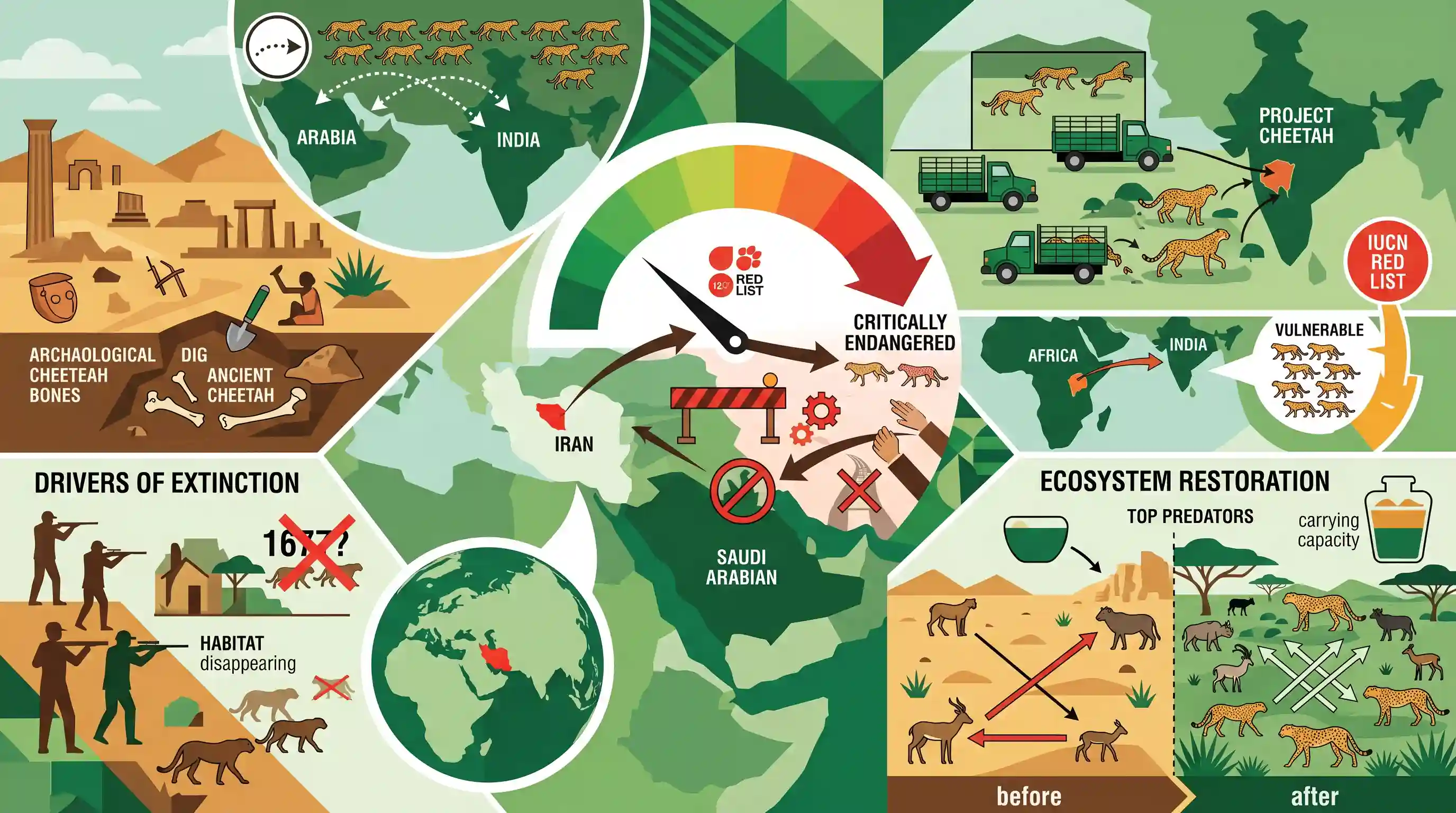
The article explores the ambitious prospect of rewilding the near-extinct Asiatic cheetah in Saudi Arabia following the recent discovery of ancient cheetah remains in the region. Historically roaming across the Arabian Peninsula and India, the Asiatic cheetah is now critically endangered, with the sole surviving population of fewer than 50 individuals confined to central Iran. Due to the extreme vulnerability of this source population, translocating Asiatic cheetahs presents severe ecological and geopolitical hurdles. The scenario offers a strong parallel to India's 'Project Cheetah', which bypassed the shortage of Asiatic cheetahs by introducing the Vulnerable African cheetah to Kuno National Park. The article underscores the vital role of apex predators in restoring the carrying capacity and food webs of arid ecosystems, while highlighting the historical drivers of their extinction, such as overhunting and habitat loss.
Key Points
- The Asiatic Cheetah is classified as Critically Endangered by the IUCN, with fewer than 50 individuals surviving exclusively in central Iran.
- Historical extinction of cheetahs in the Arabian Peninsula and India was driven by overhunting, habitat degradation, and a steep decline in natural prey bases.
- The recent discovery of ancient cheetah remains in Saudi Arabia has catalysed conservation discussions around 'rewilding' the region with apex predators to restore its arid ecosystems.
- Translocating Asiatic cheetahs to Saudi Arabia presents immense ecological and diplomatic challenges due to the fragile and minuscule source population in Iran.
- The situation provides a comparative parallel to India's 'Project Cheetah', where African cheetahs were introduced to Kuno National Park due to the unavailability of the Asiatic subspecies.
Important Terms
Project Cheetah

India’s flagship initiative to reintroduce cheetahs, primarily the African subspecies, into Kuno National Park. It is the world’s first intercontinental large-carnivore translocation project.
UPSC context
GS Paper III (Environment); tests knowledge of species recovery programs and intercontinental conservation diplomacy.
Asiatic Cheetah
A subspecies of cheetah (*Acinonyx jubatus venaticus*) native to Asia. It is Critically Endangered, with fewer than 50 individuals surviving exclusively in central Iran.
UPSC context
Prelims (Environment); focuses on flagship species, IUCN status, and historical range in India and the Middle East.
IUCN Red List
The world's most comprehensive inventory of the global conservation status of biological species, categorizing them from 'Least Concern' to 'Extinct' based on extinction risk.
UPSC context
Prelims/GS Paper III; fundamental for identifying the protection priority of globally threatened species.
Wildlife Protection Act, 1972
India’s primary legal framework for protecting flora and fauna. It lists cheetahs under Schedule I, granting them the highest level of legal protection and prohibiting hunting.
UPSC context
GS Paper II/III; essential for understanding domestic legal mandates for habitat and species conservation.
National Center for Wildlife (NCW)
The Saudi government agency responsible for protecting biodiversity and managing the National Cheetah Reintroduction Program, which recently reported the birth of captive-bred cubs.
UPSC context
GS Paper III; relevant for comparative studies on international conservation models and regional biodiversity strategies.
Rewilding
The ecological process of restoring natural processes and wilderness areas by reintroducing apex predators or keystone species to repair degraded ecosystems and food webs.
UPSC context
GS Paper III (Ecology); tests understanding of ecosystem restoration techniques and trophic cascades.
Prelims Trap
India recently reintroduced the Asiatic cheetah to Kuno National Park to restore its grassland ecosystems.
India introduced the African cheetah (Vulnerable), not the Asiatic cheetah (Critically Endangered). The Asiatic population in Iran is too fragile for international translocation.
Static Concepts Connected
What are the key differences between Asiatic and African cheetahs?
- IUCN Status: The Asiatic cheetah is 'Critically Endangered', whereas the African cheetah is classified as 'Vulnerable' on the IUCN Red List.
- Current Range: The Asiatic cheetah survives exclusively in a tiny population in central Iran. The African cheetah is spread across several African nations.
- Physical Traits: Asiatic cheetahs are generally slightly smaller, have a paler coat, and possess a thicker winter coat compared to their African counterparts.
How do 'Umbrella' species function in ecosystem restoration?
- Umbrella Species: These are species selected for conservation-related decisions, because protecting these species indirectly protects many other species that make up the ecological community of its habitat.
- Conservation Mechanism: By conserving apex predators like cheetahs or tigers, vast tracts of associated habitats (like savannas or forests) and their prey bases are automatically preserved.
Cross-Topic Patterns
Conservation as geopolitical diplomacy
Translocating the Asiatic cheetah involves complex Iran-Saudi diplomacy. India similarly navigated international wildlife trade laws (CITES) and bilateral MOUs with Namibia and South Africa for its reintroduction program.
Grassland and savanna ecosystem conservation
Cheetah reintroduction focuses attention on dry deciduous and savanna ecosystems, which have historically been neglected or misclassified as 'wastelands' in Indian forest policy compared to timber-rich dense forests.

Expect a multi-statement Prelims question contrasting Asiatic/African cheetah IUCN statuses, natural ranges, and Project Cheetah logistics.
Linked PYQs · 4
Linked PYQs · 4
- 2012PrelimsGS1
Which one of the following groups of animals belongs to the category of endangered species?
- 2014PrelimsGS1
The most important strategy for the conservation of biodiversity together with traditional human life is the establishment of
- 2022PrelimsGS1
With reference to Indian laws about wildlife protection, consider the following statements : 1. Wild animals are the sole property of the government. 2. When a wild animal is declared protected, such animal is entitled for equal protection whether it is found in protected areas or outside. 3. Apprehension of a protected wild animal becoming a danger to human life is sufficient ground for its capture or killing. Which of the statements given above is/are correct?
- 2019MainsGS3
Define the concept of carrying capacity of an ecosystem as relevant to an environment. Explain how understanding this concept is vital while planning for sustainable development of a region.
