United States UN Assembly Visa Restrictions and Geopolitics
Source:Indian Express ↗
Why It Matters
Understanding these dynamics is vital for aspirants as it demonstrates how a host nation leverages the logistical privileges of an international organization (like the UN) to assert geopolitical power, enforce sanctions, and express bilateral displeasure, heavily impacting global governance and diplomatic parity.
Summary
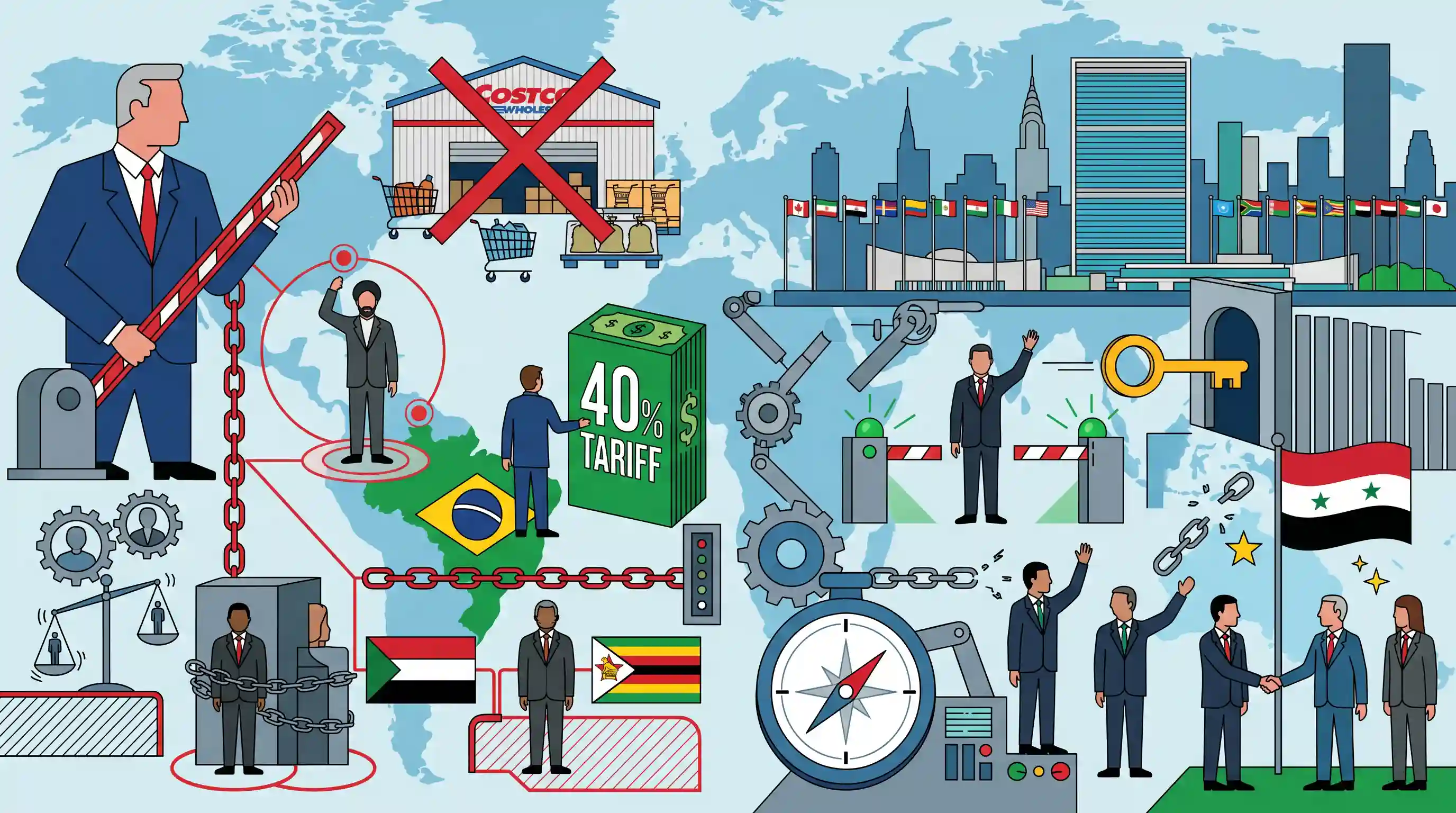
The US government is preparing to impose stricter visa and travel restrictions on foreign delegations from countries like Iran, Sudan, Zimbabwe, and potentially Brazil ahead of the UN General Assembly in New York. The curbs include unconventional measures, such as prohibiting Iranian diplomats from making bulk purchases at retailers like Costco without explicit US State Department approval. Relations with Brazil are under strain over the prosecution of former President Jair Bolsonaro and the imposition of a 40% US tariff, leaving open the possibility of curbing President Lula da Silva's movement. Meanwhile, Syrian diplomats have received a waiver from long-standing UN travel restrictions, marking a strategic shift by the US aimed at reintegrating Syria following the ouster of Bashar al-Assad. These developments highlight the strategic deployment of diplomatic privileges and host-country logistical control to enforce geopolitical priorities.
Key Points
- The US is considering additional visa and travel curbs on delegations from Iran, Sudan, Zimbabwe, and possibly Brazil ahead of the UN General Assembly.
- A proposed measure would explicitly ban Iranian diplomats from bulk shopping at wholesale retailers like Costco and Sam's Club without US State Department approval.
- Potential restrictions on Brazilian President Lula da Silva follow US objections to the prosecution of former President Jair Bolsonaro, reflecting strained bilateral ties further aggravated by recent US tariffs on Brazil.
- Conversely, the US has granted a waiver easing long-standing travel restrictions on Syrian diplomats following the ouster of Bashar al-Assad to facilitate Syria's regional reintegration.
- The actions demonstrate how host nations can deploy logistical and domestic privileges as tools of geopolitical leverage.
Important Terms
UN General Assembly (UNGA)

The primary deliberative and policymaking organ of the United Nations, where all 193 member states have equal representation to discuss international issues like peace, security, and human rights.
UPSC context
GS Paper II: International Relations. Essential for understanding multilateralism, global governance, and India's advocacy for UN security council reforms.
US State Department
The executive department of the U.S. federal government responsible for foreign policy, international relations, and diplomatic missions, equivalent to India's Ministry of External Affairs.
UPSC context
GS Paper II: Bilateral Relations. Critical for analyzing India-US strategic partnerships, visa policies, and the management of diplomatic protocol.
UN Headquarters Agreement (1947)
A 1947 treaty between the UN and USA establishing the UN seat in New York. It obligates the US to allow unimpeded access for foreign diplomats to the HQ district.
UPSC context
GS Paper II: International Treaties. Tests knowledge of the legal friction between a host country's security laws and its international obligations.
Vienna Convention on Diplomatic Relations (1961)
A 1961 international treaty defining the framework for diplomatic relations, including the principles of diplomatic immunity and the specific privileges accorded to foreign missions and staff.
UPSC context
GS Paper II: International Law. A fundamental concept regarding the protection of diplomats and the resolution of bilateral diplomatic disputes.
Diplomatic Privileges and Immunities
Legal protections and rights (e.g., freedom of movement, communication, and exemption from local jurisdiction) granted to diplomats to ensure they can perform their duties without interference.
UPSC context
GS Paper II: Diplomacy. Relevant for understanding international standards and recent high-profile diplomatic tensions (e.g., India-Canada or India-USA).
Persona Non Grata
A Latin term for an 'unwelcome person.' In diplomacy, it is a formal declaration by a host country that a foreign diplomat's presence is no longer permitted.
UPSC context
GS Paper II: Bilateral Relations. Refers to the formal mechanism for expelling diplomats during periods of heightened international tension or misconduct.
Prelims Trap
The US has absolute legal discretion to deny visas to any foreign diplomat attending the UN General Assembly.
The US does not have absolute discretion. Under the 1947 UN Headquarters Agreement, it is legally obligated to grant entry to UN delegates, but frequently exploits domestic "national security" exceptions to impose curbs.
Static Concepts Connected
What frameworks govern diplomatic privileges and host-country duties at the UN?
- Vienna Convention (1961): Establishes baseline diplomatic immunity, inviolability of missions, and freedom of movement for bilateral envoys globally.
- UN HQ Agreement (1947): A treaty specifically obligating the US to allow unhindered transit and entry to the UN headquarters for all member state delegates.
- National Security Exceptions: Host countries can legally restrict diplomats' geographic movement by citing national security zones, leading to controversial travel radii (e.g., a 25-mile limit).
How does a host country legally expel or discipline foreign diplomats?
- Persona Non Grata (PNG): Under Article 9 of the Vienna Convention, a host state can declare any diplomat PNG at any time without explaining its decision, forcing their removal.
- Loss of Privileges: Host nations cannot prosecute diplomats due to immunity, but can restrict their logistical access or withdraw specific domestic privileges if they violate local laws.
Cross-Topic Patterns
Extraterritorial Leverage & Strategic Autonomy
US unilateral actions—from visa curbs on Iranian diplomats to broad CAATSA sanctions—recurrently challenge India's strategic autonomy, particularly regarding energy security and the Chabahar Port operations.
Syrian Reintegration in the Middle East
The US easing travel curbs on Syrian diplomats mirrors the broader Arab League readmission, signalling a strategic shift from isolation policies to managing post-conflict regional stability.

Expect a 2026 Prelims statement question distinguishing bilateral immunity (Vienna Convention) from UN host duties (1947 HQ Agreement).
Linked PYQs · 4
Linked PYQs · 4
- 2012MainsGS2
How have the US sanctions against Iran affected India's bilateral relations with Iran?
- 2018MainsGS2
In what ways would the ongoing US-Iran Nuclear Pact Controversy affect the national interest of India? How should India respond to this situation?
- 2023PrelimsGS1
Consider the following pairs: Area of conflict mentioned in news Country where it is located 1. Donbas : Syria 2. Kachin : Ethiopia 3. Tigray : North Yemen How many of the above pairs are correctly matched?
- 2023PrelimsGS1
In the recent years Chad, Guinea, Mali and Sudan caught the international attention for which one of the following reasons common to all of them?
