Building Code Implementation Delays in Himalayan Seismic Zones
Source:The Hindu ↗
Why It Matters
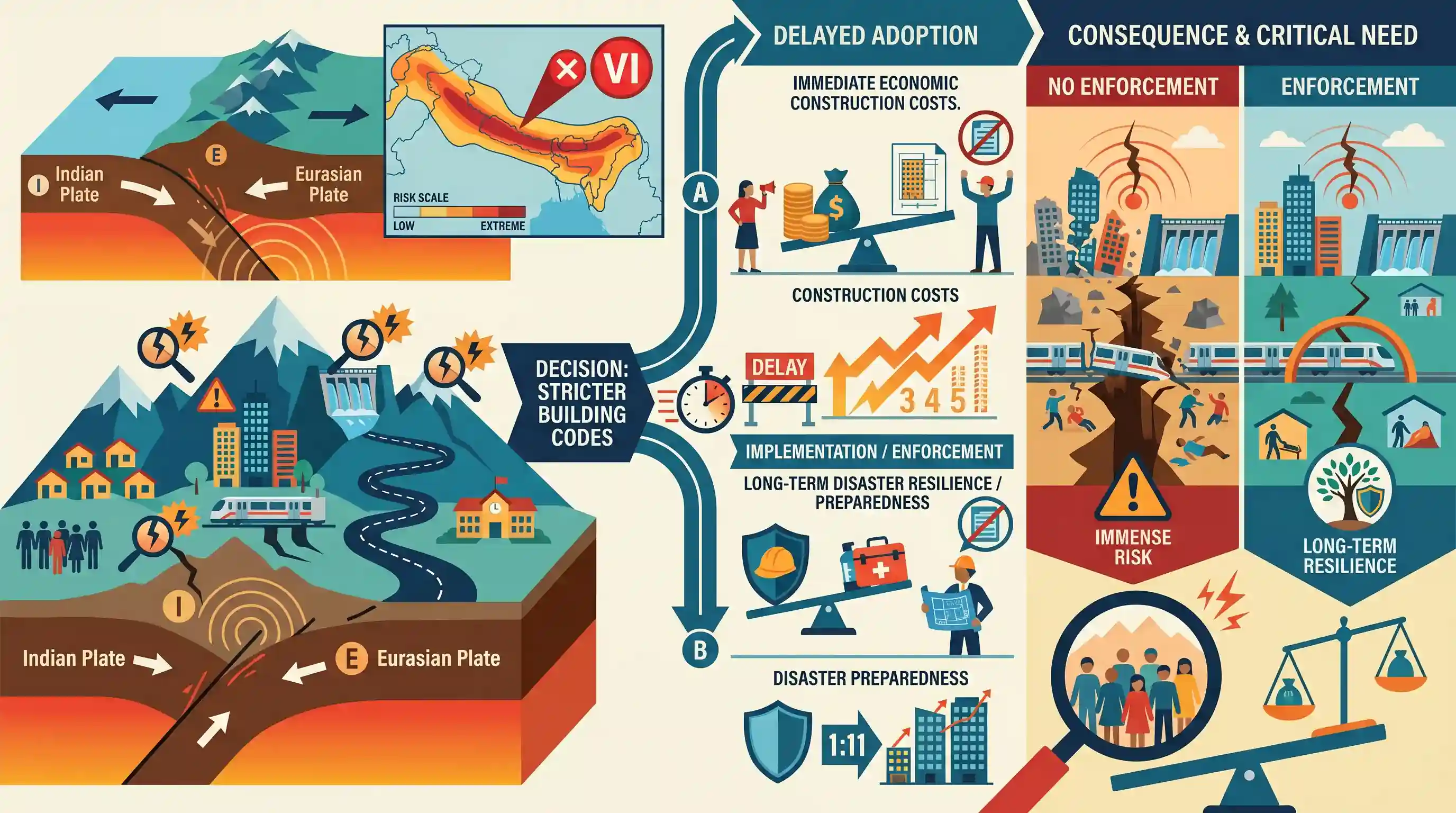
It connects geological hazards (earthquakes in the Himalayas) with governance and economic constraints (building code enforcement and costs), illustrating the real-world challenges of disaster mitigation in vulnerable zones.
Summary
The article highlights the ongoing vulnerability of the Himalayan region to severe earthquakes and related disasters. Despite the clear threats, the implementation and enforcement of stricter, earthquake-resistant building codes are being delayed primarily due to concerns over increased construction costs. This lack of adherence to safety standards exposes the region's populations and infrastructure to immense risk, underscoring the conflict between immediate economic considerations and the critical need for long-term disaster resilience and preparedness.
Key Points
- The Himalayan region is highly seismically active and prone to devastating earthquakes, necessitating disaster-resilient infrastructure.
- Implementation of safer building codes (like those mandated by the Bureau of Indian Standards) is hampered by the higher costs associated with earthquake-resistant materials and structural engineering.
- Delays in municipal enforcement of these safety standards increase the vulnerability of rapidly growing urban centers in the mountains.
- There is a pressing need for a proactive approach to disaster management that prioritizes structural safety and hazard zonation over short-term financial savings.
Important Terms
National Building Code (NBC) of India

A comprehensive document published by the Bureau of Indian Standards (BIS) providing guidelines for regulating building construction, structural integrity, and fire safety across India.
UPSC context
GS Paper III: Disaster Management and Infrastructure. Tests knowledge of safety standards in urban planning.
Bureau of Indian Standards (BIS)
India’s National Standards Body established under the BIS Act 2016, responsible for standardisation, quality certification (ISI mark), and earthquake-resistant design codes.
UPSC context
GS Paper III: Economy and Statutory Bodies. Relevant for regulatory frameworks and quality assurance.
National Disaster Management Authority (NDMA)
The apex statutory body for disaster management in India, chaired by the Prime Minister, responsible for laying down policies, plans, and guidelines for disaster response.
UPSC context
GS Paper III: Disaster Management. Essential for understanding India's institutional framework for disaster preparedness.
Seismic Zoning
The classification of regions into four intensity zones (II to V) based on earthquake probability, as mapped by the Bureau of Indian Standards.
UPSC context
GS Paper I: Geography / GS Paper III: Disaster Management. Vital for identifying high-risk Himalayan regions.
Disaster Resilient Infrastructure (DRI)
Infrastructure systems designed to withstand natural hazards and ensure the continuity of essential services during and after a disaster.
UPSC context
GS Paper III: Disaster Management. Focuses on long-term mitigation and sustainable development goals.
Disaster Management Act, 2005
The landmark legislation that provided the legal and institutional framework for disaster management in India, establishing the NDMA and SDMAs.
UPSC context
GS Paper III: Disaster Management. The primary law governing all disaster-related administrative actions in India.
Prelims Trap
"India is currently divided into six seismic zones, and the National Building Code is formulated and enforced directly by the NDMA."
India currently has four seismic zones (II-V); Zone VI was only in a withdrawn draft. Furthermore, BIS formulates the codes, while local municipalities enforce them, not NDMA.
Static Concepts Connected
How is seismic zonation currently classified in India?
- Four Zones: India currently has four seismic zones (II, III, IV, and V). The erstwhile Zone I was merged with Zone II.
- Zone V (Very High Risk): Includes the entire Northeast, parts of J&K, Himachal Pradesh, Uttarakhand, Rann of Kutch, North Bihar, and Andaman & Nicobar Islands.
- Zone IV (High Risk): Includes remaining parts of J&K, HP, Delhi, Sikkim, and northern parts of UP, Bihar, and West Bengal.
What is the mandate of the Bureau of Indian Standards (BIS)?
- Statutory Body: It is a statutory body established under the BIS Act, 2016, functioning under the Ministry of Consumer Affairs, Food and Public Distribution.
- Standard Formulation: BIS formulates the National Building Code (NBC) and seismic design codes (like IS 1893) which provide guidelines for structurally safe construction.
Cross-Topic Patterns
Sendai Framework vs. Infrastructure Capex
The withdrawal of stricter codes due to 20% cost inflation directly contradicts Sendai Priority 3, which mandates upfront public and private investments in structural resilience despite immediate capital expenditure constraints.
Joshimath and Himalayan Carrying Capacity
Unregulated construction amplifying seismic threats echoes the Joshimath land subsidence crisis. Both highlight the fatal gap between municipal enforcement and geological realities in fragile Himalayan ecosystems.

Expect a Prelims question testing India's 4 seismic zones (II-V) alongside the specific statutory roles of BIS vs NDMA in building codes.
Linked PYQs · 5
Linked PYQs · 5
- 2021MainsGS3
Discuss about the vulnerability of India to earthquake related hazards. Give examples including the salient features of major disasters caused by earthquakes in different parts of India during the last three decades.
- 2019MainsGS3
Vulnerability is an essential element for defining disaster impacts and its threat to people. How and in what ways can vulnerability to disasters be characterized? Discuss different types of vulnerability with reference to disasters.
- 2019MainsGS3
Disaster preparedness is the first step in any disaster management process. Explain how hazard zonation mapping will help disaster mitigation in the case of landslides.
- 2024MainsGS3
What is disaster resilience? How is it determined? Describe various elements of a resilience framework. Also mention the global targets of Sendai Framework for Disaster Risk Reduction (2015–2030).
- 2021MainsGS1
Differentiate the causes of landslides in the Himalayan region and Western Ghats.
