India and Climate Finance at COP31 Challenges and Strategy
Source:Indian Express ↗
Why It Matters
It provides crucial insights into India's negotiating stance and geopolitical strategy on climate finance, equity, and CBDR at international climate summits like COP31, which is a core theme in GS3 Environment and Economy.
Summary
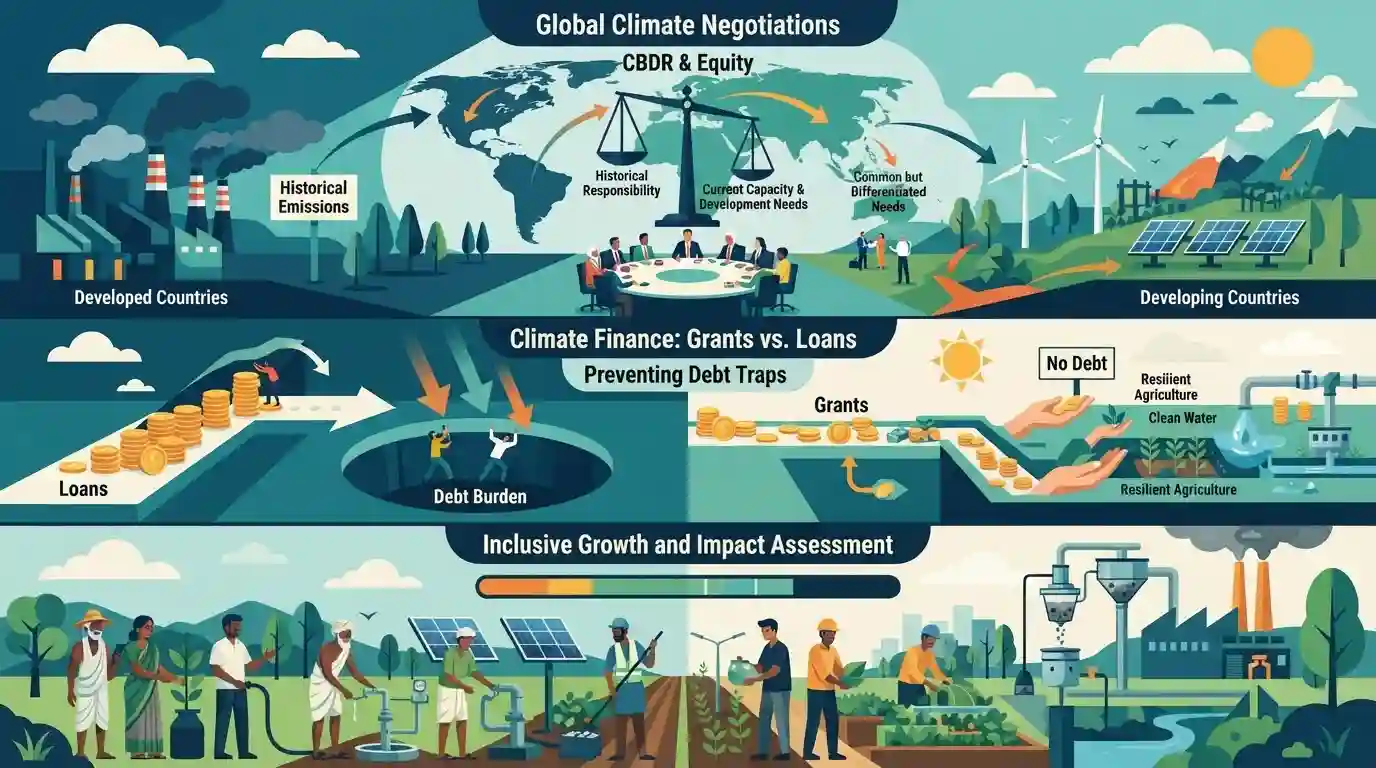
The article discusses India's stance on climate finance ahead of COP31, emphasizing the urgent need for grants rather than loans to prevent debt traps in developing countries, and reiterating the core principles of equity and CBDR in global climate negotiations.
Key Points
- COP31 brings critical focus on climate finance, shifting the debate towards grants over loans to avoid worsening the debt distress of developing nations.
- India and other Global South economies face challenges balancing rapid development with energy transition, requiring predictable, accessible, and non-debt-creating climate funds.
- Developed nations must honor historical responsibilities under Common But Differentiated Responsibilities (CBDR) rather than shifting financial burdens through commercial loans.
- The framing of climate finance must prioritize adaptation and loss-and-damage mechanisms alongside mitigation.
Important Terms
COP31

The 31st Conference of the Parties to the UNFCCC, serving as the supreme decision-making body for reviewing the implementation of global climate conventions and advancing multilateral climate action.
UPSC context
UPSC Mains GS Paper III: Environment, Conservation, and Climate Negotiations. Tests understanding of contemporary international summits and India's negotiating stance.
Paris Agreement
A landmark 2015 legally binding international treaty on climate change adopted under the UNFCCC framework, aiming to hold global temperature rise well below 2 degrees Celsius.
UPSC context
UPSC Mains GS Paper III: Environmental conventions, international treaties, and India's climate commitments (NDCs).
UNFCCC
The United Nations Framework Convention on Climate Change, a foundational international environmental treaty adopted in 1992 to stabilize greenhouse gas concentrations in the atmosphere.
UPSC context
UPSC Prelims and Mains GS Paper III: Core environmental governance architecture and global climate bodies.
IPCC
The Intergovernmental Panel on Climate Change, the United Nations body for assessing the science related to climate change, providing regular scientific assessments.
UPSC context
UPSC Prelims and Mains GS Paper III: Climate science, scientific assessments, and environmental pollution and degradation.
Static Concepts Connected
What are the core principles governing international climate change negotiations under the UNFCCC framework?
- Historical burden: Historical responsibility acknowledging that developed nations are principally responsible for cumulative greenhouse gas emissions.
- CBDR-RC principle: Common But Differentiated Responsibilities and Respective Capabilities (CBDR-RC) accounts for differing national circumstances and economic capacities.
- Equitable space: Equity ensures that developing countries retain sufficient carbon space for poverty eradication and socio-economic development.
Cross-Topic Patterns
Climate Finance vs Sovereign Debt Distress
Developing economies argue that high-cost climate loans worsen sovereign debt profiles, creating a direct intersection between international climate negotiations and sovereign debt sustainability in multilateral forums.
Global South Equity and Multilateral Governance
India's demand for adequate carbon space directly links climate finance equity to broader debates on UNSC reforms and global economic governance restructuring.

Expect a statement-based prelims question on CBDR-RC and whether UNFCCC explicitly mandates grants over loans for climate finance.
Linked PYQs · 2
Linked PYQs · 2
- 2025MainsGS3
Write a review on India's climate commitments under the Paris Agreement (2015) and mention how these have been further strengthened in COP26 (2021). In this direction, how has the first Nationally Determined Contribution intended by India been updated in 2022?
- 2021MainsGS3
Describe the major outcomes of the 26th session of the Conference of the Parties (COP) to the United Nations Framework Convention on Climate Change (UNFCCC). What are the commitments made by India in this conference?
