COP31 Draft Agreement and Net Zero Emissions Targets
Source:Indian Express ↗
Why It Matters
Crucial for understanding international climate diplomacy, India's stance on net-zero commitments, and equity principles under the UNFCCC.
Summary
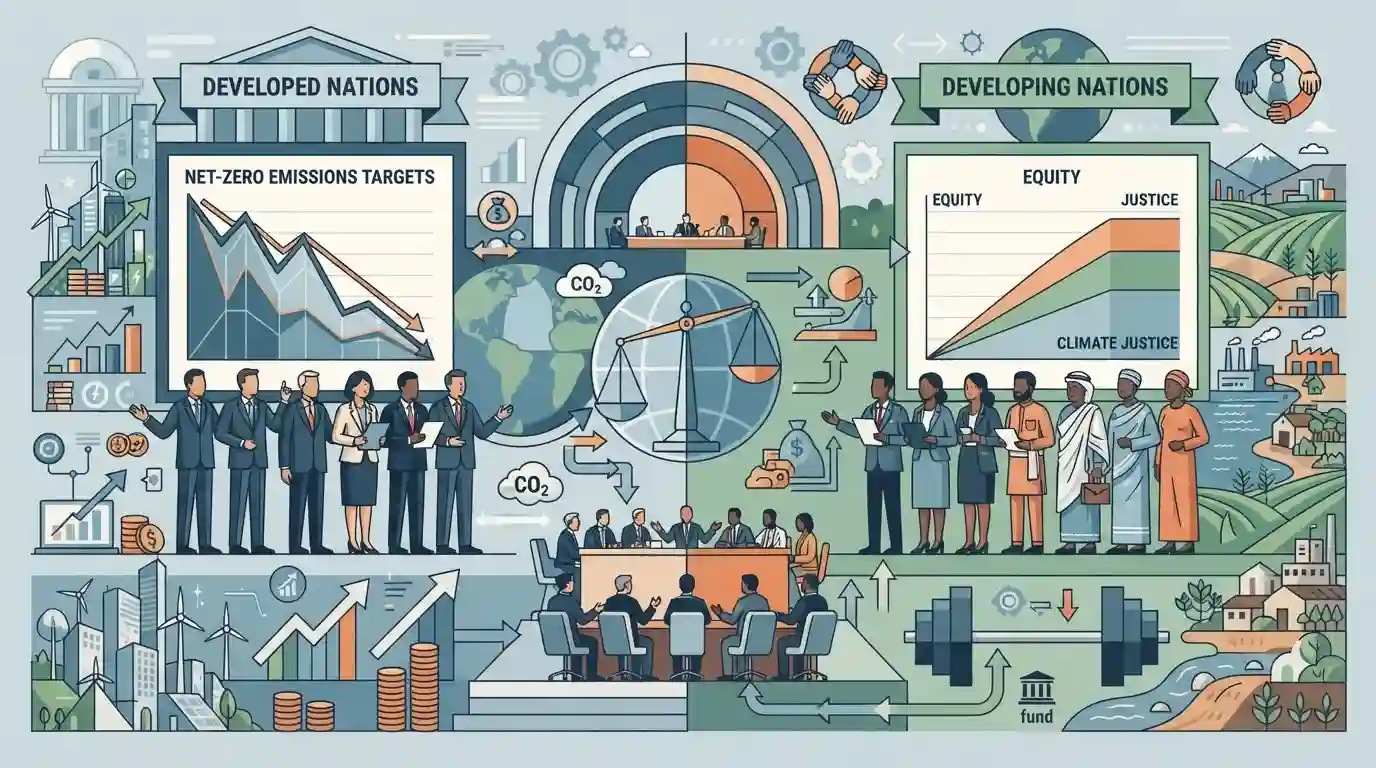
The COP31 draft agreement on net-zero emissions targets highlights major geopolitical divisions between developed and developing countries regarding climate timelines, equity, and financial support under the UNFCCC framework.
Key Points
- COP31 draft agreement introduces text calling for net-zero emissions targets, igniting debates among developed and developing nations over timelines and equity.
- The negotiations center on balancing historical responsibilities of developed nations with ambitious climate action requirements for emerging economies.
- Financing and technology transfer remain critical sticking points in achieving accelerated global emission cuts.
Important Terms
Paris Agreement

An international treaty adopted in 2015 under the UNFCCC to limit global warming to well below 2°C, preferably 1.5°C, through nationally determined climate actions.
UPSC context
UPSC Prelims/Mains (GS Paper III): Environment & Ecology. Evaluates international climate change governance, commitments, and CBDR-RC principles.
Net Zero Emissions Target
Achieving an overall balance between greenhouse gas emissions produced and greenhouse gas emissions removed from the atmosphere.
UPSC context
UPSC Mains GS Paper III: Conservation, environmental pollution and degradation. Tests understanding of decarbonization pathways and India's long-term climate goals.
United Nations Framework Convention on Climate Change
The foundational 1992 Rio Earth Summit treaty that provides the overarching international legal framework for combating global climate change.
UPSC context
UPSC Prelims/Mains (GS Paper III): Core international environmental treaty framework, principles of equity, and historical responsibility.
Conference of the Parties
The supreme decision-making body of the UNFCCC, comprising all member states that review implementation of climate conventions and agreements.
UPSC context
UPSC Prelims: International environmental negotiations, annual climate summits, and outcomes related to climate finance and mitigation.
Static Concepts Connected
What are the core pillars of the UNFCCC and the CBDR-RC principle?
- Rio Summit: Established at the 1992 Rio Earth Summit, the UNFCCC sets the overarching framework for intergovernmental efforts to tackle climate change.
- Historical Debt: Acknowledges that developed countries bear historical responsibility for greenhouse gas emissions and possess greater financial and technological capacities.
- Equity Basis: Requires all parties to protect the climate system based on equity and in accordance with their common but differentiated responsibilities and respective capabilities.
Cross-Topic Patterns
Net-Zero Targets vs. CBDR-RC Principle
The debate on net-zero emission timelines directly tests the principle of Common But Differentiated Responsibilities (CBDR-RC) against global mitigation targets under international environmental law.
Climate Finance and North-South Diplomacy
Climate finance and technology transfer obligations of developed nations link international environmental negotiations directly to North-South economic diplomacy and multilateral trade forums.

CBDR-RC application, net-zero timelines, and climate finance obligations often appear as multi-statement conceptual trap questions.
Linked PYQs · 2
Linked PYQs · 2
- 2025MainsGS3
Write a review on India's climate commitments under the Paris Agreement (2015) and mention how these have been further strengthened in COP26 (2021). In this direction, how has the first Nationally Determined Contribution intended by India been updated in 2022?
- 2021MainsGS3
Describe the major outcomes of the 26th session of the Conference of the Parties (COP) to the United Nations Framework Convention on Climate Change (UNFCCC). What are the commitments made by India in this conference?
