COP31 Climate Summit Fossil Fuel Finance and Negotiations
Source:Indian Express ↗
Why It Matters
Understanding the dynamics of UN climate summits, fossil fuel phase-out debates, and climate finance architecture is essential for questions on global environmental governance and India's negotiating stance.
Summary
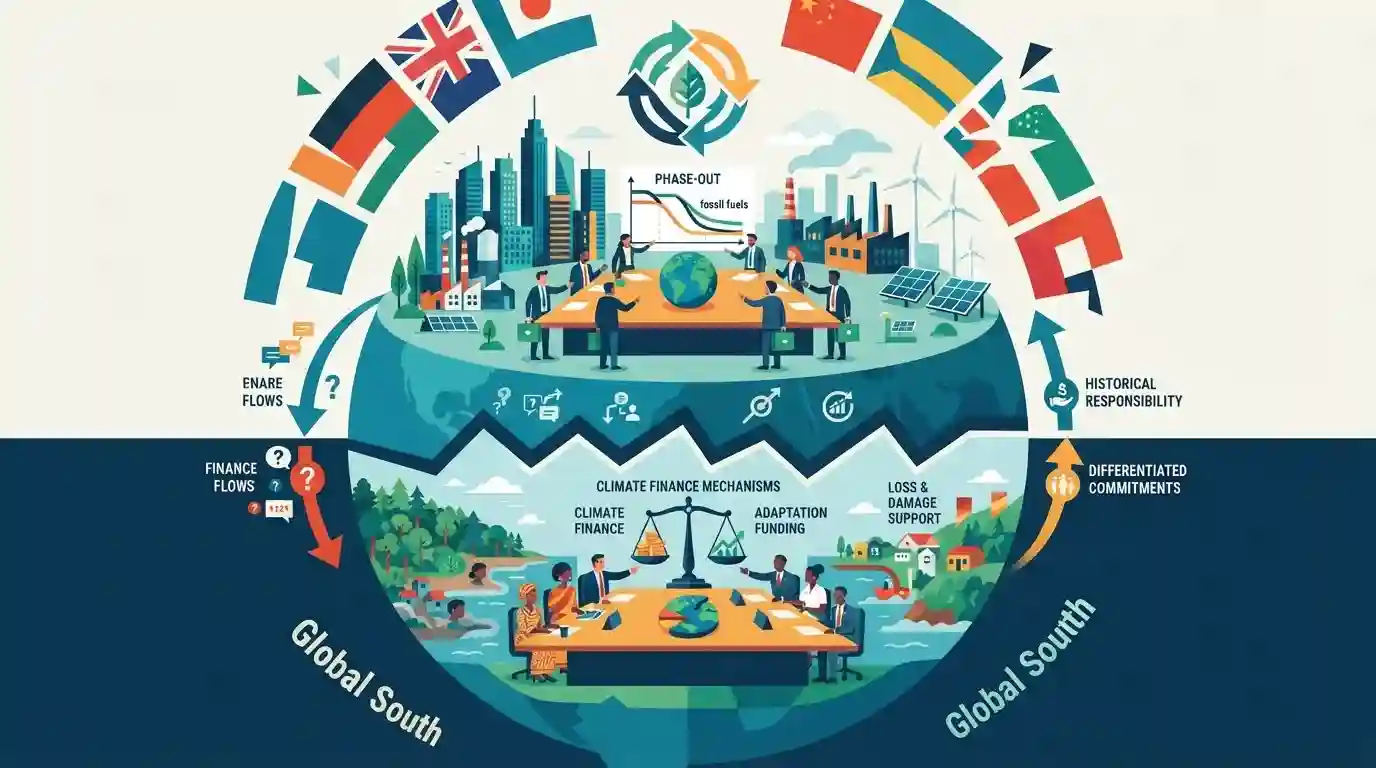
The article examines the core negotiations and key areas of contention at the COP31 climate summit, focusing on the polarized debates between developed and developing nations regarding fossil fuel phase-outs and adequate climate finance mechanisms.
Key Points
- COP31 climate summit negotiations focus heavily on contentious debates surrounding fossil fuel phase-out commitments and climate finance.
- Developing nations demand enhanced, predictable financial support from developed countries to meet their Nationally Determined Contributions (NDCs).
- Geopolitical friction and divergent economic priorities between developed and developing economies continue to stall consensus on mitigation targets.
Important Terms
COP31

The 31st United Nations Climate Change Conference, focused on translating global climate commitments into actionable implementation, fossil fuel phase-outs, and climate finance mechanisms.
UPSC context
UPSC GS Paper III (Environment, Conservation, and Climate Change): tests current affairs in global environmental diplomacy, UNFCCC summits, and climate negotiations.
Paris Agreement
A legally binding international treaty adopted under the UNFCCC in 2015, aiming to limit global temperature rise to well below 2°C, preferably 1.5°C, above pre-industrial levels.
UPSC context
UPSC GS Paper III (Environment and Ecology): tests core international conventions, Nationally Determined Contributions (NDCs), and global climate mitigation strategies.
UNFCCC
The parent international environmental treaty adopted at the 1992 Rio Earth Summit to stabilize greenhouse gas concentrations in the atmosphere.
UPSC context
UPSC GS Paper III (Environment and Ecology): tests foundational knowledge of international environmental governance, COP mechanisms, and climate policy frameworks.
Prelims Trap
COP host countries possess the final authority to unilaterally mandate binding fossil-fuel phase-out targets for all member states.
Aspirants often assume COP host countries unilaterally dictate mitigation texts, overlooking that consensus among all UNFCCC parties is legally required.
Static Concepts Connected
What are the key mechanisms and principles governing climate finance under the UNFCCC framework?
- CBDR-RC:: Historical responsibility principle where developed nations bear primary responsibility due to cumulative emissions.
- Financial Targets:: New Collective Quantified Goal (NCQG) succeeding the previous $100 billion annual target.
- Loss & Damage:: Operationalization of loss and damage funds specifically for vulnerable developing economies.
Cross-Topic Patterns
Climate Finance + WTO Subsidy Rules
COP climate finance debates regularly intersect with WTO subsidy disputes, particularly when green-tech export restrictions or carbon border adjustments (CBAM) trigger trade retaliation from developing economies.
Fossil Fuel Phase-out + Sustainable Banking
Negotiations on fossil fuel phase-outs directly influence RBI and financial sector green taxonomy frameworks, shifting capital allocation toward transition assets.

Expect a match-the-following or statement-based question pairing COP financial commitments (NCQG) with UNFCCC accountability mechanisms.
Linked PYQs · 2
Linked PYQs · 2
- 2021MainsGS3
Describe the major outcomes of the 26th session of the Conference of the Parties (COP) to the United Nations Framework Convention on Climate Change (UNFCCC). What are the commitments made by India in this conference?
- 2025MainsGS3
Write a review on India's climate commitments under the Paris Agreement (2015) and mention how these have been further strengthened in COP26 (2021). In this direction, how has the first Nationally Determined Contribution intended by India been updated in 2022?
