Reforming Multilateral Climate Negotiations After COP Impasses
Source:Indian Express ↗
Why It Matters
The deadlock at recent COP climate summits directly impacts global climate governance, international climate finance commitments, and India's negotiating stance on fossil fuels and sustainable development under the UNFCCC framework.
Summary
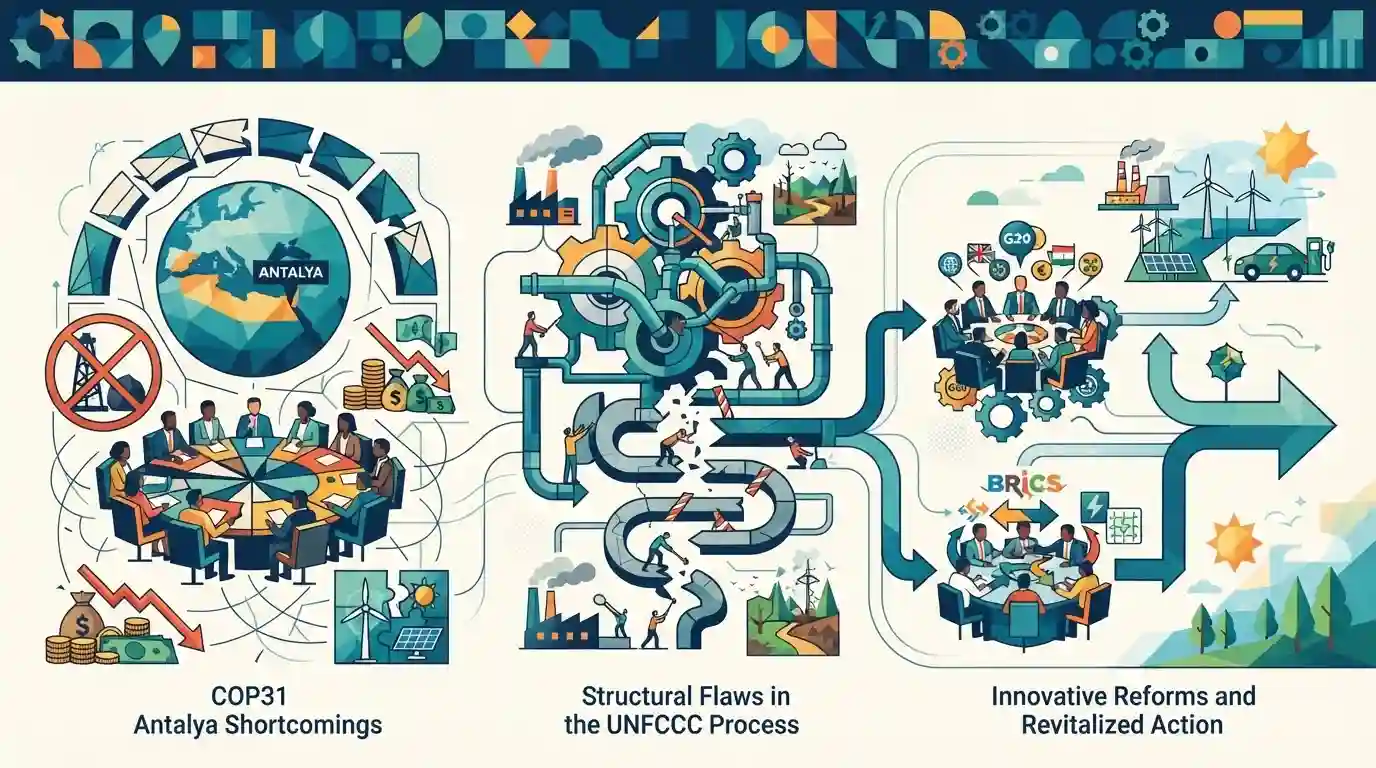
The article analyses the shortcomings of the COP31 climate summit held in Antalya, Turkey, which failed to reach consensus on fossil fuel phase-outs or climate finance. It discusses structural flaws in the UNFCCC multilateral process and proposes innovative reforms like integrated bargaining and climate minilateralism via groups like the G20 and BRICS to revitalize global climate action.
Key Points
- COP31 in Antalya, Turkey, concluded without agreements on phasing out fossil fuels or securing adequate climate finance, highlighting deep structural shortfalls in multilateral climate negotiations.
- The summit revealed profound divisions over adaptation finance, clean energy transitions, and the realistic admission that the world is likely to overshoot the 1.5°C warming limit.
- Experts advocate for a new climate playbook involving an 'integrated bargain' (tying action directly to predictable finance and technology) and climate 'minilateralism' through smaller groupings like G20 or BRICS to break institutional deadlocks.
Important Terms
UNFCCC

The UN Framework Convention on Climate Change is the foundational 1992 international treaty that sets out the overall legal framework for global efforts to combat climate change.
UPSC context
GS Paper III (Environment & Ecology); tests core international environmental governance, multilateral treaties, and global climate conventions.
Paris Agreement
A landmark 2015 international climate treaty within the UNFCCC framework aiming to limit global warming to well below 2°C, preferably 1.5°C, through voluntary Nationally Determined Contributions.
UPSC context
GS Paper III (Environment); vital for understanding global emission targets, India's NDCs, and international climate diplomacy.
G20
An international forum of the world's major economies that coordinates global economic policy and increasingly plays a critical minilateral role in driving climate finance and energy transition.
UPSC context
GS Paper II & III (IR and Economy/Environment); tests multilateral groupings, economic diplomacy, and coordinated global policy making on climate issues.
BRICS
An emerging-market geopolitical bloc comprising major developing nations that seeks to reform global governance structures, including negotiating unified positions on climate finance and sustainable development.
UPSC context
GS Paper II (International Relations); important for studying India's foreign policy alignments, multilateral groupings, and developing world perspectives on climate negotiations.
Static Concepts Connected
What are the core institutional mechanisms and principles under the UNFCCC framework?
- Framework Role: UNFCCC sets non-binding limits on greenhouse gas emissions for individual countries using annual Conference of the Parties (COP) meetings.
- CBDR Principle: CBDR-RC principle dictates that all countries share responsibility for combating climate change, but developed nations bear the primary historical burden.
- NDCs: NDCs represent national climate action plans submitted every five years under the Paris Agreement to progressively reduce emissions.
Cross-Topic Patterns
Climate Finance vs MDB Reforms
The stalemate over adaptation finance at UN summits directly connects to broader North-South trade negotiations and reform demands for multilateral development banks.

Expect statement-based questions on the limits of UNFCCC consensus and the shift toward plurilateral climate minilateralism (G20/BRICS).
Linked PYQs · 2
Linked PYQs · 2
- 2021MainsGS3
Describe the major outcomes of the 26th session of the Conference of the Parties (COP) to the United Nations Framework Convention on Climate Change (UNFCCC). What are the commitments made by India in this conference?
- 2025MainsGS3
Write a review on India's climate commitments under the Paris Agreement (2015) and mention how these have been further strengthened in COP26 (2021). In this direction, how has the first Nationally Determined Contribution intended by India been updated in 2022?
