COP31 Climate Summit and India Strategic Agenda
Source:Indian Express ↗
Why It Matters
Crucial for understanding India's evolving stance on international climate negotiations, equity, climate finance, and commitments under the UNFCCC framework.
Summary
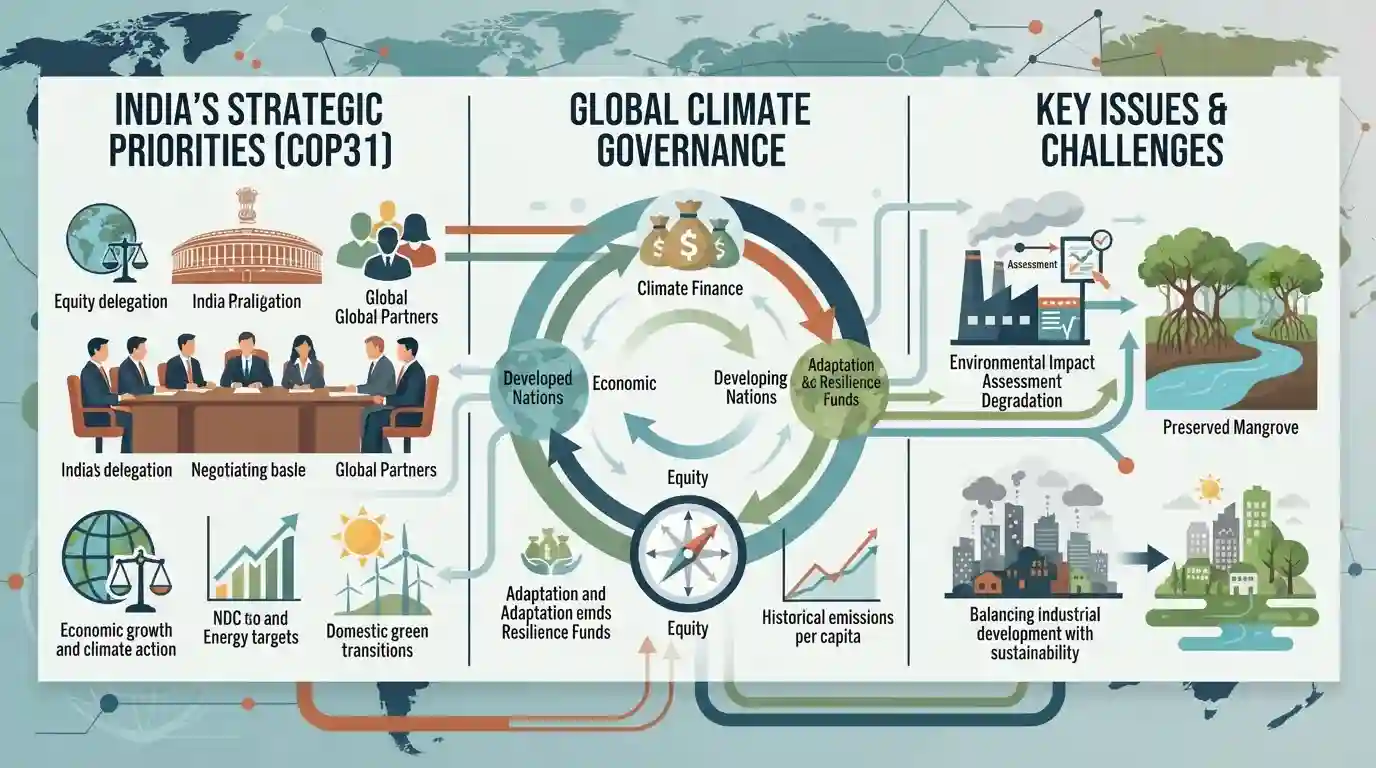
The article discusses India's strategic priorities and negotiating agenda for the upcoming COP31 climate summit to be hosted in Antalya, Turkey. It highlights key global climate governance issues, including climate finance, equity, and Nationally Determined Contributions (NDCs).
Key Points
- Turkey is set to host COP31 climate summit in Antalya, marking a major diplomatic and logistical milestone for the region.
- India's agenda at COP summits typically focuses on equity, climate justice, CBDR-RC (Common But Differentiated Responsibilities and Respective Capabilities), and climate finance for developing nations.
- Key negotiation areas include updating Nationally Determined Contributions (NDCs), scaling up adaptation finance, and transition support for emerging economies.
Important Terms
COP31

The 31st Conference of the Parties to the UNFCCC, held in Antalya, Turkey, serving as a key global multilateral forum for reviewing climate commitments and negotiating climate finance and emissions reduction strategies.
UPSC context
UPSC Prelims/Mains (GS Paper III - Environment). Tests knowledge of international environmental conventions, summits, and India's negotiating positions.
Nationally Determined Contributions
Non-binding climate action plans submitted every five years by countries under the Paris Agreement, detailing national targets for reducing greenhouse gas emissions and adapting to climate impacts.
UPSC context
UPSC Prelims/Mains (GS Paper III - Environment). Frequently asked regarding India's climate pledges, net-zero targets, and global climate governance.
Paris Agreement
A landmark 2015 international climate treaty under the UNFCCC framework committing nations to hold global temperature increases well below 2 degrees Celsius above pre-industrial levels.
UPSC context
UPSC Prelims/Mains (GS Paper III - Environment). Core component of global environmental architecture and international climate diplomacy.
UNFCCC
The primary international environmental treaty adopted in 1992 to stabilize greenhouse gas concentrations in the atmosphere at a level that prevents dangerous anthropogenic interference with the climate system.
UPSC context
UPSC Prelims/Mains (GS Paper III - Environment). Fundamental treaty foundation for global climate negotiations and COP summits.
Static Concepts Connected
What are the core pillars of the UNFCCC Paris Agreement framework?
- NDC Cycle: Nationally Determined Contributions (NDCs) submitted and updated every five years by each member country.
- Equity Principle: Common But Differentiated Responsibilities (CBDR-RC) acknowledging historical emissions and economic capacities.
- Transparency: Enhanced Transparency Framework (ETF) for tracking climate action and support provided or received.
Cross-Topic Patterns
NDCs vs. Climate Finance Realities
Developing nations link ambitious NDCs to predictable climate finance flows from developed countries, turning environmental talks into protracted North-South financial negotiations.

Expect statements linking CBDR-RC evolution under the Paris Agreement to mandatory financial transparency and adaptation fund flows.
Linked PYQs · 3
Linked PYQs · 3
- 2025MainsGS3
Write a review on India's climate commitments under the Paris Agreement (2015) and mention how these have been further strengthened in COP26 (2021). In this direction, how has the first Nationally Determined Contribution intended by India been updated in 2022?
- 2021MainsGS3
Describe the major outcomes of the 26th session of the Conference of the Parties (COP) to the United Nations Framework Convention on Climate Change (UNFCCC). What are the commitments made by India in this conference?
- 2022MainsGS3
Do you think India will meet 50 percent of its energy needs from renewable energy by 2030 ? Justify your answer. How will the shift of subsidies from fossil fuels to renewables help achieve the above objective ? Explain.
