COP31 Antalya Climate Deal Collapse and India Implications
Source:Indian Express ↗
Why It Matters
Understanding multilateral climate negotiations, climate finance disputes, and India's negotiating stance at UNFCCC COPs is vital for GS3 Environment and IR questions.
Summary
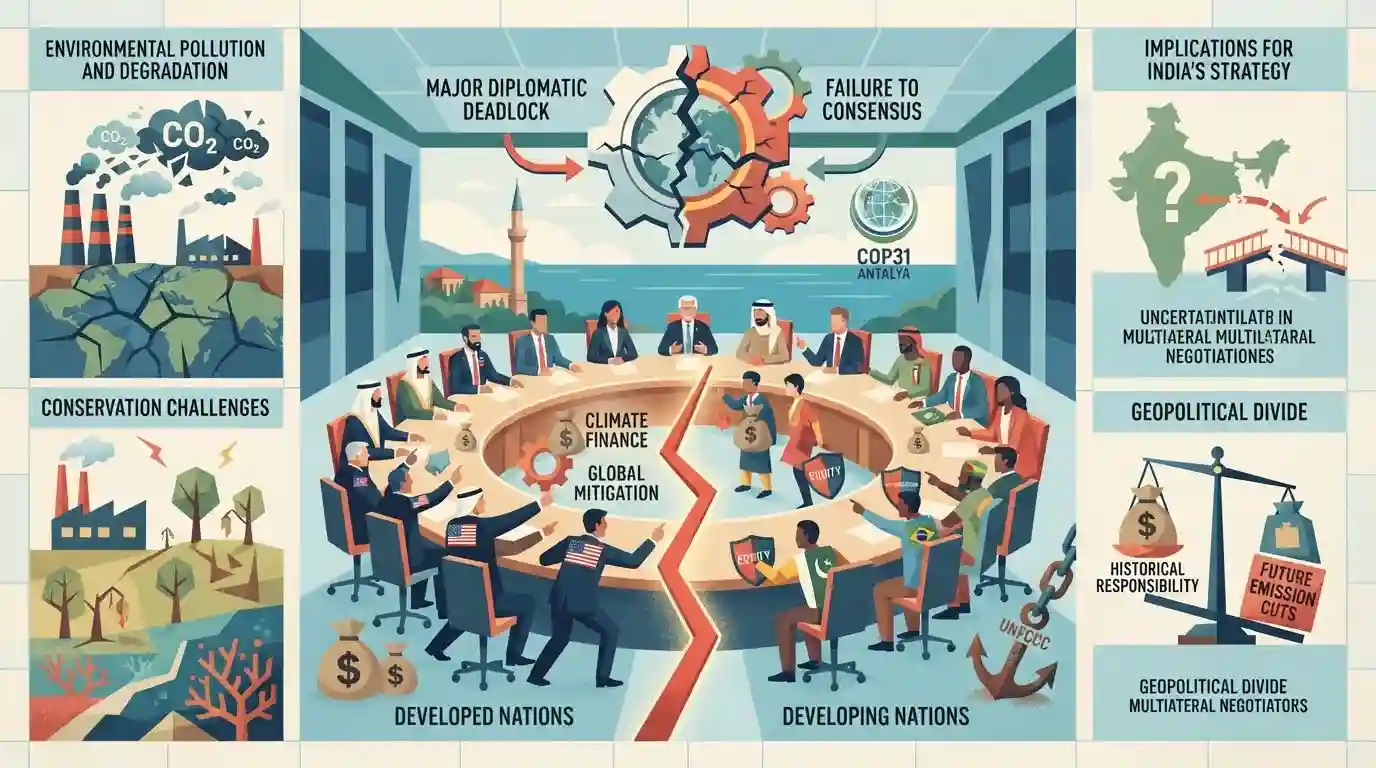
The COP31 climate conference in Antalya, Turkey, suffered a major diplomatic deadlock and failure, stalling crucial consensus on climate finance and global mitigation targets. The collapse underscores deep-seated geopolitical divisions between developed and developing nations over financial responsibilities, equity, and the implementation of climate commitments under the UNFCCC, with significant implications for India's climate strategy and multilateral negotiations.
Key Points
- The COP31 climate summit negotiations held in Antalya, Turkey, faced severe deadlock and failure over core issues including climate finance and mitigation ambitions.
- Developed and developing nations clashed over the quantum and mobilization of climate finance, transparency, and equity principles like Common But Differentiated Responsibilities (CBDR).
- India's stance emphasized climate justice, historical responsibility of developed nations, and adequate financial and technological support for transition.
- The breakdown highlights systemic gridlocks in multilateral climate governance and multilateralism under the UNFCCC framework.
Important Terms
UNFCCC

The foundational 1994 international environmental treaty providing the overarching framework for intergovernmental efforts to tackle climate change, primarily through annual Conferences of the Parties (COPs).
UPSC context
UPSC Prelims/Mains (Environment): Tests understanding of core global climate governance architecture and historical multilateral treaties.
Paris Agreement
A landmark 2015 legally binding international treaty under the UNFCCC aiming to hold global temperature rise well below 2°C and pursue efforts to limit it to 1.5°C.
UPSC context
UPSC Prelims/Mains (Environment & IR): Crucial for questions on mitigation, adaptation, climate equity, and India's international obligations.
Nationally Determined Contributions
Voluntary national climate action plans submitted every five years by signatories to the Paris Agreement, detailing emissions reduction targets and adaptation strategies.
UPSC context
UPSC Mains (GS Paper III - Environment): Evaluates India's domestic climate commitments, पंचामृत targets, and transition to green energy.
COP31
The 31st United Nations Climate Change Conference held in Antalya, Turkey, notable for diplomatic deadlocks and friction over climate finance and mitigation goals.
UPSC context
UPSC Current Affairs (International Relations & Environment): Tests tracking of recent global climate summits, geopolitical divides, and North-South negotiations.
Prelims Trap
Nationally Determined Contributions (NDCs) under the Paris Agreement are legally binding emission reduction targets enforceable by the UNFCCC compliance committee.
Aspirants often confuse voluntary pledges under NDCs with legally binding mitigation targets under the UNFCCC framework.
Static Concepts Connected
What are the core tenets and legal nature of the CBDR-RC principle under the UNFCCC?
- Historical Responsibility: Historical responsibility acknowledged because developed countries are historically responsible for the majority of cumulative global greenhouse gas emissions.
- Different Capacities: Different capacities recognized as developing nations require financial resources and technology transfer to pursue low-carbon pathways without compromising poverty eradication.
- Legal Differentiation: Legal differentiation established initially under the 1992 UNFCCC Annex I/Non-Annex I split, which has evolved into nuanced NDCs under the Paris Agreement.
Cross-Topic Patterns
Climate Finance Deadlocks vs. Trade Protectionism
Climate deadlocks over adaptation and mitigation financing directly intersect with WTO subsidy rules for green tech and critical mineral export restrictions.
Multilateral Gridlock and Plurilateral Coalitions
The breakdown of multilateral consensus in UNFCCC forums pushes developing nations like India toward plurilateral coalitions like ISA and CDRI.

Expect statements testing the operationalization of CBDR-RC versus new financial architectures like the NCQG in recent COP outcomes.
Linked PYQs · 2
Linked PYQs · 2
- 2021MainsGS3
Describe the major outcomes of the 26th session of the Conference of the Parties (COP) to the United Nations Framework Convention on Climate Change (UNFCCC). What are the commitments made by India in this conference?
- 2025MainsGS3
Write a review on India's climate commitments under the Paris Agreement (2015) and mention how these have been further strengthened in COP26 (2021). In this direction, how has the first Nationally Determined Contribution intended by India been updated in 2022?
