India Stance on Climate Equity and Adaptation at COP30
Source:The Hindu ↗
Why It Matters
Provides crucial talking points on India's evolving stance at global climate negotiations (UNFCCC COP), focusing on climate justice, CBDR-RC, and opposition to unilateral trade barriers like carbon border taxes. Directly relevant for GS-3 Environment (Climate Change negotiations) and GS-2 IR (Global groupings affecting India's interests).
Summary
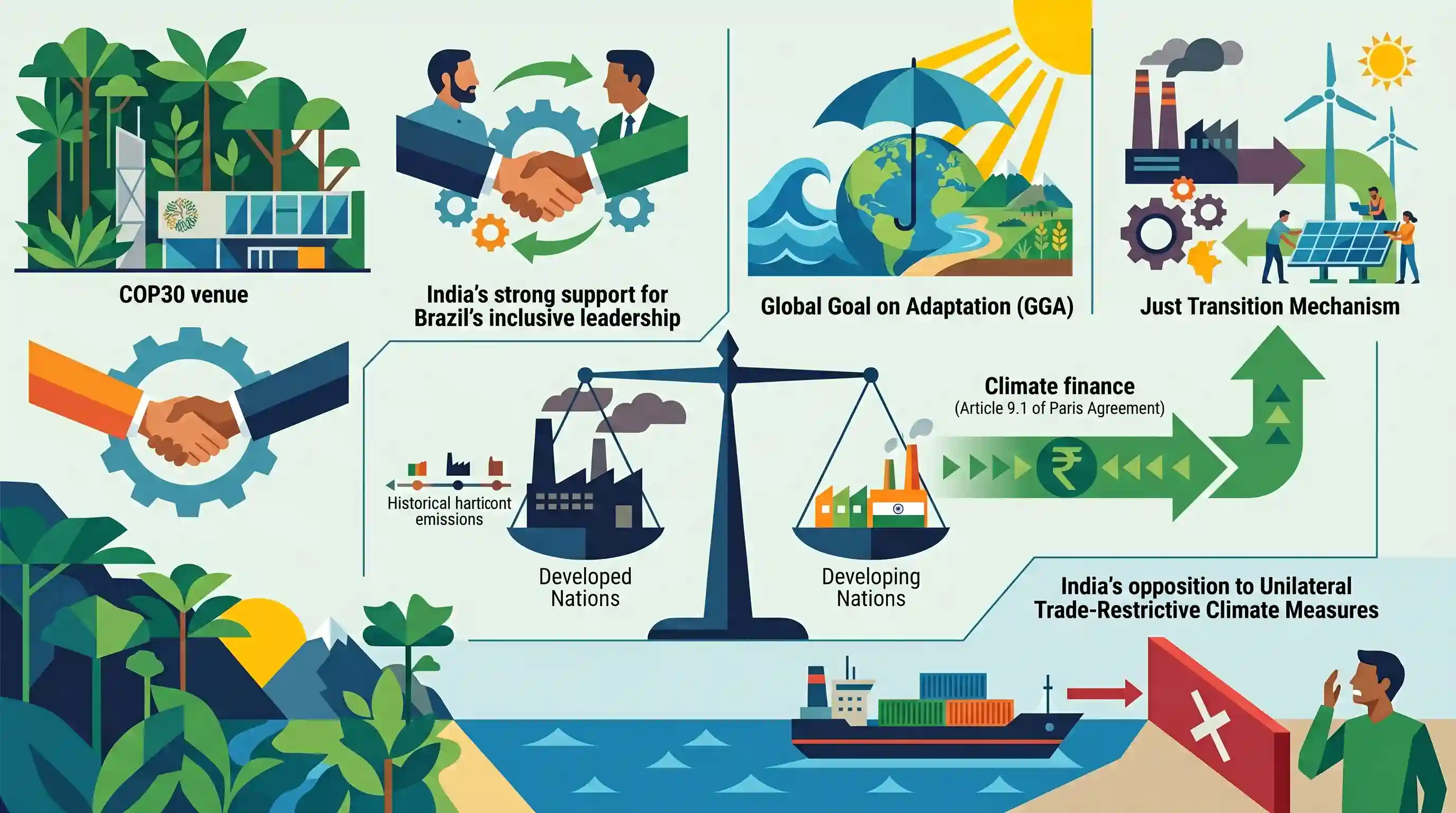
At the COP30 climate summit in Belém, Brazil, India extended strong support for the host country's inclusive leadership while expressing reservations about the summit's overall success in generating robust climate prevention policies. India welcomed progress on the Global Goal on Adaptation (GGA) and the establishment of the Just Transition Mechanism, but strongly emphasized the dimension of climate equity. Stressing the long-standing obligations of developed nations under Article 9.1 of the Paris Agreement, India called for adequate climate finance. Furthermore, India opposed Unilateral Trade-Restrictive Climate Measures, asserting they violate the principle of Common But Differentiated Responsibilities and Respective Capabilities (CBDR-RC) and unfairly shift the burden of climate change mitigation onto developing nations with minimal historical responsibility.
Key Points
- India extended support for Brazil's inclusive COP30 Presidency but refrained from declaring the summit an outright success in establishing binding climate change prevention policies.
- Welcomed progress on the Global Goal on Adaptation (GGA), stressing the necessity of incorporating equity into adaptation goals.
- Reiterated that developed nations must honor their historical obligations to provide climate finance, citing Article 9.1 of the Paris Agreement.
- Expressed satisfaction with the establishment of the Just Transition Mechanism to support equitable shifts to green economies.
- Strongly opposed Unilateral Trade-Restrictive Climate Measures, arguing they violate the principles of equity and CBDR-RC by shifting the mitigation burden to developing nations.
Important Terms
Common But Differentiated Responsibilities and Respective Capabilities (CBDR-RC)

A foundational UNFCCC principle acknowledging that all states share responsibility for climate action but have different obligations based on historical emissions and current financial/technical capacities.
UPSC context
GS Paper 3 (Environment); core principle of climate equity and India's 'Global South' leadership stance.
Article 9.1 (Paris Agreement)
A provision in the Paris Agreement that legally obligates developed nations to provide financial resources to assist developing countries with mitigation and adaptation efforts.
UPSC context
GS Paper 3 (Climate Finance); tests understanding of treaty obligations versus voluntary financial mobilization.
Global Goal on Adaptation (GGA)
A framework under Article 7 of the Paris Agreement designed to enhance adaptive capacity, strengthen resilience, and reduce climate vulnerability globally, putting adaptation on par with mitigation.
UPSC context
GS Paper 3 (Environment); tests knowledge of global resilience frameworks and adaptation financing gaps.
Just Transition Mechanism
A framework (including the Belém Action Mechanism) ensuring that the transition to green economies is fair and inclusive, protecting workers and communities dependent on carbon-intensive industries.
UPSC context
GS Paper 3 (Environment/Energy); tests concepts of climate justice and equitable energy shifts.
Paris Agreement
A landmark 2015 legally binding international treaty aimed at limiting global warming to well below 2°C (preferably 1.5°C) through national climate action plans (NDCs).
UPSC context
GS Paper 3 (Environment); foundational climate treaty requiring detailed knowledge of global governance mechanisms.
UNFCCC
The 1992 international treaty that provides the overarching framework for global climate negotiations and holds annual Conference of the Parties (COP) meetings.
UPSC context
GS Paper 3 (Environment); the primary institutional body for international environmental law and multilateral agreements.
Prelims Trap
Unilateral carbon border taxes are UNFCCC-endorsed mechanisms designed to enforce CBDR-RC.
Developing nations fiercely argue that unilateral measures like CBAM actually violate CBDR-RC by shifting the mitigation burden onto poorer nations.
Static Concepts Connected
What is the principle of CBDR-RC in international climate law?
- Origin: Formalized at the 1992 Earth Summit (UNFCCC), serving as the cornerstone of international climate equity.
- Core Logic: While all states must address climate change (Common), developed nations have greater historical emissions and financial capacity to act (Differentiated).
- Application: It underpins why developed nations have explicit financial obligations (like Article 9.1 of the Paris Agreement) to assist developing countries.
What are Unilateral Trade-Restrictive Climate Measures?
- Definition: Domestic policies that impose tariffs or taxes on imported goods based on their carbon footprint, such as the EU's Carbon Border Adjustment Mechanism (CBAM).
- Developed View: They aim to prevent "carbon leakage"—where industries relocate to countries with lax emission rules to avoid domestic carbon costs.
- Developing View: Viewed as protectionist non-tariff barriers that violate WTO rules and UNFCCC equity principles by penalizing less industrialized economies.
Cross-Topic Patterns
Carbon Border Taxes vs. WTO rules
The clash between policies like the EU's Carbon Border Adjustment Mechanism (CBAM) and developing nations bridges environmental equity (CBDR-RC) with WTO non-discrimination principles, creating a dual-subject flashpoint.
Evolution of Climate Finance Obligations
Tracing the shift from Kyoto's rigid Annex I targets to the Paris Agreement's bottom-up approach highlights the escalating geopolitical friction over developed nations' delayed historical financial obligations.

The conflict between unilateral trade rules (e.g., CBAM) and UNFCCC's CBDR-RC principle is prime material for a 2026 GS-3 question.
Linked PYQs · 5
Linked PYQs · 5
- 2022MainsGS3
Discuss global warming and mention its effects on the global climate. Explain the control measures to bring down the level of greenhouse gases which cause global warming, in the light of the Kyoto Protocol, 1997.
- 2025MainsGS3
Write a review on India's climate commitments under the Paris Agreement (2015) and mention how these have been further strengthened in COP26 (2021). In this direction, how has the first Nationally Determined Contribution intended by India been updated in 2022?
- 2021MainsGS3
Describe the major outcomes of the 26th session of the Conference of the Parties (COP) to the United Nations Framework Convention on Climate Change (UNFCCC). What are the commitments made by India in this conference?
- 2020MainsGS3
Explain intra-generational and inter-generational issues of equity from the perspective of inclusive growth and sustainable development.
- 2025PrelimsGS1
Consider the following statements : Statement I: Article 6 of the Paris Agreement on climate change is frequently discussed in global discussions on sustainable development and climate change. Statement II: Article 6 of the Paris Agreement on climate change sets out the principles of carbon markets. Statement III : Article 6 of the Paris Agreement on climate change intends to promote inter-country non-market strategies to reach their climate targets. Which one of the following is correct in respect of the above statements?
