COP30 Draft Agreement on Climate Finance and Unilateral Trade Measures
Source:Indian Express ↗
Why It Matters
The intersection of climate action and international trade is a pivotal concern for developing economies like India. Understanding the diplomatic pushback against mechanisms like CBAM is crucial for analyzing India's foreign policy, export competitiveness, and stance in multilateral climate negotiations.
Summary
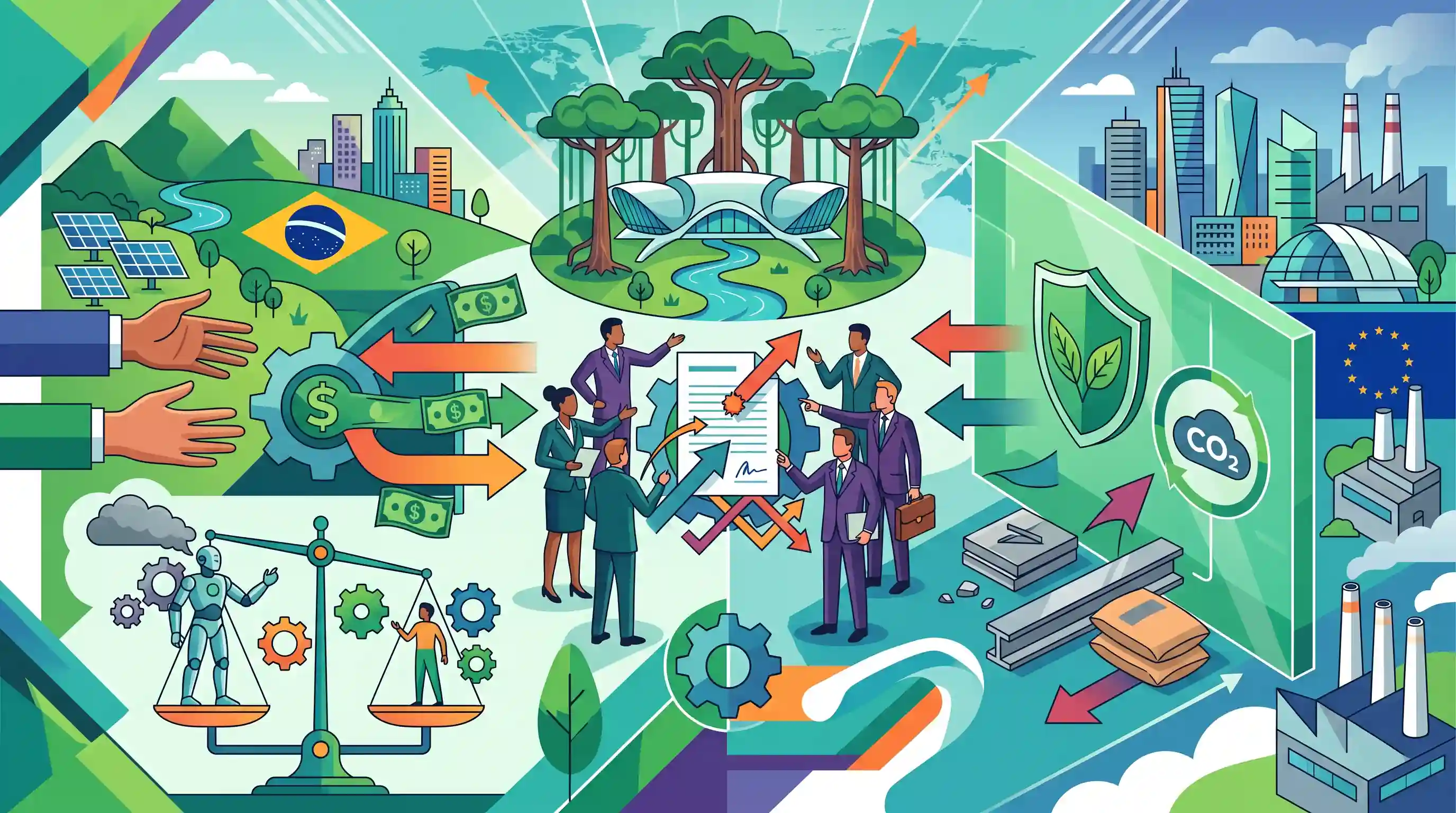
In preparation for the COP30 climate summit in Belém, host country Brazil has released a preliminary 'political' draft agreement focusing heavily on climate finance and global trade dynamics. The draft highlights the ongoing necessity to solidify the New Collective Quantified Goal (NCQG), pushing developed countries for stronger public finance commitments to aid the Global South. A significant portion of the text is dedicated to criticizing unilateral trade policies implemented under environmental pretenses, such as the EU's Carbon Border Adjustment Mechanism (CBAM). By invoking the principle of Common But Differentiated Responsibilities and Respective Capabilities (CBDR-RC), the draft asserts that such border carbon taxes risk acting as arbitrary trade barriers that disproportionately penalize developing economies, shaping the central diplomatic battleground for the upcoming COP30 negotiations.
Key Points
- Brazil, the host of COP30, has released a draft 'political' agreement aiming to steer global negotiations on climate finance and unilateral trade measures.
- The draft centers on the New Collective Quantified Goal (NCQG) for climate finance, reiterating the demand for developed nations to provide adequate and predictable public finance to developing countries.
- It directly addresses controversial unilateral trade measures, such as the EU's Carbon Border Adjustment Mechanism (CBAM), echoing concerns from the Global South about disguised green protectionism.
- The text strongly aligns with the UNFCCC principle of Common But Differentiated Responsibilities and Respective Capabilities (CBDR-RC), advocating that environmental measures should not arbitrarily restrict international trade or unfairly burden developing economies.
Important Terms
New Collective Quantified Goal (NCQG)

A new post-2025 climate finance target set to replace the previous USD 100 billion annual goal, aiming to provide trillions for developing nations' mitigation and adaptation.
UPSC context
GS Paper 3: Environmental Conservation and Climate Finance; critical for analyzing global equity and India's demands at COP summits.
Carbon Border Adjustment Mechanism (CBAM)
The EU's policy tool that imposes a carbon price on carbon-intensive imports (like steel and aluminum) to match the costs paid by domestic EU producers.
UPSC context
GS Paper 2 & 3: International Relations and Trade; tests impact on Indian exports and potential violations of WTO/climate equity.
Common But Differentiated Responsibilities and Respective Capabilities (CBDR-RC)
A principle under the UNFCCC acknowledging that all states share responsibility for environmental protection but have different obligations based on historical contributions and economic capacity.
UPSC context
GS Paper 3: International Environmental Governance; the cornerstone of climate justice debates between the Global North and South.
Paris Agreement
A legally binding 2015 international treaty aiming to limit global warming to well below 2°C, preferably 1.5°C, through nationally determined contributions (NDCs).
UPSC context
GS Paper 3: Environment; tests understanding of current global climate legal frameworks and India's 2070 net-zero pledge.
United Nations Framework Convention on Climate Change (UNFCCC)
The foundational 1992 treaty established at the Rio Earth Summit to stabilize greenhouse gas concentrations and prevent dangerous human interference with the climate.
UPSC context
GS Paper 3: International Conventions; foundational knowledge for all environment-related questions in Prelims and Mains.
COP30 (Belém Climate Summit)
The 30th session of the Conference of the Parties to the UNFCCC, held in Brazil, focusing on climate finance and trade-related environmental measures.
UPSC context
GS Paper 3: Current Affairs; tests the specific outcomes of the Brazil summit, including the 'Global Mutirão' draft.
Prelims Trap
"The Carbon Border Adjustment Mechanism (CBAM) is a UN-mandated tariff adopted under the UNFCCC framework."
CBAM is a unilateral measure by the European Union, not a UN or WTO-mandated tariff. Developing nations actively criticize it at UNFCCC platforms as a violation of CBDR-RC.
Static Concepts Connected
What is the New Collective Quantified Goal (NCQG) in climate finance?
- Post-2025 Target: It is a forthcoming climate finance target meant to replace the 2009 Copenhagen pledge of $100 billion per year, which expired in 2025.
- Needs-based Quantum: While $100 billion is set as the absolute floor, the NCQG aims to establish a much higher, needs-based quantum for developing nations.
- Contributor Base Debate: A major friction point is developed countries pushing to expand the contributor base to include wealthy developing nations like China and Gulf states.
How does CBDR-RC function in international environmental frameworks?
- Rio Origin: Formalized at the 1992 Earth Summit (Rio Declaration) and embedded in the UNFCCC as a guiding framework for climate equity.
- Shared but Differentiated: Acknowledges that while all nations share a common duty to protect the global environment, they have different historical contributions to the problem.
- Historical Liability: Mandates that developed nations, having greater historical emissions and financial capacity, must take the lead in mitigation and providing climate finance.
Cross-Topic Patterns
Carbon Taxes & WTO Exceptions
The clash between the EU's CBAM and WTO's non-discrimination rules (GATT Article XX environmental exceptions) bridges Environment (GS3) and International Economy (GS3), testing the boundaries of "green protectionism."
BASIC Group's Negotiating Stance
Brazil, South Africa, India, and China (BASIC) jointly oppose unilateral climate trade barriers, linking climate diplomacy directly to the broader Global South's multipolar geopolitical assertions.

A 2026 prelims/mains question will likely pair the EU's CBAM with India's export vulnerabilities and the NCQG climate finance gridlock.
Linked PYQs · 5
Linked PYQs · 5
- 2025MainsGS3
Write a review on India's climate commitments under the Paris Agreement (2015) and mention how these have been further strengthened in COP26 (2021). In this direction, how has the first Nationally Determined Contribution intended by India been updated in 2022?
- 2021MainsGS3
Describe the major outcomes of the 26th session of the Conference of the Parties (COP) to the United Nations Framework Convention on Climate Change (UNFCCC). What are the commitments made by India in this conference?
- 2025PrelimsGS1
Consider the following statements : Statement I: Article 6 of the Paris Agreement on climate change is frequently discussed in global discussions on sustainable development and climate change. Statement II: Article 6 of the Paris Agreement on climate change sets out the principles of carbon markets. Statement III : Article 6 of the Paris Agreement on climate change intends to promote inter-country non-market strategies to reach their climate targets. Which one of the following is correct in respect of the above statements?
- 2023PrelimsGS1
Consider the following statements: Statement-I: Carbon markets are likely to be one of the most widespread tools in the fight against climate change. Statement-II: Carbon markets transfer resources from the private sector to the State. Which one of the following is correct in respect of the above statements?
- 2010PrelimsGS1
The United Nations Framework Convention on Climate Change (UNFCCC) is an international treaty drawn at
