Sundarbans Delta Faces Severe Erosion and Rising Sea Levels
Source:The Hindu ↗
Why It Matters
Understanding the specific vulnerabilities of the Sundarbans provides vital case studies for Mains answers on coastal erosion, sea-level rise, and the ecological importance of mangroves. Furthermore, it outlines India's key priorities for upcoming climate negotiations (COP30), particularly regarding adaptation finance and the intersection of air pollution and climate policy.
Summary
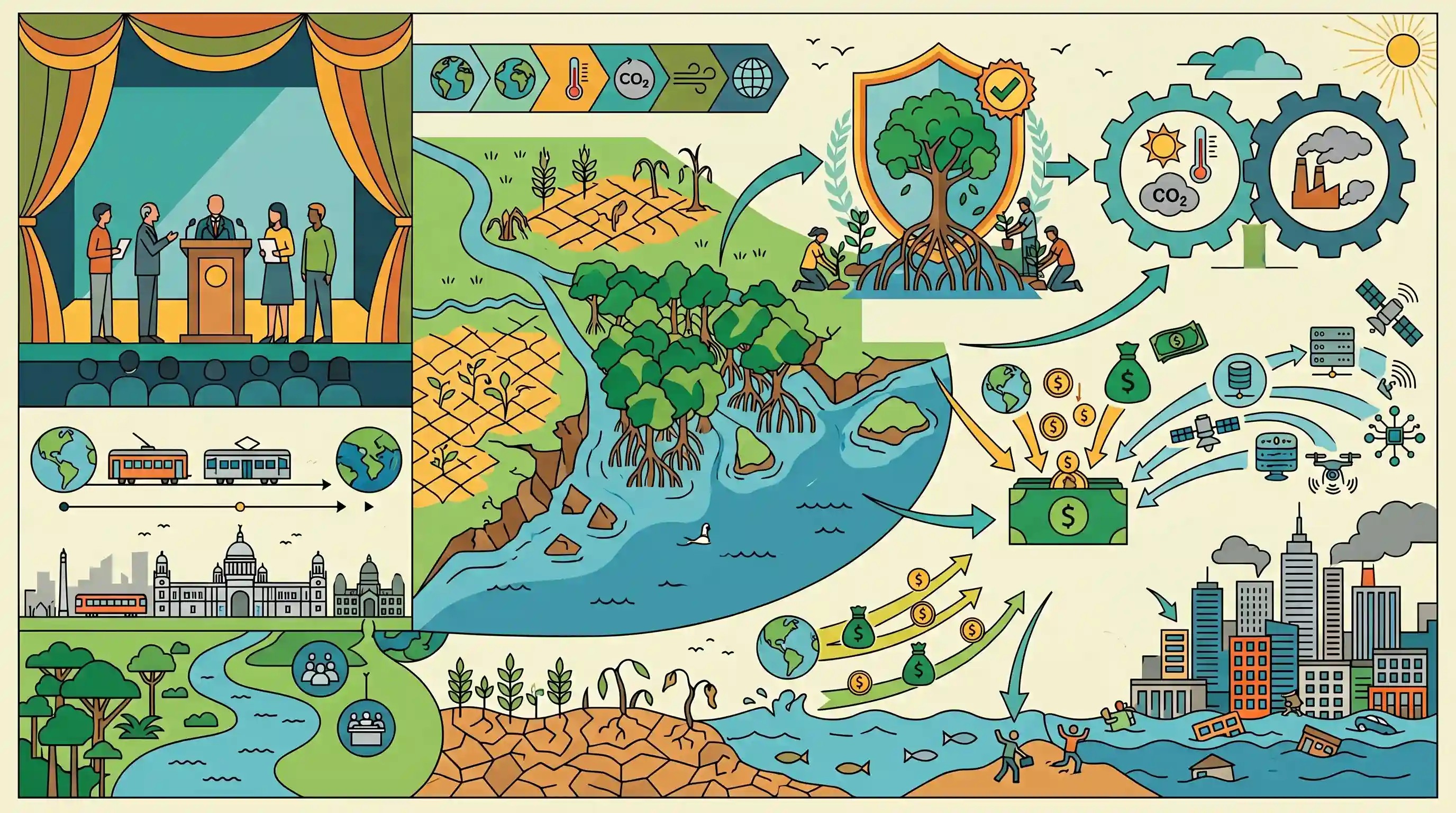
A curtain-raiser event in Kolkata for the upcoming UNFCCC COP30 in Belém highlighted the acute vulnerability of the Sundarbans delta to climate change. Experts warned of severe coastal erosion, rising sea levels, and agricultural loss, calling for dedicated global climate finance, technological aid, and a 'special status' for ecologically sensitive mangrove ecosystems. The discussions also stressed the need for integrated policymaking that treats climate change and air pollution as interconnected challenges, while addressing the heightened climate risks faced by unplanned coastal urban centers like Kolkata.
Key Points
- The Sundarbans delta is facing severe ecological threats, including coastal erosion, rising sea levels, and shrinking freshwater supplies, putting millions of livelihoods at risk.
- Experts at a COP30 curtain-raiser emphasized the need to grant special vulnerability status to the Sundarbans and ensure global technological and financial support for adaptation.
- Climate change and air pollution must be addressed holistically rather than as isolated problems, given their intertwined impacts on health and the environment.
- Unplanned urbanization exacerbates the vulnerability of coastal cities like Kolkata, making integrated climate action crucial ahead of the Belém summit.
Important Terms
UNFCCC

An international environmental treaty adopted at the 1992 Rio Earth Summit to stabilize greenhouse gas concentrations. It provides the framework for global climate negotiations and annual Conference of the Parties (COP) meetings.
UPSC context
GS Papers II & III; foundational for global governance, international treaties, and climate mitigation strategies.
UNFCCC COP30
The 30th UN Climate Change Conference, scheduled for 2025 in Belém, Brazil. Known as the 'Amazon COP,' it focuses on implementation, nature-based solutions, and updated Nationally Determined Contributions (NDCs).
UPSC context
GS Paper III; critical current affair regarding global climate leadership, tropical forest conservation, and finance.
Paris Agreement
A legally binding 2015 international treaty aiming to limit global warming to well below 2°C, preferably 1.5°C. It introduced the system of self-determined climate targets known as NDCs.
UPSC context
GS Paper III; central to India’s climate commitments and global environmental governance.
Center for Study of Science, Technology and Policy (CSTEP)
A prominent Bengaluru-based Indian think tank that provides evidence-based research to influence policy in energy, climate, and air quality. It supports government bodies like NITI Aayog.
UPSC context
GS Paper III; relevant for science-policy interface and institutional roles in India's energy transition.
Bengal Chamber of Commerce and Industry (BCC&I)
One of India's oldest industry associations (Kolkata-based) that advocates for sustainable development and regional climate resilience, particularly for the ecologically sensitive Sundarbans delta.
UPSC context
GS Paper III; highlights the role of industry and regional stakeholders in climate adaptation.
Prelims Trap
The UNFCCC has formally granted the Sundarbans 'special vulnerability status' for adaptation finance.
This is a demand by experts, not a legally binding UNFCCC category. Currently, UNFCCC recognizes country groupings like SIDS and LDCs for special consideration, not specific sub-national ecosystems.
Static Concepts Connected
What are the unique ecological adaptations of mangrove vegetation?
- Pneumatophores: Upward-growing, blind roots that emerge from the water/mud to facilitate gas exchange in oxygen-poor, waterlogged soils.
- Vivipary: Seeds germinate while still attached to the parent tree, increasing survival chances when they drop into the tidal mud.
- Salt tolerance: Leaves have specialized salt glands to excrete excess salt, and roots act as ultra-filters to block salt entry.
How does the UNFCCC address climate-induced 'Loss and Damage'?
- Warsaw International Mechanism: Established at COP19 (2013) to avert, minimize, and address loss and damage associated with the impacts of climate change in developing countries.
- Santiago Network: Established at COP25 to catalyze technical assistance for vulnerable countries implementing loss and damage approaches.
- Loss and Damage Fund: A dedicated financial mechanism agreed upon at COP27 and operationalized at COP28 to directly compensate vulnerable nations.
Cross-Topic Patterns
SLCPs bridging pollution and climate
Black carbon and tropospheric ozone link local air quality to regional climate warming. UPSC often pairs domestic pollution policies (NCAP) with global warming mitigation frameworks.
Transboundary conservation vs. sovereignty
The Sundarbans spans India and Bangladesh, making its survival a bilateral diplomatic issue (2011 MoU) that complicates purely national-level climate adaptation planning.

Expect a 2026 Mains question linking transboundary ecological zones (like the Sundarbans) to the UNFCCC Loss and Damage Fund.
Linked PYQs · 4
Linked PYQs · 4
- 2019MainsGS1
Discuss the causes of depletion of mangroves and explain their importance in maintaining coastal ecology.
- 2022MainsGS3
Explain the causes and effects of coastal erosion in India. What are the available coastal management techniques for combating the hazard?
- 2025MainsGS1
How are climate change and the sea level rise affecting the very existence of many island nations? Discuss with examples.
- 2021MainsGS3
Describe the major outcomes of the 26th session of the Conference of the Parties (COP) to the United Nations Framework Convention on Climate Change (UNFCCC). What are the commitments made by India in this conference?
