COP30 Conclusions on Climate Finance and Fossil Fuel Transition
Source:The Hindu ↗
Why It Matters
Outcomes of the UNFCCC COP are highly relevant for UPSC. Aspirants must track evolving terms like 'Global Mutirão', 'Global Implementation Accelerator', and debates around Article 9 of the Paris Agreement (Climate Finance) for Prelims. The recurring friction over fossil fuel phase-out timelines between developed and developing nations forms the core of GS3 environment mains answers.
Summary
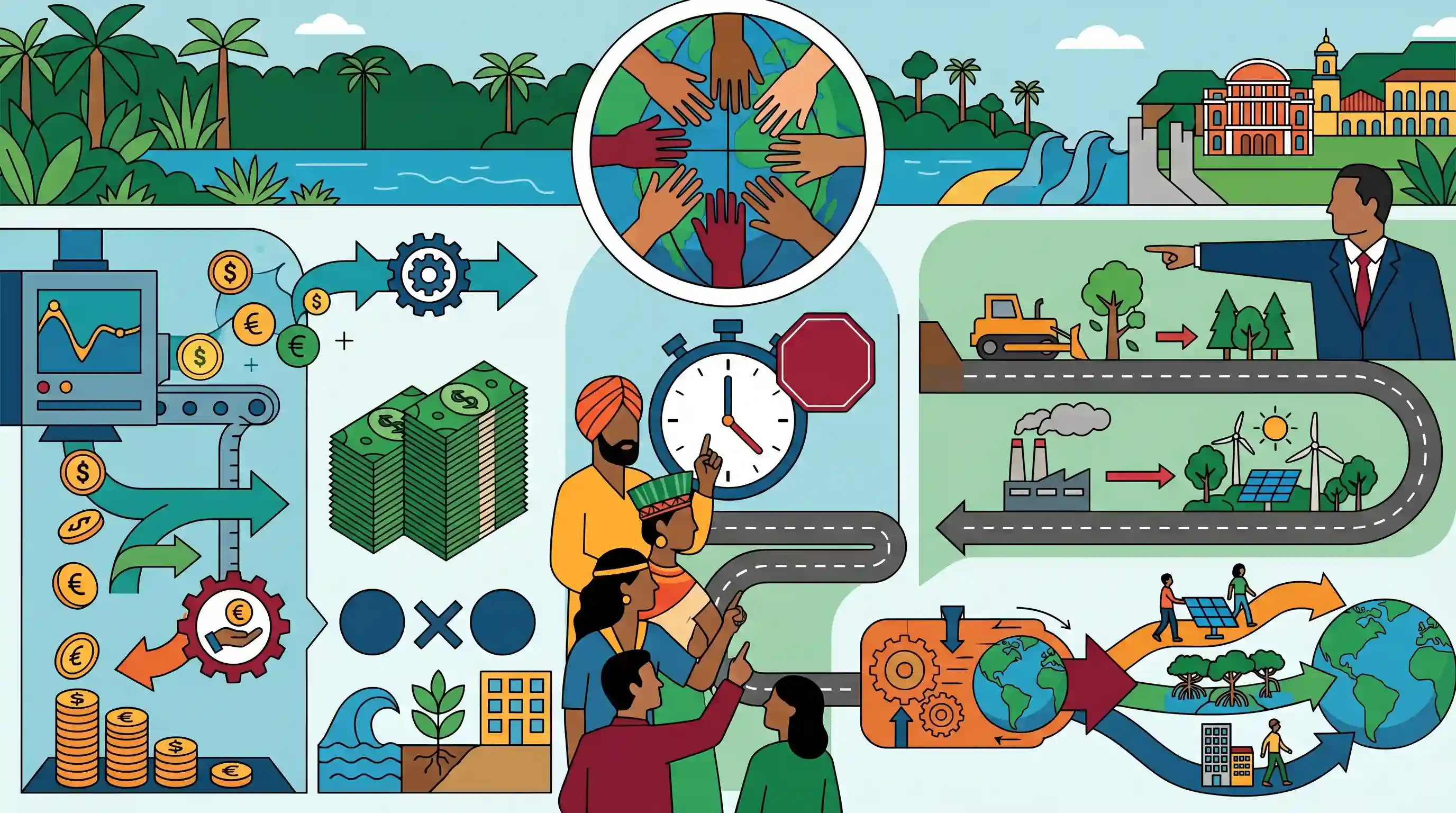
The 30th Conference of Parties (COP30) in Belém, Brazil, concluded with the 'Global Mutirão' consensus, establishing a two-year work program on climate finance under Article 9 of the Paris Agreement and calling to triple adaptation finance. Amidst intense negotiations, developing nations like India successfully resisted binding timelines for fossil fuel elimination. In response, COP President André Corrêa do Lago proposed non-binding roadmaps aimed at halting deforestation and ensuring a just transition away from fossil fuels. The summit also launched a Global Implementation Accelerator and recognized diverse national pathways for achieving climate resilience.
Key Points
- COP30 concluded in Belém, Brazil, with the adoption of the 'Global Mutirão' consensus agreement focusing on a global mobilization against climate change.
- The COP President announced non-binding roadmaps to halt deforestation and ensure a just transition away from fossil fuels, bridging the gap between developing and developed nations' demands.
- Developing countries, including India and major petro-states, successfully opposed the inclusion of definitive timelines for a fossil fuel phase-out in the binding text.
- The summit emphasized operationalizing Article 9 of the Paris Agreement, establishing a two-year work program on climate finance to assist developing nations.
- Other key highlights included calls to triple adaptation finance by 2035, recognizing diverse national pathways for a 'just transition', and launching a Global Implementation Accelerator.
Important Terms
Global Mutirão

A COP30 decision package named after a Brazilian/Indigenous concept of 'collective effort,' emphasizing voluntary implementation and diverse local actions to address climate challenges.
UPSC context
GS III/Environment. Important for understanding the 'Implementation COP' outcomes and non-binding cooperation frameworks.
Paris Agreement
A 2015 legally binding international treaty focused on limiting global temperature rise through Nationally Determined Contributions (NDCs) submitted by nearly 200 parties.
UPSC context
GS II & III. Essential for climate governance, international relations, and India’s long-term environmental targets.
Global Goal on Adaptation (GGA)
A collective commitment under the Paris Agreement to enhance global resilience; COP30 finalized the UAE-Belém work program by adopting 59 metrics known as the Belém Adaptation Indicators.
UPSC context
GS III/Conservation. Tests knowledge of global frameworks for climate resilience and vulnerability reduction.
Article 9 (Paris Agreement)
A Paris Agreement provision requiring developed nations to provide financial resources to developing countries for mitigation and adaptation, emphasizing public funds over private mobilization.
UPSC context
GS III/Climate Finance. Key for understanding North-South funding disputes and the principle of equity in climate action.
Council on Energy, Environment and Water (CEEW)
A prominent New Delhi-based independent think tank that provides research on India's energy transition, climate risks, and sustainable development for policymakers.
UPSC context
GS III/Environmental Pollution. Relevant for citing data-driven research on India’s domestic climate and energy policies.
Prelims Trap
The Belém Roadmaps adopted at COP30 mandate legally binding timelines for halting deforestation and phasing out fossil fuels.
Developing nations successfully resisted binding timelines. The Belém Roadmaps are non-binding compromises proposed by the COP Presidency to bridge demands between developed and developing nations.
Static Concepts Connected
What are the key provisions of Article 9 of the Paris Agreement?
- Developed Country Mandate: Legally obligates developed nations to provide financial resources to developing nations for both climate change mitigation and adaptation.
- Voluntary Contributions: Encourages other parties (such as emerging economies) to provide or continue to provide such financial support voluntarily.
- Funding Balance: Aims to strike a balance between adaptation and mitigation finance, prioritizing the poorest and most climate-vulnerable nations.
What is Common but Differentiated Responsibilities (CBDR) in climate talks?
- Earth Summit Origin: Formalized in the 1992 Rio Declaration and forms a core guiding principle of the UNFCCC framework.
- Historical Responsibility: Acknowledges that developed nations contributed the most to historical greenhouse gas emissions, thus bearing a greater mitigation burden.
- Equity Basis: Used by developing nations like India to demand 'carbon space' for economic growth and to oppose uniform, binding fossil-fuel phase-out timelines.
Cross-Topic Patterns
Fossil phase-out vs. Energy Security
India's resistance to binding phase-outs at COP30 links to its domestic reliance on coal for base-load power, pitting international climate commitments against domestic energy security and economic growth.
Indigenous terms in climate diplomacy
The 'Global Mutirão' (Tupi-Guarani concept) continues the trend of integrating indigenous frameworks into UNFCCC consensus, similar to the Talanoa Dialogue introduced by Fiji at COP23.

Expect a 2026 Prelims question pairing 'Global Mutirão' with the specific mandates of Article 9 of the Paris Agreement vs voluntary goals.
Linked PYQs · 4
Linked PYQs · 4
- 2025MainsGS3
Write a review on India's climate commitments under the Paris Agreement (2015) and mention how these have been further strengthened in COP26 (2021). In this direction, how has the first Nationally Determined Contribution intended by India been updated in 2022?
- 2021MainsGS3
Describe the major outcomes of the 26th session of the Conference of the Parties (COP) to the United Nations Framework Convention on Climate Change (UNFCCC). What are the commitments made by India in this conference?
- 2025PrelimsGS1
Consider the following statements : Statement I: Article 6 of the Paris Agreement on climate change is frequently discussed in global discussions on sustainable development and climate change. Statement II: Article 6 of the Paris Agreement on climate change sets out the principles of carbon markets. Statement III : Article 6 of the Paris Agreement on climate change intends to promote inter-country non-market strategies to reach their climate targets. Which one of the following is correct in respect of the above statements?
- 2021PrelimsGS1
With reference to the 'New York Declaration on Forests', which of the following statements are correct? 1. It was first endorsed at the United Nations Climate Summit in 2014. 2. It endorses a global timeline to end the loss of forests. 3. It is a legally binding international declaration. 4. It is endorsed by governments, big companies and indigenous communities. 5. India was one of the signatories at its inception. Select the correct answer using the code given below.
