Climate change conference implementation and loss and damage fund
Source:Indian Express ↗
Why It Matters
UNFCCC COP summits are the highest international decision-making bodies on climate action. COP30's emphasis on the implementation of the Paris Agreement, NDCs, and the Loss and Damage fund makes it highly relevant for UPSC aspirants, as these mechanisms frequently appear in GS3 Environment and Prelims questions.
Summary
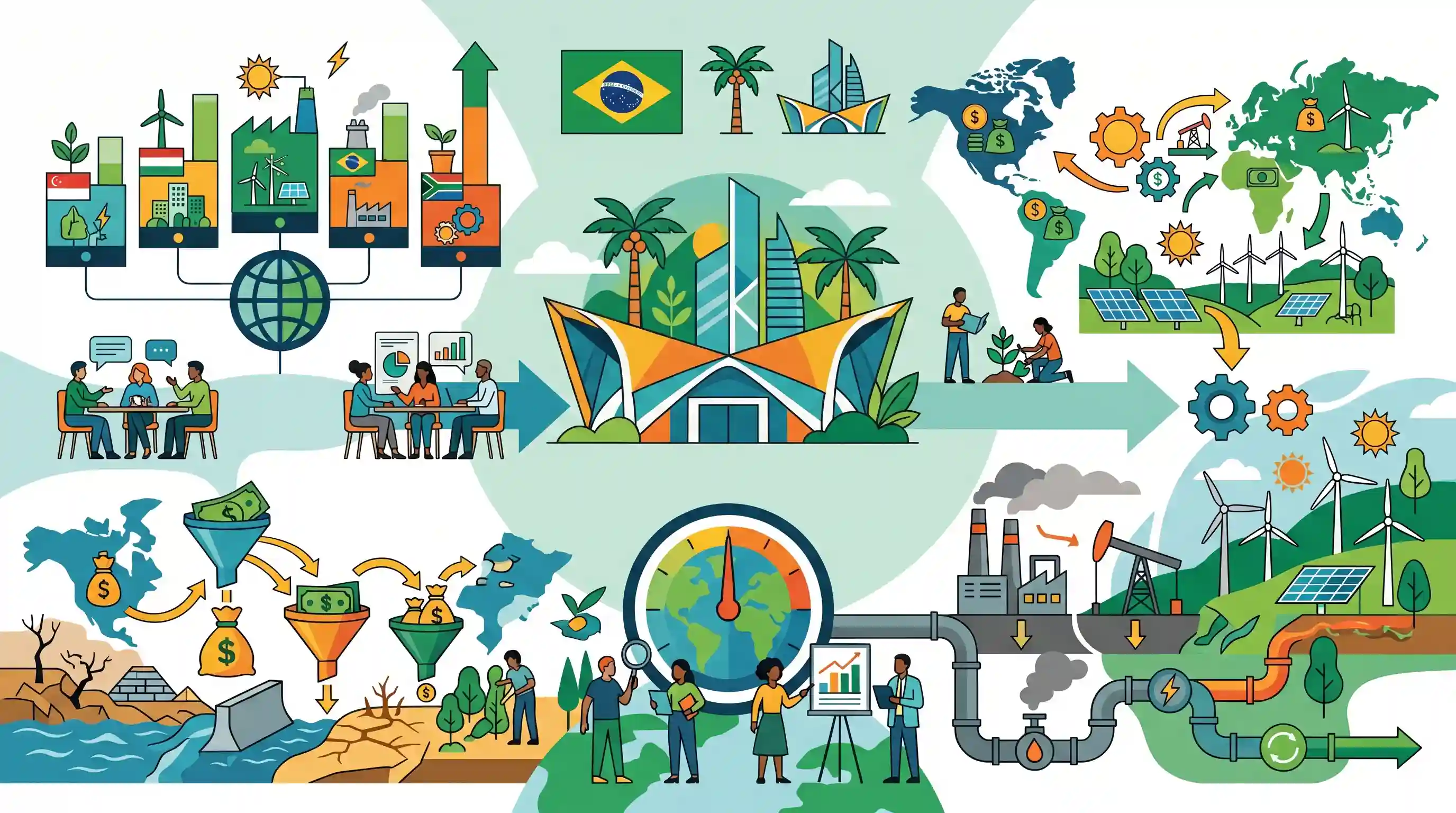
COP30 of the UNFCCC has commenced in Belém, Brazil, with a strategic pivot towards the implementation of existing climate targets rather than negotiating new sweeping pledges. Following limited breakthroughs in recent conferences, the summit's core agenda focuses on actualizing Nationally Determined Contributions (NDCs), operationalizing the Loss and Damage Fund, advancing crucial climate finance for developing countries, and executing the Global Stocktake mandate to phase down fossil fuels to align with the Paris Agreement’s 1.5°C goal.
Key Points
- COP30 of the UNFCCC is being hosted in Belém, Brazil, centering the summit around the critical Amazon region.
- The summit shifts focus from drafting new climate pledges to the actual implementation of existing goals under the Paris Agreement.
- Key agenda items include the updating and strict enforcement of Nationally Determined Contributions (NDCs) by member nations.
- Climate finance remains a major priority, particularly the operationalization of the Loss and Damage fund to assist vulnerable nations.
- Phasing down fossil fuels, in alignment with the outcomes of the first Global Stocktake, is essential to keep the 1.5°C global warming limit alive.
Important Terms
UNFCCC

An international environmental treaty adopted in 1992 at the Rio Earth Summit to stabilize global greenhouse gas concentrations and prevent dangerous human interference with the climate system.
UPSC context
GS Paper III (Environment). Tests foundational knowledge of global climate governance and the legal framework for international negotiations.
Paris Agreement
A legally binding 2015 treaty where countries committed to limiting global temperature rise to well below 2°C, preferably 1.5°C, compared to pre-industrial levels.
UPSC context
GS Paper III (Environment & Ecology) and GS Paper II (IR). Tests understanding of international climate obligations and India's leadership role.
Nationally Determined Contributions (NDCs)
Voluntary, self-defined national climate action plans submitted every five years under the Paris Agreement, outlining targets for reducing emissions and adapting to climate impacts.
UPSC context
GS Paper III (Environment). Crucial for questions on India's 'Panchamrit' targets and the 'ratchet mechanism' of climate ambition.
Global Stocktake
A periodic review mechanism established under the Paris Agreement to assess collective global progress toward climate goals every five years and inform more ambitious future actions.
UPSC context
GS Paper III (Environment). Tests ability to evaluate the effectiveness of global climate policies and identify gaps in implementation.
Loss and Damage Fund
A financial mechanism established to provide compensation and assistance to vulnerable developing nations for unavoidable economic and non-economic damages caused by climate change.
UPSC context
GS Paper III (Environment) and GS Paper II (Climate Justice). Focuses on the North-South divide and historical responsibility for emissions.
Prelims Trap
The Loss and Damage Fund was established under the legally binding provisions of the original 1992 UNFCCC.
The Fund was actually established decades later at COP27 (2022) in Egypt. Furthermore, financial contributions to the fund by developed nations remain strictly voluntary.
Static Concepts Connected
What is the mechanism and purpose of the Global Stocktake (GST)?
- Paris Agreement Mandate: It is formally mandated under Article 14 of the 2015 Paris Agreement to evaluate global collective progress toward long-term climate goals.
- Assessment Cycle: It operates on a five-year cycle. The first-ever GST concluded at COP28 (2023) in Dubai with a call to transition away from fossil fuels.
- Primary Objective: The findings are designed to inform and pressure countries into updating and enhancing their Nationally Determined Contributions (NDCs) for the next cycle.
How is the Loss and Damage (L&D) Fund structured?
- Establishment Timeline: It was agreed upon at COP27 in Sharm el-Sheikh and formally operationalized at COP28 in Dubai.
- Interim Secretariat: The World Bank serves as the interim trustee and hosts the fund's independent secretariat for its initial four years.
- Target Beneficiaries: It provides financial assistance to particularly vulnerable developing nations suffering irreversible impacts of climate change (e.g., sea-level rise, extreme weather).
Cross-Topic Patterns
Amazon rainforest tipping points
Hosting COP30 in Belém highlights the Amazon's role as a global carbon sink. UPSC may link this to physical geography questions on equatorial biomes, deforestation, and savanna transitions.
Climate finance vs. CBAM trade barriers
Developing nations face a double whammy: struggling to secure promised NCQG climate finance while confronting the EU's incoming Carbon Border Adjustment Mechanism (CBAM) tariffs on their exports.

Expect a multi-statement question matching recent COP summits (COP27, 28, 29, 30) with their flagship outcomes like GST, L&D, and NCQG.
Linked PYQs · 5
Linked PYQs · 5
- 2025MainsGS3
Write a review on India's climate commitments under the Paris Agreement (2015) and mention how these have been further strengthened in COP26 (2021). In this direction, how has the first Nationally Determined Contribution intended by India been updated in 2022?
- 2021MainsGS3
Describe the major outcomes of the 26th session of the Conference of the Parties (COP) to the United Nations Framework Convention on Climate Change (UNFCCC). What are the commitments made by India in this conference?
- 2016PrelimsGS1
The term 'Intended Nationally Determined Contributions' is sometimes seen in the news in the context of
- 2016PrelimsGS1
With reference to the Agreement at the UNFCCC Meeting in Paris in 2015, which of the following statements is/are correct? 1. The Agreement was signed by all the member countries of the UN and it will go into effect in 2017. 2. The Agreement aims to limit the greenhouse gas emissions so that the rise in average global temperature by the end of this century does not exceed 2°C or even 1.5°C above pre-industrial levels. 3. Developed countries acknowledged their historical responsibility in global warming and committed to donate $ 1000 billion a year from 2020 to help developing countries to cope with climate change. Select the correct answer using the code given below.
- 2025PrelimsGS1
Consider the following statements : Statement I: Article 6 of the Paris Agreement on climate change is frequently discussed in global discussions on sustainable development and climate change. Statement II: Article 6 of the Paris Agreement on climate change sets out the principles of carbon markets. Statement III : Article 6 of the Paris Agreement on climate change intends to promote inter-country non-market strategies to reach their climate targets. Which one of the following is correct in respect of the above statements?
