UNFCCC climate summit agenda and nationally determined contributions
Source:The Hindu ↗
Why It Matters
COP summits and international climate treaties form the core of UPSC's Environment syllabus. The 10-year anniversary of the Paris Agreement and the deadline for updated NDCs make COP30 highly relevant for both Prelims (treaty mechanisms, carbon markets) and Mains (climate finance, India's NDCs, global climate governance).
Summary
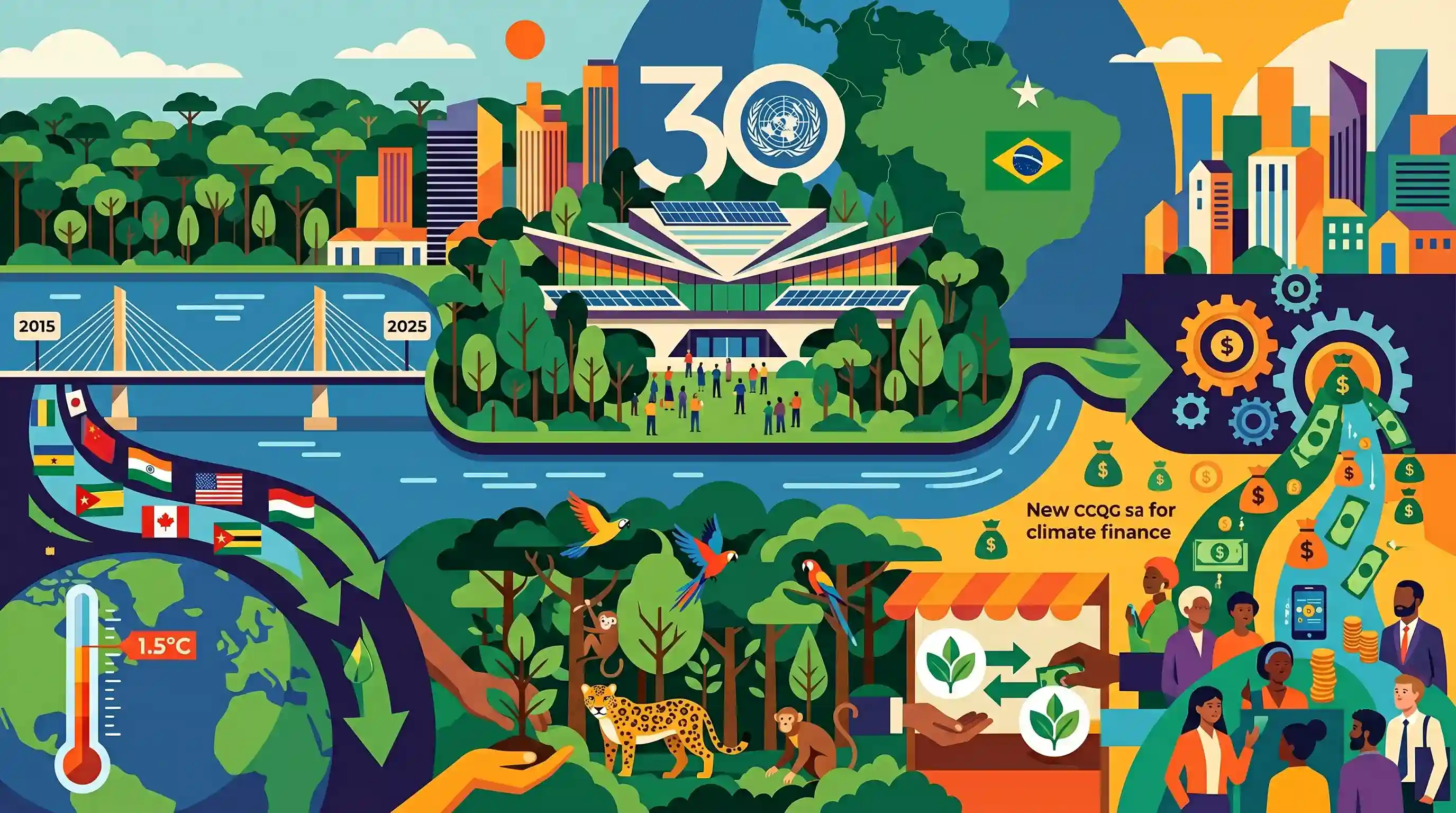
The 30th UN Climate Change Conference (COP30) is scheduled to take place in Belém, Brazil, in November 2025. Set against the backdrop of the Amazon rainforest, the summit represents a critical milestone as it coincides with the 10th anniversary of the landmark 2015 Paris Agreement. The core agenda will revolve around the submission of updated Nationally Determined Contributions (NDCs) by member nations, which are crucial for keeping the 1.5°C global warming target alive. Beyond emission reduction targets, COP30 will focus heavily on advancing the New Collective Quantified Goal (NCQG) for climate finance, emphasizing support for developing nations. Furthermore, the summit's location underscores a strong expectation to prioritize nature-based solutions, forest preservation, and carbon market mechanisms.
Key Points
- COP30 will be hosted in 2025 in Belém, Brazil, located in the Amazon region, marking the 10-year anniversary of the 2015 Paris Agreement.
- Nations are mandated to submit their updated and enhanced Nationally Determined Contributions (NDCs) by 2025 to align with the 1.5°C global warming limit.
- Climate finance will be a major focal point, building on the New Collective Quantified Goal (NCQG) established at COP29 to replace the $100 billion annual target.
- Given the host location, the summit is expected to heavily prioritize nature-based solutions, forest conservation, and the intersection of biodiversity and climate change.
- Discussions will also focus on the ongoing operationalization of international carbon markets under Article 6 of the Paris Agreement.
Important Terms
UNFCCC

An international environmental treaty adopted in 1992 to stabilize greenhouse gas concentrations. it serves as the parent framework for major climate agreements like the Kyoto Protocol and the Paris Agreement.
UPSC context
GS Paper II and III. Tests knowledge of the foundation of global climate governance and institutional frameworks.
Paris Agreement
A legally binding 2015 international treaty aiming to limit global warming to well below 2°C, preferably 1.5°C. It requires all parties to submit progressively ambitious climate action plans.
UPSC context
GS Paper III (Environment). Tests understanding of the core global climate treaty and its impact on India’s policies.
Nationally Determined Contributions (NDCs)
Voluntary climate action plans where countries outline targets for emission reductions and adaptation. Under the Paris Agreement, these must be updated every five years with increasing ambition.
UPSC context
GS Paper III (Environment). Tests knowledge of country-specific pledges and the mechanism for increasing global climate ambition.
New Collective Quantified Goal (NCQG)
A post-2025 climate finance target being negotiated to replace the $100 billion annual pledge. It aims to scale up financial support from developed to developing nations.
UPSC context
GS Paper III (Environment/Economy). Tests understanding of climate finance, equity, and the financial obligations of developed nations.
Article 6 of the Paris Agreement
A provision enabling international cooperation through market-based mechanisms (like carbon trading) and non-market approaches to help countries achieve their emission reduction targets more efficiently.
UPSC context
GS Paper III (Environment/Economy). Tests knowledge of carbon markets and technical mechanisms for international climate cooperation.
Prelims Trap
"The NCQG is a binding commitment for developed countries to provide exactly $100 billion annually."
NCQG replaces the outdated 2009 $100-billion pledge with a new, higher post-2025 financial framework based on developing nations' actual needs, not a flat $100B.
Static Concepts Connected
What are the mechanisms under Article 6 of the Paris Agreement?
- Article 6.2: Allows decentralized bilateral or multilateral trading of carbon credits, known as Internationally Transferred Mitigation Outcomes (ITMOs).
- Article 6.4: Establishes a centralized, UN-supervised global carbon market, effectively replacing the Clean Development Mechanism (CDM) of the Kyoto Protocol.
- Article 6.8: Focuses on non-market approaches, promoting bilateral/multilateral cooperation in mitigation and adaptation without the trading of emission reduction credits.
What are the core rules governing Nationally Determined Contributions (NDCs)?
- Ratchet Mechanism: NDCs must be updated every five years. Each successive NDC must represent a progression (greater ambition) beyond the country's current pledge.
- Binding to Submit: The submission and regular updating of NDCs is legally binding under international law, although achieving the exact domestic targets contained within them is not.
- Global Stocktake Linkage: The updating of NDCs is directly informed by the Global Stocktake (GST), which assesses the world's collective progress toward achieving the Paris Agreement goals.
Cross-Topic Patterns
Climate Action + Kunming-Montreal Biodiversity Framework
Hosting COP30 in the Amazon emphasizes Nature-Based Solutions, bridging UNFCCC emission goals with the Convention on Biological Diversity's (CBD) Kunming-Montreal Global Biodiversity Framework targets for ecosystem conservation.
NCQG + Common But Differentiated Responsibilities (CBDR)
The transition to NCQG revives the static concept of Common But Differentiated Responsibilities (CBDR-RC), sparking geopolitical debates on whether emerging economies should now join developed nations as climate financiers.

Expect a multi-statement prelims question in 2026 integrating Article 6 carbon markets, the Ratchet Mechanism for NDCs, and the NCQG.
Linked PYQs · 5
Linked PYQs · 5
- 2025PrelimsGS1
Consider the following statements : Statement I: Article 6 of the Paris Agreement on climate change is frequently discussed in global discussions on sustainable development and climate change. Statement II: Article 6 of the Paris Agreement on climate change sets out the principles of carbon markets. Statement III : Article 6 of the Paris Agreement on climate change intends to promote inter-country non-market strategies to reach their climate targets. Which one of the following is correct in respect of the above statements?
- 2016PrelimsGS1
The term 'Intended Nationally Determined Contributions' is sometimes seen in the news in the context of
- 2016PrelimsGS1
With reference to the Agreement at the UNFCCC Meeting in Paris in 2015, which of the following statements is/are correct? 1. The Agreement was signed by all the member countries of the UN and it will go into effect in 2017. 2. The Agreement aims to limit the greenhouse gas emissions so that the rise in average global temperature by the end of this century does not exceed 2°C or even 1.5°C above pre-industrial levels. 3. Developed countries acknowledged their historical responsibility in global warming and committed to donate $ 1000 billion a year from 2020 to help developing countries to cope with climate change. Select the correct answer using the code given below.
- 2025MainsGS3
Write a review on India's climate commitments under the Paris Agreement (2015) and mention how these have been further strengthened in COP26 (2021). In this direction, how has the first Nationally Determined Contribution intended by India been updated in 2022?
- 2021MainsGS3
Describe the major outcomes of the 26th session of the Conference of the Parties (COP) to the United Nations Framework Convention on Climate Change (UNFCCC). What are the commitments made by India in this conference?
