COP30 Climate Summit Focuses on NDCs and Climate Finance Goals
Source:The Hindu ↗
Why It Matters
UNFCCC COP summits and India's commitments under the Paris Agreement are perennial UPSC topics. COP30 is especially critical due to the NDC update deadline, the focus on the Amazon (biodiversity), and the implementation of new climate finance goals (NCQG), which can feature in both GS1 Geography and GS3 Environment questions.
Summary
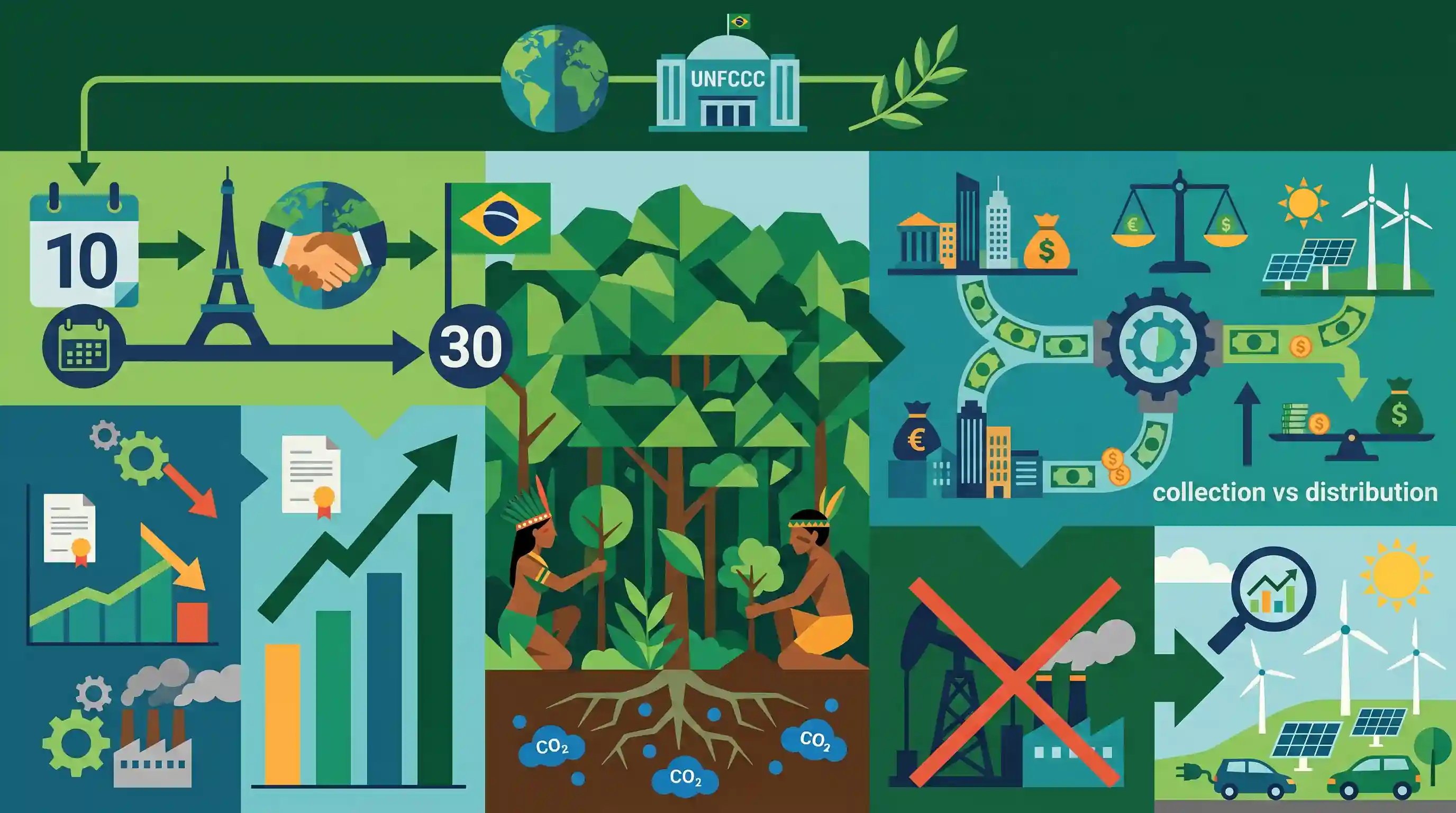
COP30, to be held in Belém, Brazil, is a highly anticipated UN climate summit marking the decade anniversary of the Paris Agreement. A central feature will be the mandatory submission of new Nationally Determined Contributions (NDCs) by member states, which must outline stronger emission reduction targets for the coming decade. Because of its location near the Amazon rainforest, the summit will bring forest conservation and indigenous rights into the spotlight as crucial nature-based climate solutions. Additionally, COP30 will serve as a testing ground for implementing the New Collective Quantified Goal (NCQG) for climate finance and tracking global progress on transitioning away from fossil fuels.
Key Points
- COP30 represents a major milestone, occurring on the 10-year anniversary of the Paris Agreement, requiring nations to submit updated, more ambitious Nationally Determined Contributions (NDCs) to limit global warming to 1.5°C.
- Hosted in Belém, Brazil, located near the Amazon rainforest, the summit will heavily feature the protection of tropical forests, nature-based solutions, and the rights of indigenous communities.
- Following the establishment of the New Collective Quantified Goal (NCQG) on climate finance, COP30 will focus on scaling up financial commitments from developed countries to support vulnerable nations.
- The summit will demand tangible pathways for the transition away from fossil fuels, building on the initial commitments formulated during the Global Stocktake.
Important Terms
Paris Agreement

A landmark 2015 legally binding international treaty aiming to limit global warming to well below 2°C, preferably 1.5°C, through voluntary national climate commitments.
UPSC context
GS Paper III (Environment); tests understanding of global mitigation frameworks and India's leadership in climate diplomacy.
Nationally Determined Contributions (NDCs)
Self-defined national climate action plans submitted every five years under the Paris Agreement, outlining targets for emission reductions and climate adaptation.
UPSC context
GS Paper III (Environment); crucial for questions on India's 'Panchamrit' targets and the global 'ratchet mechanism' for ambition.
New Collective Quantified Goal (NCQG)
A new post-2025 global climate finance target intended to replace the previous USD 100 billion annual goal, focusing on the needs of developing nations.
UPSC context
GS Paper III (Climate Finance); tests concepts of climate justice and the financial obligations of developed vs. developing countries.
UNFCCC
The 1992 foundational international environmental treaty established to stabilize greenhouse gas concentrations and prevent dangerous human interference with the climate system.
UPSC context
GS Paper II (International Relations) and III (Environment); basic framework for all COP summits and international climate governance.
COP30
The 30th UN climate summit, to be held in Brazil, focusing on the first decade of the Paris Agreement and mandatory NDC updates.
UPSC context
Current Affairs/GS III; significant for its focus on the Amazon rainforest, nature-based solutions, and indigenous rights.
Prelims Trap
"The emission reduction targets outlined in Nationally Determined Contributions (NDCs) are legally binding."
While the Paris Agreement mandates the submission and regular updating of NDCs (procedurally binding), the specific domestic emission reduction targets within them are not legally binding.
Static Concepts Connected
What is the Global Stocktake (GST) mechanism?
- Core function: A mandatory five-year review process under the Paris Agreement designed to assess collective global progress toward limiting global warming to 1.5°C.
- Ratchet mechanism: GST outcomes directly inform the next round of NDCs, forcing countries to 'ratchet up' their climate ambitions based on scientific findings.
How does the NCQG differ from previous climate finance goals?
- Scale & Baseline: It replaces the unfulfilled $100 billion annual pledge from COP15 (Copenhagen) with a $1.3 trillion annual mobilization target by 2035.
- Expanded Scope: It shifts focus toward a broader, needs-based framework for developing countries, covering mitigation, adaptation, and loss and damage.
Cross-Topic Patterns
Amazon conservation & nature-based finance
COP30's focus on the 'Tropical Forests Forever Facility' links global climate negotiations to innovative macroeconomic conservation finance, mirroring the rising trend of debt-for-nature swaps in developing nations.
Energy transition vs. Equity (CBDR)
The aggressive push to 'transition away' from fossil fuels directly tests the principle of Common But Differentiated Responsibilities (CBDR), a recurring focal point for India's defense of its coal dependency.

Expect a 2026 prelims question pairing the NCQG target with the mechanics of the Global Stocktake and the procedural nature of NDCs.
Linked PYQs · 4
Linked PYQs · 4
- 2016PrelimsGS1
The term 'Intended Nationally Determined Contributions' is sometimes seen in the news in the context of
- 2025MainsGS3
Write a review on India's climate commitments under the Paris Agreement (2015) and mention how these have been further strengthened in COP26 (2021). In this direction, how has the first Nationally Determined Contribution intended by India been updated in 2022?
- 2021MainsGS3
Describe the major outcomes of the 26th session of the Conference of the Parties (COP) to the United Nations Framework Convention on Climate Change (UNFCCC). What are the commitments made by India in this conference?
- 2021PrelimsGS1
With reference to the 'New York Declaration on Forests', which of the following statements are correct? 1. It was first endorsed at the United Nations Climate Summit in 2014. 2. It endorses a global timeline to end the loss of forests. 3. It is a legally binding international declaration. 4. It is endorsed by governments, big companies and indigenous communities. 5. India was one of the signatories at its inception. Select the correct answer using the code given below.
