Climate Summit COP30 Agenda and Nationally Determined Contributions
Source:The Hindu ↗
Why It Matters
COP30 is the most critical climate summit since Paris 2015, as countries must submit their 2035 NDCs and evaluate the implementation of the Global Stocktake, directly impacting India's climate obligations and energy transition strategies.
Summary
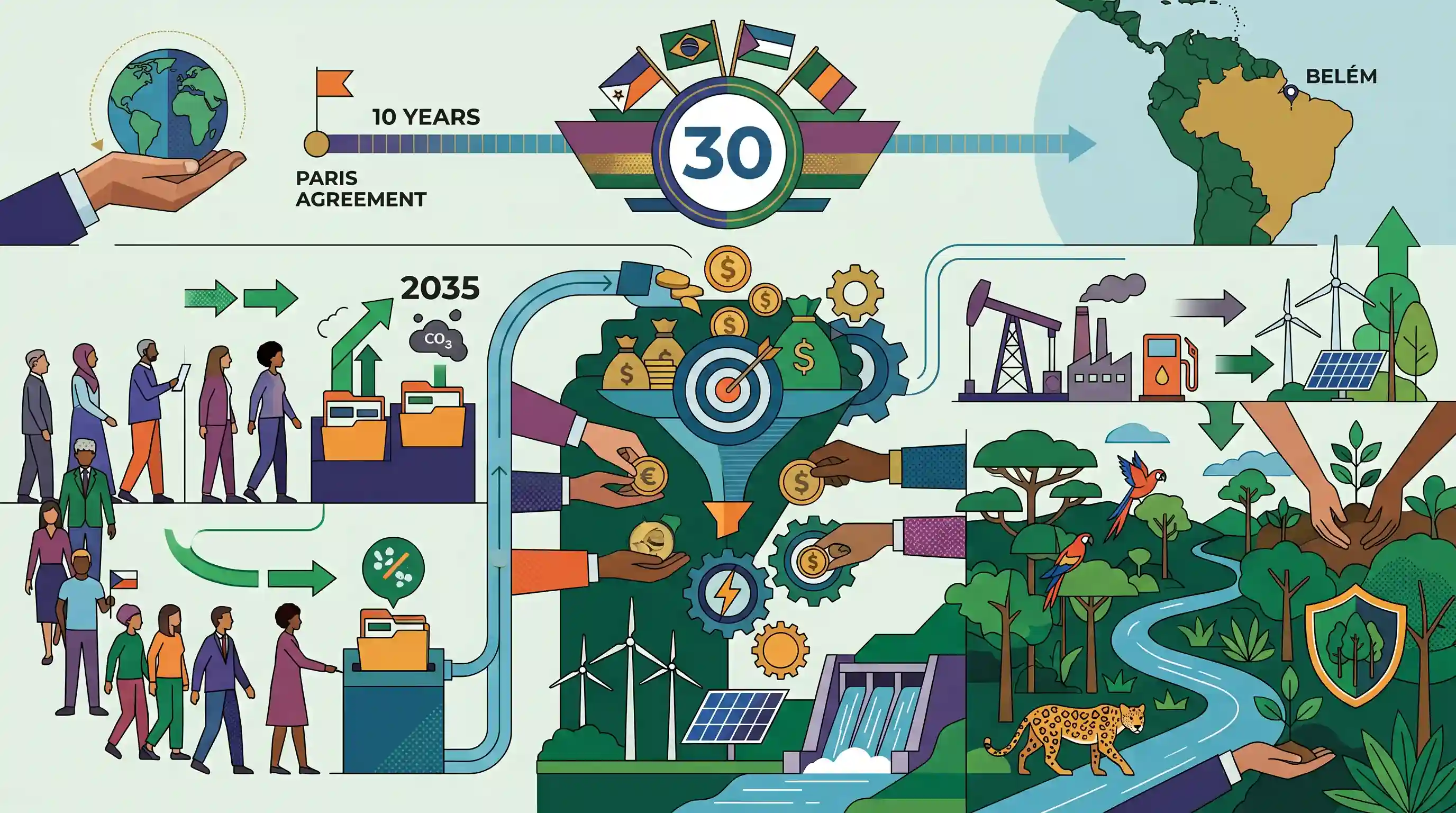
The article serves as a beginner's guide to COP30, the 30th UN Climate Change Conference scheduled to take place in Belém, Brazil, in 2025. It marks a crucial milestone exactly 10 years after the adoption of the Paris Agreement. Key expectations include the submission of new Nationally Determined Contributions (NDCs) by all member states, which must outline their emission reduction targets for 2035. Additionally, discussions will heavily focus on climate finance—particularly the implementation of the New Collective Quantified Goal (NCQG)—and operationalizing the transition away from fossil fuels as mandated by the first Global Stocktake at COP28. Hosted in the Amazon, the summit is also expected to place a strong emphasis on nature-based solutions and forest conservation.
Key Points
- COP30 will be hosted in Belém, Brazil, in November 2025, marking the 10th anniversary of the 2015 Paris Agreement.
- A central agenda item is the deadline for countries to submit updated Nationally Determined Contributions (NDCs) detailing their 2035 climate targets.
- It will assess the progress of transitioning away from fossil fuels and implementing the Global Stocktake agreements from COP28.
- Climate finance will be a major sticking point, focusing on scaling up funding for mitigation, adaptation, and the Loss and Damage Fund.
- Given its location in the Amazon, the summit will likely emphasize tropical forest protection, nature-based solutions, and biodiversity preservation.
Important Terms
UNFCCC

The 1992 international treaty aimed at stabilizing greenhouse gas concentrations to prevent dangerous human interference with the climate. It serves as the parent framework for the Paris Agreement.
UPSC context
GS Paper III (Environment); fundamental to global climate governance and India’s international environmental commitments.
Paris Agreement
A legally binding 2015 international treaty aiming to limit global warming to well below 2°C, preferably 1.5°C, through voluntary national climate plans called NDCs.
UPSC context
GS Paper III (Environment); central to climate change mitigation and international diplomacy.
Nationally Determined Contributions (NDCs)
Non-binding national climate action plans submitted every five years under the Paris Agreement, outlining specific targets for reducing emissions and adapting to climate impacts.
UPSC context
GS Paper III (Environment); tests knowledge of India’s specific targets (Panchamrit) and global accountability.
Global Stocktake
A five-yearly review process under the Paris Agreement to assess collective global progress toward climate goals. The first stocktake concluded at COP28 in 2023.
UPSC context
GS Paper III (Environment); relevant for evaluating international climate effectiveness and future policy.
New Collective Quantified Goal (NCQG)
A new post-2025 climate finance target intended to replace the $100 billion annual commitment, providing scaled-up financial support to developing nations.
UPSC context
GS Paper III (Environment/Economy); crucial for discussions on climate justice and North-South financial transfers.
Loss and Damage Fund
A financial mechanism providing assistance to vulnerable nations for irreversible losses caused by climate impacts that cannot be avoided through mitigation or adaptation.
UPSC context
GS Paper III (Environment); key for understanding climate equity and outcomes of recent COP summits.
Prelims Trap
The Global Stocktake (GST) is an annual mandatory review conducted at every COP to assess NDC progress.
The GST operates on a 5-year cycle, not annually. The first GST concluded at COP28 (2023) to inform the next round of NDCs due at COP30.
Static Concepts Connected
How does the 'Ratchet Mechanism' function under the Paris Agreement?
- 5-Year Cycle: Member states must submit updated Nationally Determined Contributions (NDCs) every five years.
- Progression Principle: Each successive NDC must represent a progression beyond the current one, reflecting the highest possible ambition of the member state.
- Global Stocktake (GST): Conducted every 5 years, it assesses collective global progress and directly informs the drafting of the next round of NDCs.
What is the evolution of UNFCCC climate finance targets?
- Copenhagen Accord: At the 2009 Copenhagen COP, developed nations pledged to mobilize $100 billion annually by 2020 for developing nations (later extended to 2025).
- NCQG: The New Collective Quantified Goal replaces the $100B target post-2025. It sets a new baseline floor, accounting for the evolving needs of developing countries.
- Loss & Damage Fund: Distinct from mitigation and adaptation finance, this was formalized at COP27 to compensate vulnerable nations for irreversible climate impacts.
Cross-Topic Patterns
Amazon conservation & debt-for-nature swaps
Brazil's focus on the Amazon at COP30 will spotlight tropical forest conservation, linking climate mitigation to innovative financing models like 'debt-for-nature swaps' for developing economies.
Convergence of UNFCCC and UN CBD
COP30's emphasis on nature-based solutions increasingly blurs the historical silos between the UNFCCC (climate change) and UN CBD (biodiversity), testing carbon sinks and species conservation together.

Expect a 2026 prelims question pairing the NCQG (climate finance) with the Global Stocktake, specifically testing 5-year cycle timelines.
Linked PYQs · 5
Linked PYQs · 5
- 2016PrelimsGS1
The term 'Intended Nationally Determined Contributions' is sometimes seen in the news in the context of
- 2016PrelimsGS1
With reference to the Agreement at the UNFCCC Meeting in Paris in 2015, which of the following statements is/are correct? 1. The Agreement was signed by all the member countries of the UN and it will go into effect in 2017. 2. The Agreement aims to limit the greenhouse gas emissions so that the rise in average global temperature by the end of this century does not exceed 2°C or even 1.5°C above pre-industrial levels. 3. Developed countries acknowledged their historical responsibility in global warming and committed to donate $ 1000 billion a year from 2020 to help developing countries to cope with climate change. Select the correct answer using the code given below.
- 2025MainsGS3
Write a review on India's climate commitments under the Paris Agreement (2015) and mention how these have been further strengthened in COP26 (2021). In this direction, how has the first Nationally Determined Contribution intended by India been updated in 2022?
- 2021MainsGS3
Describe the major outcomes of the 26th session of the Conference of the Parties (COP) to the United Nations Framework Convention on Climate Change (UNFCCC). What are the commitments made by India in this conference?
- 2025PrelimsGS1
Consider the following statements : Statement I: Article 6 of the Paris Agreement on climate change is frequently discussed in global discussions on sustainable development and climate change. Statement II: Article 6 of the Paris Agreement on climate change sets out the principles of carbon markets. Statement III : Article 6 of the Paris Agreement on climate change intends to promote inter-country non-market strategies to reach their climate targets. Which one of the following is correct in respect of the above statements?
