COP30 Climate Adaptation Financing and Vulnerable Nations
Source:Indian Express ↗
Why It Matters
Highlights the transition of global climate dialogue from mitigation to adaptation, addressing the massive climate finance gap. Important for understanding India's stance on climate justice, adaptation financing, and vulnerability to extreme weather events.
Summary
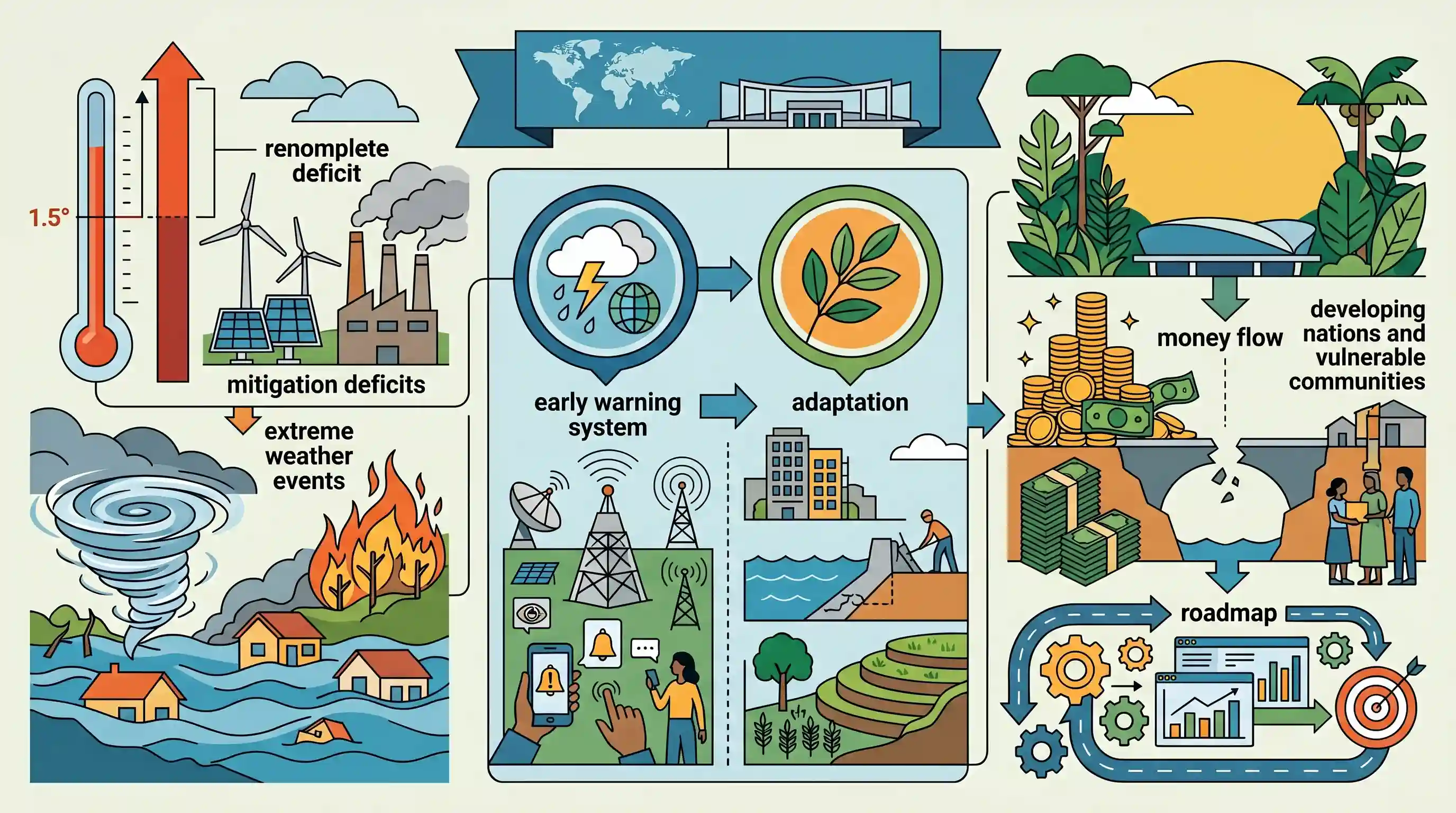
The upcoming UNFCCC COP 30 in Belem, Brazil, will underscore the gap between current global climate action and the Paris Agreement's 1.5 degrees Celsius target. Despite the shift towards renewable energy, mitigation deficits are exacerbating extreme weather events. Consequently, the World Meteorological Organisation and the UNEP emphasize an urgent need for adaptation measures, particularly early warning systems. Developing nations face a severe climate finance shortfall, requiring $310 billion annually by 2035 to address adaptation gaps. COP 30's priority must be establishing a roadmap with mechanisms to track global adaptation progress and ensuring scaled-up climate finance reaches the most vulnerable populations.
Key Points
- COP 30 in Belem, Brazil, marks a decade since the Paris Agreement, but global warming mitigation efforts have fallen significantly short of the 1.5 degrees Celsius threshold.
- Waning mitigation success shifts the focus towards climate adaptation, including investments in early warning systems as emphasized by the WMO.
- The UNEP Adaptation Gap Report 2025 highlights a staggering $310 billion annual need for developing countries by 2035, which is 12 times the current funding.
- COP 30 must establish a global tracking roadmap for adaptation—unlike mitigation, it lacks a single global metric—and prioritize reaching the most socially vulnerable communities with scaled-up climate finance.
Important Terms
UNFCCC

A 1992 international treaty aimed at stabilizing greenhouse gas concentrations to prevent dangerous human interference with the climate system. It is the parent treaty of the Paris Agreement.
UPSC context
GS Paper III (Environment); core framework for all climate negotiations, NDCs, and annual COP summits.
Paris Agreement
A legally binding 2015 international treaty (COP21) aiming to limit global warming to well below 2°C, preferably 1.5°C, compared to pre-industrial levels through Nationally Determined Contributions (NDCs).
UPSC context
GS Paper III (Environment); tests knowledge of mitigation targets, Global Stocktake, and climate justice.
World Meteorological Organisation (WMO)
A specialized UN agency (est. 1950) coordinating global cooperation on weather, climate, and water. It produces the 'State of the Global Climate' report and supports early warning systems.
UPSC context
GS Paper II (International Relations) and III (Disaster Management); focus on climate monitoring and disaster risk reduction.
United Nations Environment Programme (UNEP)
The leading global environmental authority (est. 1972) that sets the global environmental agenda. It publishes the 'Adaptation Gap Report' highlighting the finance shortfall for developing nations.
UPSC context
GS Paper III (Environment); crucial for topics on global environmental governance and sustainable development reports.
New Collective Quantified Goal (NCQG)
A new climate finance target being negotiated under the UNFCCC to succeed the $100 billion annual pledge, intended to address the financial needs of developing countries post-2025.
UPSC context
GS Paper III (Economy/Environment); tests understanding of North-South climate finance divides and international equity.
Global Goal on Adaptation (GGA)
A goal established under Article 7 of the Paris Agreement to enhance adaptive capacity, strengthen resilience, and reduce vulnerability to climate change globally.
UPSC context
GS Paper III (Environment); relevant for discussions on climate resilience and protection of vulnerable populations.
Prelims Trap
"Climate adaptation progress is tracked using a universal global metric, similar to CO2 equivalents."
Unlike mitigation (which uses CO2 equivalents globally), adaptation is highly localized and currently lacks a single, standardized global tracking metric.
Static Concepts Connected
How do climate mitigation and adaptation differ under the UNFCCC framework?
- Mitigation: Focuses on reducing or preventing greenhouse gas emissions, such as transitioning to renewables or creating carbon sinks.
- Adaptation: Focuses on adjusting to current or expected climate impacts, such as building resilient infrastructure or early warning systems.
- Measurement Metrics: Mitigation uses a universal metric (CO2 equivalents), whereas adaptation lacks a single standardized global metric due to its highly localized nature.
What is the 'Early Warnings for All' initiative?
- Objective: A UN initiative aiming to ensure every person on Earth is protected by multi-hazard early warning systems by 2027.
- Key Agencies: Spearheaded by the World Meteorological Organization (WMO) and the UN Office for Disaster Risk Reduction (UNDRR).
- Sendai Framework: Directly aligns with Target G of the Sendai Framework, marking a shift from post-disaster response to pre-disaster adaptation.
Cross-Topic Patterns
Adaptation Finance & CBDR-RC
The $310B adaptation finance shortfall highlights structural failures in the Common But Differentiated Responsibilities (CBDR) principle, tying GS3 Environment to GS2 Global North-South diplomatic debates.
CDRI's growing international relevance
The WMO's push for early warning systems at COP 30 elevates the strategic importance of the India-led Coalition for Disaster Resilient Infrastructure (CDRI) in global climate diplomacy.

Expect a 2026 Prelims question mapping key climate reports to publishers (e.g., UNEP's Adaptation Gap Report) alongside EWS initiatives.
Linked PYQs · 5
Linked PYQs · 5
- 2025MainsGS3
Write a review on India's climate commitments under the Paris Agreement (2015) and mention how these have been further strengthened in COP26 (2021). In this direction, how has the first Nationally Determined Contribution intended by India been updated in 2022?
- 2021MainsGS3
Describe the major outcomes of the 26th session of the Conference of the Parties (COP) to the United Nations Framework Convention on Climate Change (UNFCCC). What are the commitments made by India in this conference?
- 2019MainsGS3
Vulnerability is an essential element for defining disaster impacts and its threat to people. How and in what ways can vulnerability to disasters be characterized? Discuss different types of vulnerability with reference to disasters.
- 2013MainsGS3
How important are vulnerability and risk assessment for pre-disaster management ? As an administrator, what are key areas that you would focus on in a Disaster Management System.
- 2022MainsGS3
Discuss global warming and mention its effects on the global climate. Explain the control measures to bring down the level of greenhouse gases which cause global warming, in the light of the Kyoto Protocol, 1997.
