COP 30 Climate Finance Outcomes and Emission Reduction Gaps
Source:Indian Express ↗
Why It Matters
Understanding the outcomes of COP meetings is essential for GS Paper 3 (Environment). It highlights the fundamental debate in international climate negotiations: the friction between establishing robust climate finance mechanisms (adaptation/loss and damage) and the failure to enforce strict greenhouse gas emission reductions (mitigation).
Summary
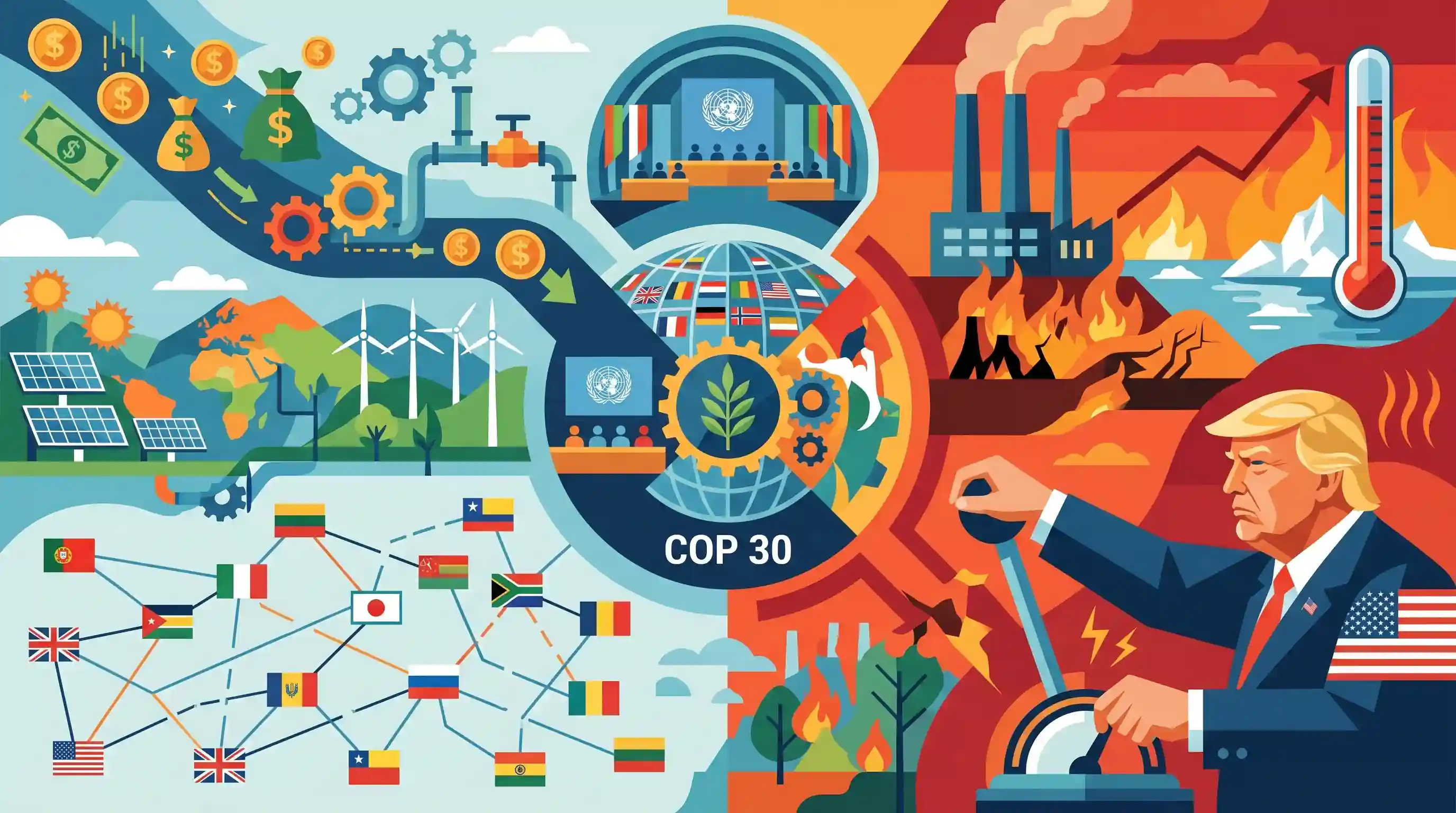
The editorial analyzes the outcomes of the recent COP 30 climate summit, noting that while there were positive developments regarding climate finance frameworks, the international community largely failed to make meaningful progress on mitigation strategies to curb rising global temperatures. It underscores the ongoing challenges within global climate diplomacy—particularly the reliance on voluntary emission targets—and notes the complications introduced by the evolving political climate in the US under Donald Trump, which threatens the broader stability of the Paris Agreement.
Key Points
- COP 30 achieved incremental progress in structuring and mobilizing climate finance to support developing nations in adaptation and mitigation.
- Despite the financial headway, the summit fell short of securing more ambitious, binding commitments to reduce greenhouse gas emissions and limit global temperature rise to the 1.5°C threshold.
- The geopolitical landscape of climate diplomacy is overshadowed by the shifting stance of the United States, particularly the implications of Donald Trump's policies towards the Paris Pact.
- The persistent gap between financial negotiations and actual temperature reduction highlights a critical structural challenge in global climate governance.
Important Terms
UNFCCC

A 1992 international treaty aimed at stabilizing greenhouse gas concentrations to prevent dangerous human interference with the Earth's climate system.
UPSC context
GS Paper II and III; foundational framework for global climate negotiations and treaties like the Paris Agreement.
Paris Agreement
A legally binding 2015 treaty aiming to limit global warming to well below 2°C, preferably 1.5°C, through national climate commitments.
UPSC context
GS Paper III (Environment); essential for understanding international climate architecture and India's global commitments.
Climate Finance
Financial resources—public, private, or alternative—provided to support mitigation and adaptation actions, particularly in developing nations, to address climate change.
UPSC context
GS Paper III (Economics/Environment); central to North-South diplomacy and the principle of Common but Differentiated Responsibilities.
Nationally Determined Contributions (NDCs)
Self-determined national climate action plans under the Paris Agreement, updated every five years to outline emission reduction and adaptation targets.
UPSC context
Prelims and Mains (GS III); tests knowledge of bottom-up climate action and India's specific targets.
Mitigation
Efforts and strategies designed to reduce greenhouse gas emissions or enhance carbon sinks to limit the extent of global warming.
UPSC context
GS Paper III (Environment); fundamental concept distinguished from adaptation (managing impacts vs. addressing causes).
Conference of the Parties (COP)
The supreme decision-making body of the UNFCCC, where member nations meet annually to negotiate global climate policy and review progress.
UPSC context
GS Paper II and III; critical for tracking evolving global climate governance and milestone agreements.
COP 30
The 30th UN Climate Summit (2025) in Belém, Brazil, focused on "NDC 3.0" submissions and accelerating the implementation of the Paris Agreement.
UPSC context
GS Paper III (Current Affairs); key for topics regarding 2025-2030 climate targets and the Belem Package.
Prelims Trap
"Member nations are legally bound to achieve the emission targets set in their NDCs."
The Paris Agreement legally binds nations to submit and regularly update NDCs, but the actual achievement of the specific emission targets within them remains strictly voluntary.
Static Concepts Connected
How does the Paris Agreement's 'ratchet mechanism' work?
- 5-year cycles: Countries must submit updated Nationally Determined Contributions (NDCs) every five years.
- Progression principle: Each successive NDC must represent a progression beyond the country's current pledge, preventing backsliding.
- Global Stocktake: A periodic assessment of collective progress (first held at COP 28) designed to inform the next round of NDCs.
What distinguishes the New Collective Quantified Goal (NCQG)?
- Post-2025 framework: It is the post-2025 climate finance framework, replacing the 2009 Copenhagen pledge of $100 billion per year.
- Minimum floor: The unmet $100 billion annual target serves as the minimum floor for this new quantified goal.
- Quality focus: Unlike previous goals, NCQG emphasizes the quality of finance (grants vs. debt-inducing loans) and improved accessibility for developing nations.
Cross-Topic Patterns
Climate finance & the debt trap
The shift from grants to loans in climate finance worsens debt distress in the Global South, linking UNFCCC goals directly with IMF/World Bank sovereign debt restructuring mechanisms.
US politics and UN treaty stability
Potential US withdrawal from the Paris Agreement (Article 28) mirrors its historical oscillation on Kyoto and the WHO, highlighting systemic vulnerabilities in consensus-based UN treaties.

A 2026 prelims question will likely test the exact legal standing of NDCs (submission is binding, targets are not) alongside NCQG basics.
Linked PYQs · 5
Linked PYQs · 5
- 2025MainsGS3
Write a review on India's climate commitments under the Paris Agreement (2015) and mention how these have been further strengthened in COP26 (2021). In this direction, how has the first Nationally Determined Contribution intended by India been updated in 2022?
- 2021MainsGS3
Describe the major outcomes of the 26th session of the Conference of the Parties (COP) to the United Nations Framework Convention on Climate Change (UNFCCC). What are the commitments made by India in this conference?
- 2025PrelimsGS1
Consider the following statements : Statement I: Article 6 of the Paris Agreement on climate change is frequently discussed in global discussions on sustainable development and climate change. Statement II: Article 6 of the Paris Agreement on climate change sets out the principles of carbon markets. Statement III : Article 6 of the Paris Agreement on climate change intends to promote inter-country non-market strategies to reach their climate targets. Which one of the following is correct in respect of the above statements?
- 2016PrelimsGS1
With reference to the Agreement at the UNFCCC Meeting in Paris in 2015, which of the following statements is/are correct? 1. The Agreement was signed by all the member countries of the UN and it will go into effect in 2017. 2. The Agreement aims to limit the greenhouse gas emissions so that the rise in average global temperature by the end of this century does not exceed 2°C or even 1.5°C above pre-industrial levels. 3. Developed countries acknowledged their historical responsibility in global warming and committed to donate $ 1000 billion a year from 2020 to help developing countries to cope with climate change. Select the correct answer using the code given below.
- 2022MainsGS3
Discuss global warming and mention its effects on the global climate. Explain the control measures to bring down the level of greenhouse gases which cause global warming, in the light of the Kyoto Protocol, 1997.
