Supreme Court Ruling on Religious Conversion and Quota Benefits
Source:nationalheraldindia ↗
Why It Matters
This Supreme Court judgment clarifies the legal parameters around religious conversion and reservation benefits, impacting the jurisprudence of affirmative action and social justice in India.
Summary
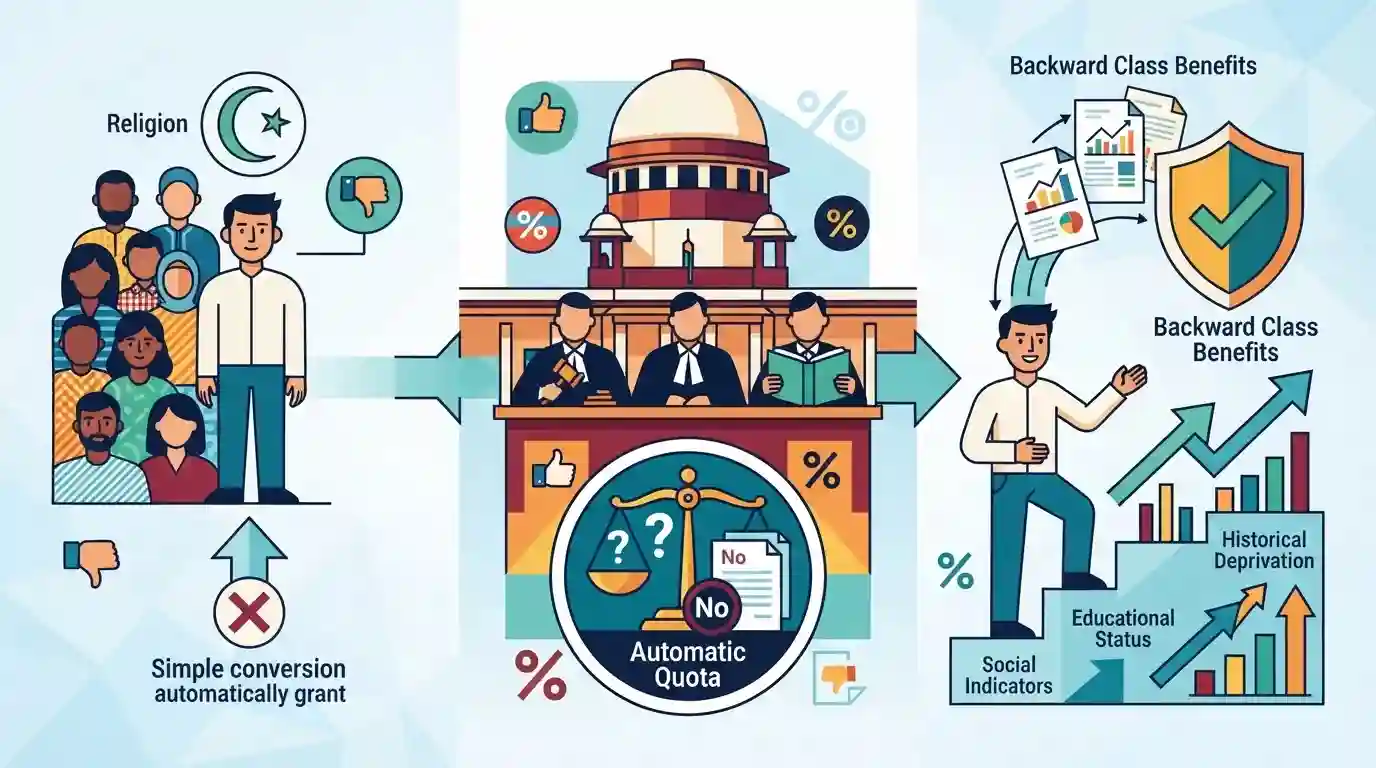
The Supreme Court held that simple conversion to Islam does not automatically qualify a person for backward class reservation benefits. The apex court underscored that proof of continued social and educational backwardness, alongside historical deprivation, is mandatory to claim quota benefits post-conversion.
Key Points
- The Supreme Court ruled that mere conversion to Islam does not automatically entitle a person to claim backward class quota benefits.
- To claim reservation benefits under backward classes, an individual must establish that they continue to face social and educational backwardness akin to those recognized for quotas.
- The court emphasized that social status and the stigma of backwardness must be evaluated on a case-by-case basis post-conversion.
Important Terms
Supreme Court

The apex judicial body of India that interprets the Constitution and ensures rule of law, recently ruling that religious conversion to Islam does not automatically grant backward class reservation benefits.
UPSC context
Important for GS Paper II (Indian Polity - Judiciary, Structure, and Functioning), testing judicial review and constitutional interpretation of affirmative action.
Article 16(4)
A constitutional provision empowering the State to make reservations in public appointments for any backward class of citizens inadequately represented in state services.
UPSC context
Essential for GS Paper II (Polity and Governance - Reservation, Rights, and Social Justice), examining the scope and limits of affirmative action.
Backward Classes
Communities identified by the state or central government as socially and educationally backward, eligible for affirmative action policies like quotas in education and employment.
UPSC context
Vital for GS Paper II (Social Justice and Governance), focusing on criteria, inclusion, and legal standards for reservations.
Prelims Trap
simple conversion to Islam automatically qualifies a person for backward class reservation benefits
Aspirants often assume that backward class status under state lists automatically persists post-religious conversion, overlooking the requirement for fresh proof of continued social and educational backwardness.
Static Concepts Connected
What are the constitutional provisions governing reservations for socially and educationally backward classes in India?
- Article 15(4) & 15(5): Empowers the State to make special provisions for the advancement of any socially and educationally backward classes of citizens (SEBC) or for SCs and STs regarding educational institutions.
- Article 16(4): Provides for equality of opportunity in matters of public employment and allows the State to make reservations for any backward class of citizens not adequately represented in services.
- Article 342A: Empowers the President to specify socially and educationally backward classes in relation to a State or Union Territory, in consultation with the Governor.
Cross-Topic Patterns
Religious Conversion and Constitutional Reservations
Supreme Court rulings on reservation benefits post-conversion intersect with Article 341/342 powers and secularism under the Basic Structure doctrine.
Empirical Backwardness vs. Religious Identity
Backward class identification relies on empirical data, mirroring the evolving jurisprudence on creamy layer criteria and sub-categorization within OBCs.

SC rulings on backward class entitlements post-conversion test Article 15/16 interpretation; expect statement-based prelims questions.
Linked PYQs · 1
Linked PYQs · 1
- 2020GPSC_PRELIMSGS1
Which of the following statements is/are correct regarding Creamy layer in reservations? 1. Persons who are in the rank of colonel and above in the army and equivalent rank in navy and air force cannot avail the OBC reservations. 2. The persons holding constitutional positions like President, Vice-President and Judges of HC are exempted from the Creamy layer, they can avail the OBC reservations. 3. Persons having gross annual income upto Rs. 15 lakhs are eligible to avail OBC reservations.
