Bilateralism and Simla Agreement in Post Pahalgam Security Context
Source:The Hindu ↗
Why It Matters
This article brings forth crucial themes surrounding India-Pakistan relations and the principle of bilateralism under the Simla Agreement. It underlines the complexities added by external power involvement (US mediation) and international institutions (IMF loans to terror-sponsoring states), making it highly relevant for IR and security dynamics.
Summary
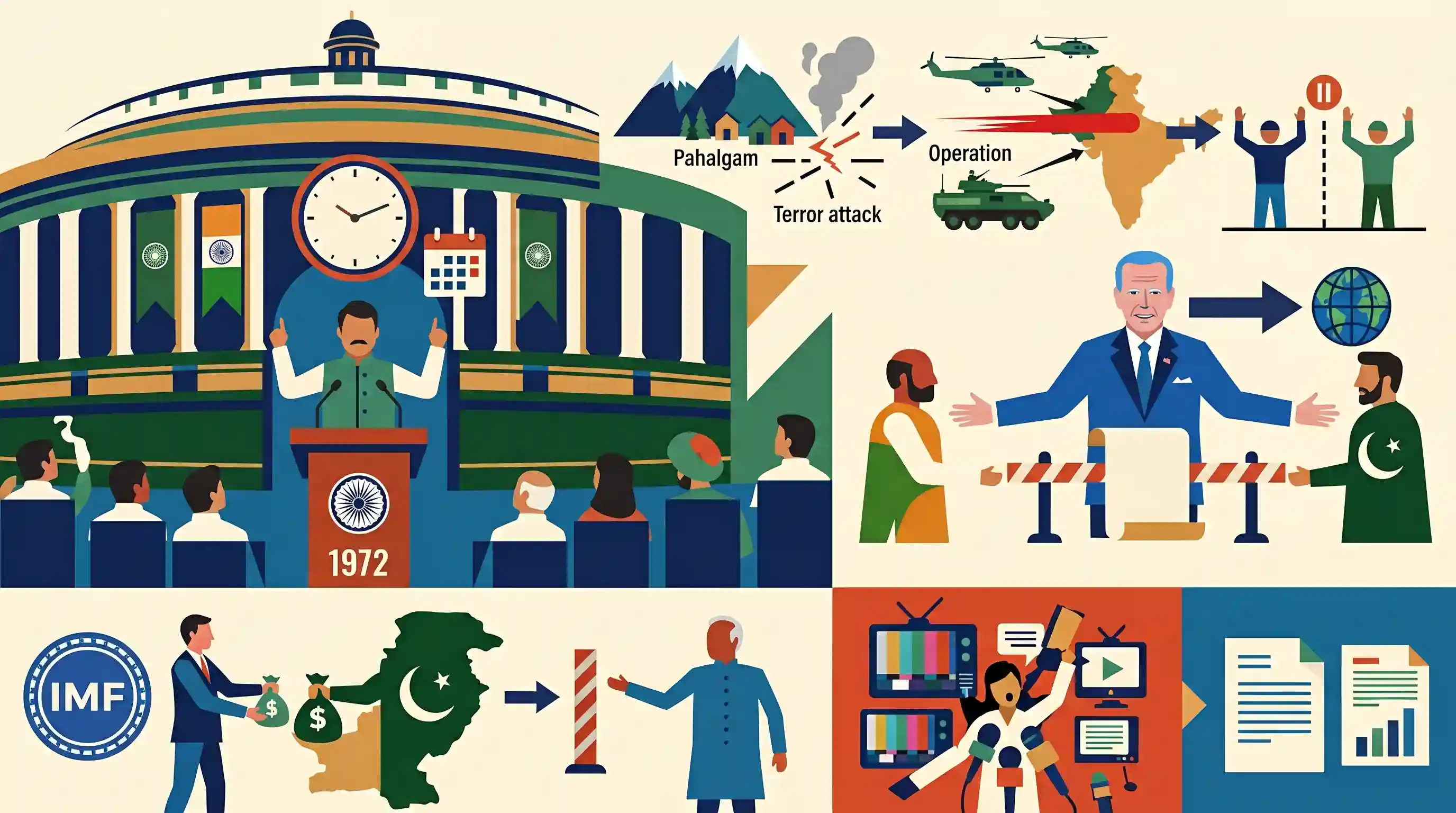
Karnataka Minister Priyank Kharge has called for a special session of Parliament to scrutinize recent national security developments, including the Pahalgam terror attack, India's retaliatory 'Operation Sindoor', and the ensuing ceasefire. He strongly objected to US President Donald Trump's mediation, asserting that third-party involvement in the Kashmir issue clearly violates the 1972 Simla Agreement and allows Pakistan to internationalize the dispute. Furthermore, Kharge criticized the Central government for its failure to block IMF financial assistance to Pakistan and rebuked sections of the media for prioritizing jingoistic sensationalism and misinformation over factual reporting.
Key Points
- Karnataka Minister Priyank Kharge demanded a special Parliament session to discuss recent national security events, notably the Pahalgam terror attack and 'Operation Sindoor'.
- The minister criticized US President Donald Trump's claim of brokering the ceasefire, arguing it humiliates India and violates the bilateral framework of the Simla Agreement.
- Concerns were raised that Pakistan is exploiting the US intervention to internationalize the Kashmir dispute.
- The Central government was criticized for failing to block International Monetary Fund (IMF) loans to Pakistan, despite its continued support for terrorism.
- Kharge condemned domestic media sensationalism and the spread of misinformation regarding military actions.
Important Terms
Simla Agreement (1972)

A 1972 peace treaty between India and Pakistan following the 1971 war. It mandates resolving disputes 'bilaterally' through peaceful means and established the Line of Control (LoC) in Jammu and Kashmir.
UPSC context
GS Paper II: International Relations. It is the cornerstone of India's 'no third-party mediation' stance on the Kashmir issue.
Operation Sindoor
India's 2025 military response to the Pahalgam terror attack, involving targeted strikes on terror infrastructure in Pakistan and PoJK. It demonstrated India's 'zero-tolerance' policy and multi-dimensional military resolve against cross-border threats.
UPSC context
GS Paper III: Internal Security. Tests knowledge of India's retaliatory doctrines and strategic restraint in the face of provocation.
Special Session of Parliament
A parliamentary sitting convened outside the standard three-session cycle (Budget, Monsoon, Winter). Under Article 85, the President can summon the Houses to discuss urgent matters of national importance.
UPSC context
GS Paper II: Indian Polity. Concerns the executive's power to summon legislature and the role of parliamentary oversight in national security.
International Monetary Fund (IMF)
Global financial institution that provides loans to countries experiencing balance-of-payments crises. India has recently opposed its bailouts to Pakistan, citing the risk of funds being diverted to state-sponsored terrorism.
UPSC context
GS Paper II: Important International Institutions. Relates to economic diplomacy and the 'fungibility' of international aid in security contexts.
Bilateralism
A diplomatic framework where issues are resolved through direct negotiations between two parties. For India, it is the non-negotiable prerequisite for any dialogue with Pakistan, rejecting all external mediation.
UPSC context
GS Paper II: Indian Foreign Policy. Tests understanding of sovereignty and historical treaties like Simla and Lahore Declarations.
Cross-border Terrorism
Terrorist activities originating in one country to target another. It remains India's primary security challenge, frequently cited as the 'root cause' of instability in South Asia and stalled diplomatic dialogues.
UPSC context
GS Paper III: Security Challenges. Tests knowledge of non-state actors and the role of external state sponsorship in internal instability.
Prelims Trap
"The Constitution of India explicitly defines the term 'Special Session' and its procedures."
The term 'Special Session' is not mentioned in the Constitution. The President summons it using general powers under Article 85(1) based on the Cabinet Committee on Parliamentary Affairs' advice.
Static Concepts Connected
What is the Constitutional basis for convening a 'Special Session' of Parliament?
- Constitutional vacuum: The term 'Special Session' is absent from the Constitution. The President summons the session using general powers under Article 85(1).
- Recommending Authority: The decision to convene any session, including a special one, is taken by the Cabinet Committee on Parliamentary Affairs (CCPA).
What are the defining principles of the 1972 Simla Agreement?
- Strict Bilateralism: India and Pakistan agreed to settle differences exclusively through bilateral negotiations, legally precluding third-party mediation like the UN or the US.
- Line of Control: The agreement formally converted the December 1971 ceasefire line into the Line of Control (LoC) between the two nations.
Cross-Topic Patterns
Economic diplomacy and FATF/IMF leverage
India's attempt to object to IMF bailouts for Pakistan demonstrates the integration of economic diplomacy with internal security, using global financial structures to penalize state-sponsored terrorism.
Media sensationalism as an internal security threat
Jingoistic media coverage during border crises connects GS2 (Role of Media in Democracy) with GS3 (Internal Security), as operational secrecy and public perception are often compromised.

Expect a 2026 Prelims statement testing the constitutional absence of 'Special Session' alongside questions on Simla's bilateral mandate.
Linked PYQs · 4
Linked PYQs · 4
- 2015MainsGS2
Terrorist activities and mutual distrust have clouded India-Pakistan relations. To what extent the use of soft power like sports and cultural exchanges could help generate goodwill between the two countries? Discuss with suitable examples.
- 2019MainsGS2
‘What introduces friction into the ties between India and the United States is that Washington is still unable to find for India a position in its global strategy, which would satisfy India's national self-esteem and ambitions.’ Explain with suitable examples.
- 2025MainsGS3
Terrorism is a global scourge. How has it manifested in India? Elaborate with contemporary examples. What are the counter measures adopted by the State? Explain.
- 2024MainsGS3
India has a long and troubled border with China and Pakistan fraught with contentious issues. Examine the conflicting issues and security challenges along the border. Also give out the development being undertaken in these areas under the Border Area Development Programme (BADP) and Border Infrastructure and Management (BIM) Scheme.
